Barbara Stanwyck was 32 and a box-office star when Paramount contract player William Holden, 21, was personally cast by director Rouben Mamoulian as the lead in his film based on Clifford Odets’s Broadway melodrama of art vs fleeting fame and riches, Golden Boy. Holden was nervous, awkward, and about to be replaced when something about the young player touched Stanwyck’s heart. She took him in hand, coached him personally and kept him from distractions (like studio publicity)…
Thity-nine years later, at the Oscars Holden had this to say to the world:
Above Holden and Stanwyck: There are only a few genuine moments in the history of the televised Academy Awards. This is one of them.
Dearest John Wilson, Conductor, it makes me happy to be in your audience and I don’t require you at all to be in mine—mostly because, as Mister Grumble just pointed out, my flicks would probably give you a heart attack. It also makes me happy that you’re going to be concentrating more on the Classic Repertoire this season, although it means leaving your faithful John Wilson Orchestra fans for a time—and only because when you’re not playing American film music, you’re not on the podium making the kind of quasi-witty comments that would make even me wince, and I used to be Arthur Godfrey’s gag man back in the fifties.
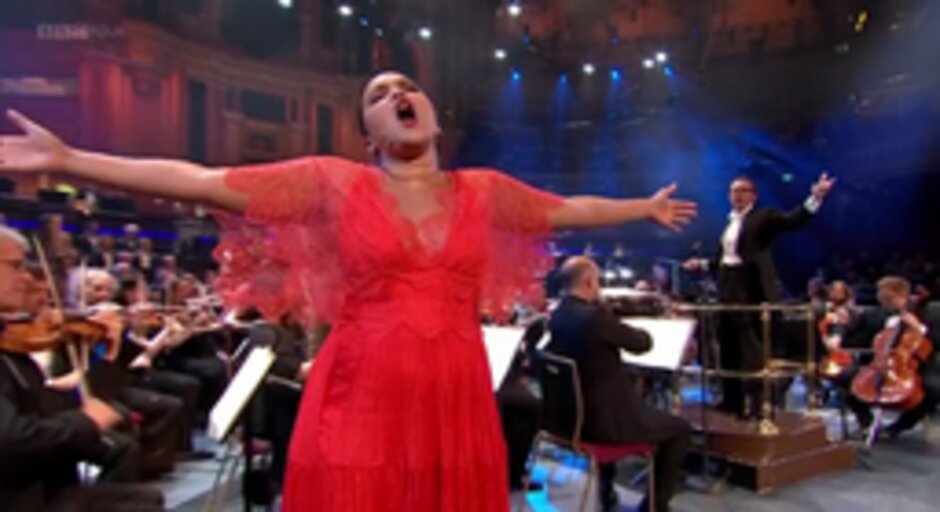
Now, Voyager (1942): Bette Davis as brave Charlotte Vale and Paul Henreid as her handsome weenie of a lover in this BBC2 Saturday Afternoon Movie I’ll bet John saw once upon a rainy day when he was a kid and couldn’t make head nor tail of, except for the music. Above: That’s my beloved John conducting the Sinfonia of London in this Max Steiner score, including the Warners Bros studio theme, which Steiner also wrote. Orchestration by Hugo Wilhelm Friedhofer.
By the way John my sweet Geordie lad, I’m getting a kick out of imagining you form the word “porn”. Pohhhrnnn.
On that note, I just want to let all of you know that I realize it’s not hard to find me. Really. I’m in the IMDb. I don’t even have to fill you in on what my screen name is because IMDb seems to have switched pretty much every one of my credits back to my legal name anyway, so it would be kind of pointless… All right. It’s Simona Wing. My castmates in my first movie, Dork & Sindy aka Playthings, gave it to me, and I consider it quite a lagniappe. Mister Grumble used it for my character’s name in his first novel (Tales from the Last Resort, Brave New Books, 2002) and no one has been able to get better use out of it since.
I have pleasant memories of that shoot. For one thing, it was shot in Marin County. In Sausalito! In a house overlooking the Bay. Do you see in that pic those houses up in the hills? The white house above the red roof, that’s where we shot.
For another thing, Craft Services was fantastic. You could graze all day.
And it was a friendly, clean shoot. Does anyone here who saw the flick remember what I was wearing before the guy in sunglasses stripped me naked, threw me into the hot tub and started chewing on my behind? That white blouse, that long black skirt, those pumps? That was my secretarial outfit, the one I wore a few months earlier in Beverly Hills when I worked for Rouben Mamoulian. Practically every day, I was that poor (took Sunset bus to foot of Schuyler Road, got off, wearing sneakers climbed hill, at Mamoulian’s door removed sneakers, put on pumps which I carried in my handbag). I remember I had one line which has since been coming back to me regularly, because whenever I run into an occasional fan, he (and it’s always a he) tends to quote it to me:
Now, you have to be a real Saturday Night Live geek to recognize that line, and I’m not going to decipher it for you. But I suppose this showed people I could do voices, because I got a lot of work from this film, almost all of it involving fakey foreign-sounding accents. Like Fatima, woman of Borneo, in the softcore version of Sadie Thompson aka Rain by Somerset Maugham. I’m not kidding.
I must’ve seen this movie four, five times when it first came out, when matinees were cheap, and what kept calling me back—besides the lovely, lush, immersive experience of just sinking back into an engaging and sensually-satisfying film in an air-conditioned theater in the middle of smelly, sticky, hot Manhattan—was, of course, the music. I really, really dug the score, just like I really dug the score of Walton (mostly)’s Battle of Britain (@1:20), a few years earlier, and went back matinees to go hear it again and again. Which doesn’t mean I like all of Richard Rodney Bennett; I think I’ve gone to almost every other movie he did a score to and can’t remember the music to any of them.
But this one I could whistle for years, decades, afterwards, and the only thing that brought it back to mind recently was—yes! yes!—falling in love with my bonny conductor John Wilson. Because of his association with Bennett, you see. Oh, they owned a house together or some such relationship [download PDF of Feb 2020 issue of Gramophone here], but that’s not what I’m talking about. Back when John was 28, he and Bennett—and The John Wilson Orchestra!!!—got together to record, as I mentioned in an earlier posting, an abomination called Orchestral Jazz. So I’m figuring that anything my bonny lad knows about jazz has to’ve come from this guy, and the trouble is, I really can’t find anything that would lead me to believe Bennett knew anything at all about jazz, except that he once partnered with jazz singer Claire Martin, and she’s the real thing.
Directed by Sidney Lumet, whose first film was about another dozen people meting out justice, 12 Angry Men (United Artists, 1957). Above Jean-Pierre Cassel: “The Orient Express”, for which the composer heavily cribbed from Ravel’s “La valse”. Composer Richard Rodney Bennett on piano, Marcus Dods conducting the Orchestra of the Royal Opera House, 1974.
But when it comes to purely orchestral music, Bennett shows that he knows a thing or two, Royal Academy graduate that he is. I’m glad, because his complete score for the film Murder on the Orient Express (Paramount, 1974) is probably the last example of a type of music they call over there English Light Music, which flourished on and off for about a hundred years since the 1870s, and is defined by easily accessible melodies and lush, decorative orchestration. In other words, music that’s delicious to hear and easy to digest. And while Murder has slightly campy touches, Bennett essentially knew who his audience was, and what they wanted.
According to composer Duning, Picnic director Joshua Logan insisted on using the old standard “Moonglow” (Hudson-Mills-DeLange, 1933) in a critical scene, as had been done in the Broadway play, but demanded that Duning’s love theme be added at a specific point. Columbia’s music director Stoloff and Duning complied, creating a unique arrangement of the song and the movie theme, and it became an iconic moment in 1950s cinema, a pairing of tunes that would thereafter seem inextricably intertwined. [Read more on George Duning from the Film Music Society here.]
Well, John, this isn’t a Joan Crawford movie so there’s no gold cigarette case but as I’m still in love with you and want to give you nice things, I’ll give you my honest appraisals, which is something I’ve been doing all along anyway (I hope you’ll agree) and not throwing myself into Long Island Sound for your sake. So let’s do this organized, going down the numbers in the program one by one because, as you recall, I used to work at ASCAP:
“We’re In the Money” (from Gold Diggers of 1933) / Harry Warren, Al Dubin Count on you to include the lyrics in pig Latin.
“The Desert Song” (from the 1953 film) / Sigmund Romberg, Oscar Hammerstein II Meh. I think the only reason you worked this in is because Kim Criswell’s singing a Romberg song in your 5 January concert in Stockholm, “Softly, As In a Morning Sunrise”, which is a hot, HOT number. In fact I can’t believe you’re going to stand on the same stage when she sings that song and not get incinerated. But that’s just you I guess.
The Treasure of the Sierra Madre (suite; from the 1948 film) / Max Steiner God, I forgot how repetitive Max Steiner can be when he’s not cribbing from Herman Hupfeld.
The Old Man and the Sea (suite, 1st movement; from the 1958 film) / Dmitri Tiomkin One movement, mercifully short.
“Seventy-Six Trombones” (YT) (from The Music Man, 1962) / Meredith Willson I lost a bet to Mister Grumble that you would never, never, EVER do this number, ever. (Because, you know, it’s so OBVIOUS.) But…yeah, it was okay. No Andre Rieu though.
“Blues in the Night” (from Blues In the Night, 1941) / Harold Arlen, Johnny Mercer A low-voiced woman should sing this. Preferably a woman who’s been there.
Auntie Mame (main title; from the 1958 film) / Bronislav Kaper You know, I’d forgotten how much I like this sweet waltz.
“The Man That Got Away” (from A Star is Born, 1954) / Harold Arlen, Ira Gershwin [in an obvious nod to the movie’s latest remake] Of all your singers, Louise Dearman is the only one who could’ve carried these two numbers in this room particularly, and whatever luck or good judgment (and I’m nuts about you dear, but I’m never completely confident about your judgment in these matters) brought her there I’m glad.
“Get Me to the Church On Time” (from My Fair Lady, 1962) / Frederick Loewe, Alan Jay Lerner A little harkening back to your 2012 Proms triumph, eh?
25-MINUTE INTERVAL Proms Plus Talk: a discussion of some of the great film scores being played tonight [Hah! In a pig’s eye] with Matthew Sweet, David Benedict and Pamela Hutchinson
Gypsy (overture; from the 1962 film) / Jule Styne, arr Ramin and Ginzler I still have the clip of you conducting this at the 2012 Proms (the other one). This one is sooo much hotter.
Now, Voyager (suite; from the 1942 film) / Max Steiner John, I’m afraid I really didn’t give this number a fair hearing the first time so I’m going to listen to it again and compare it to your Chandos 2022 recording. But you know, I almost missed the old dear telling Katie Derham that YOU wrote this arrangement because the Mountview kids down on the floor were leading a cheer [@1:05:00].
“The Deadwood Stage” (from Calamity Jane, 1953) / Sammy Fain, Paul Francis Webster [a Doris Day tribute] O-kay! A FULL number from a musical, complete with chorus—this is the very thing that made your name. All is forgiven.
“It’s Magic” (from Romance On the High Seas [correction, BBC: “On”, not “In”], 1948) / Jule Styne, Sammy Cahn [again, a Doris Day tribute] What in the name of heaven possessed whoever decided to include the worst song Jule Styne ever wrote? Redeemable only—only—if Bugs Bunny (YT) sings it.
A Streetcar Named Desire (main title; from the 1951 film) / Alex North Oh, you’re going to have fun with this one when you have to give sexy program notes to the audience from the podium, like you did in Brighton.
“The Days of Wine and Roses” (YT) (from the 1962 film) Henry Mancini arr Nelson Riddle, Johnny Mercer Nelson Riddle!? You used the freakin’ Nelson Riddle arrangement?? What are you trying to do, send love signals to Seth MacFarlane?
“Tomorrow” (from The Constant Nymph) / Erich Wolfgang Korngold You had this and your Prince Charming from Cendrillon, Kate Lindsey, up your sleeve! What a nice surprise.
ENCORE “I Could Have Danced All Night” (from My Fair Lady, 1962) / Frederick Loewe, Alan Jay Lerner Every soprano in the world wants to hear this song done right. She passes.
My bonny John was 30 when he recorded, with the orchestra that bears his name, this achingly tender theme.
I saw The Bad and the Beautiful (MGM, 1952) for the first time in New York when I was 20, at one of those great cinema art houses, the Little Carnegie I think. Anyone remember that fabulous nosh pit in the lobby of the Little Carnegie? It was set up to resemble an outdoor Parisian cafe, complete with wrought tables and chairs, painted scenery, etc… Here after the show my date treated me to a glass of cabernet and a flaky meat pasty, the leftovers of which the waiter wrapped up for me in a square of foil he molded into the shape of a swan.
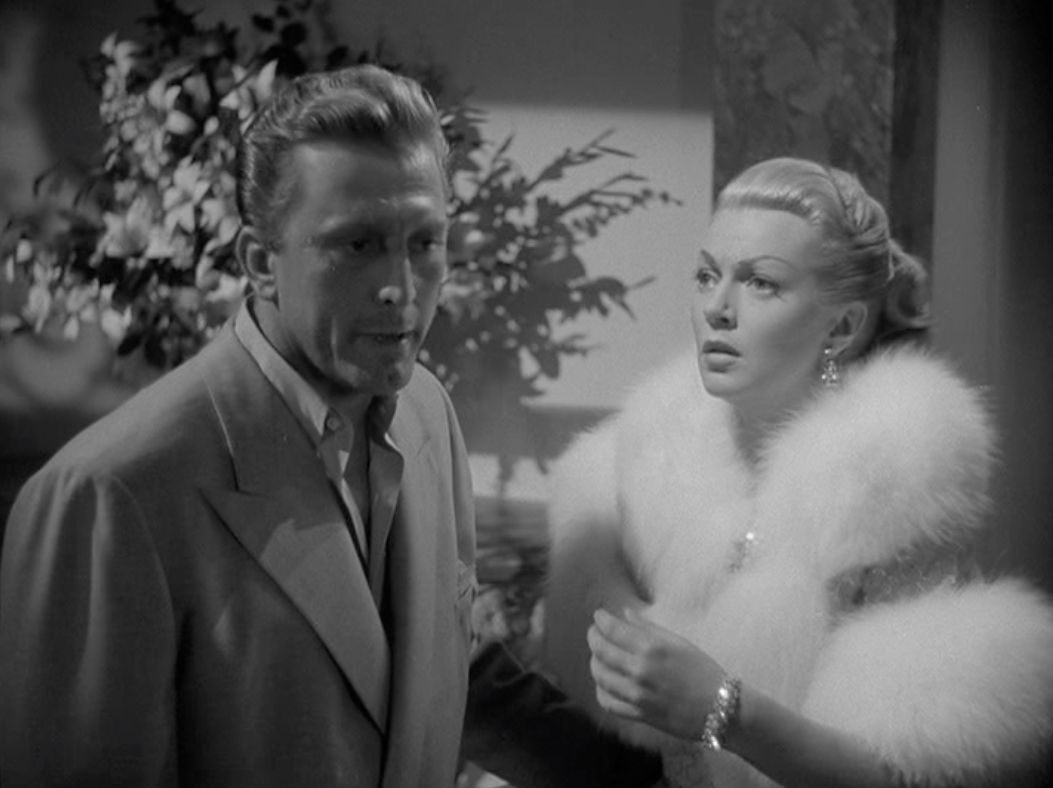
What do you do when you’re a passionate actress still in love with a wounding bastard who’s a screen genius? You make the damn movie.
As for Bad+Beautiful: Cast headed by Lana Turner, Kirk Douglas, Gloria Grahame, Dick Powell, Barry Sullivan, Gilbert Roland, Walter Pigeon. Vincent Minnelli helmed. MGM, 1952 (trailer here). 5 Oscar wins. To feel the full effect, get your heart stomped on by a Hollywood louse before viewing.
“The Bad and the Beautiful“ Soft Lights and Sweet Music, album Classic Angela Morley Arrangements The John Wilson Orchestra John Wilson, conductor Vocalion, 2002
*Oscar-winning transsexual composer-arranger Angela Morley (1924-2009) has quite a story herself, which maybe I’ll get to in another posting. For now, here’s a 1977 article in the Independent that should whet your interest.
Transcribed by me from a screenshot uploaded on John’s fan club site.
From the Sinatra Music Society Newsletter by Phil Suffolk (2001) —The world of music can be full of wonderful discoveries and surprises and this is certainly true when I encountered the name John Wilson for the first time. This was in 1997 with the release of an ASV CD devoted to lesser known compositions by that master of melody and superb orchestrator, Eric Coates, played by the BBC Concert Orchestra conducted by John Wilson.
The thing I first noticed first about this disc was the total commitment of the interpretations. A year later, a second volume appeared also devoted to the delightful compositions of Eric Coates. Once again I was struck by the deep understanding and respect show to these often unfamiliar scores, something which isn’t always the cast when this music is performed by orchestras and conductors who just do not seem to understand the idiom.
A little later I learnt that John was preparing a complete edition of the works of Eric Coates, so no wonder he is so completely “inside” this lovely music.
Born in Gateshead in 1972, John Wilson studied composition and conducting at the Royal College of Music, where he graduated in 1995 winning all the main prizes, and also where he was awarded the prestigious Tagore Gold Medal, the highest award attainable by a student at the college.
In 1996 John formed The Sinfonia of Westminster, a group comprised of the pick of the outstanding musicians from leading soloists and chamber groups. But John also enjoys a parallel career conducting The John Wilson Orchestra, which is comprised of young musicians devoted to keeping alive the music of The Great American Songbook, including arrangements by Nelson Riddle, Billy May, Robert Farnon, Paul Weston and Conrad Salinger. The orchestra has given concerts in London’s Queen Elizabeth Hall to great acclaim. He also appears regularly at Pizza in the Park and is the youngest conductor to broadcast on Radio 2’s long running Friday Night Is Music Night programme. John is also a prolific arranger himself, producing numerous orchestrations for film and television and he was also responsible for arranging all the music for the Hong Kong handover celebrations. The first two CDs to appear featuring The John Wilson Orchestra come from two different labels. The first one from Velvetone comprises 19 titles recorded at the CTS Studios in Wembley in 1998. Sarah Moule is the sensitive vocalist on eight tracks including “I Concentrate on You” and “Words Can’t Describe”, a little-known song once recorded by Sarah Vaughan. The rest is all orchestral, my favourites being “Skyliner” and “Cherokee”, both arranged by Neil Richardson, and Bob Farnon’s superb reworking of David Raksin’s classic “Laura”, which for me is worth the price of the disc alone!
John’s most recent CD is a first from Michael Dutton’s Vocalion Digital label. Previously this label has concentrated on re-issues of classic dance band and jazz recordings. They are now embarking on a series of original recordings made specially for the label, and John’s CD Orchestral Jazz is included in the first release. Using 24 strings, 4 winds, 5 rhythm and piano, this disc sounds superb and no wonder, featuring as it does on Richard Rodney Bennett playing piano on 4 tracks and providing arrangements for 8 tracks including “On the Sunny Side of the Street”, “Lush Life” and “Melancholy Baby”.
The remaining arrangements are shared between John himself and Neil Richardson.
Listen out for Ian Moffat’s superb trombone, also Enrico Tomasso on trumpet and Luke Annesley doubling on sax and clarinet. This issue should be snapped up by all who enjoy the very best in orchestral jazz. If you enjoy Nelson Riddle’s recordings then you should love this CD.
One wonders what the future has in store for John Wilson. Personally I would welcome a disc devoted to the music of Robert Farnon, and what about a CD of the great arrangements of the unsung hero of MGM musicals, Conrad Salinger. But whatever, the name John Wilson will ensure that the great music of the twentieth century will be kept alive, played and presented superbly by a young master interpreter.
The following was translated on Google from the Czech and transcribed by me—except for minor grammatical emendations—verbatim:
PRAGUE DAILY | 24 SEPTEMBER 2007 – John Wilson has brought restored film music to the Prague Autumn and is preparing to pay his respects to John Williams.
From the point of view, conductor John Wilson gives the impression of an intelligent young man. He is one of those rare people who is a joy to meet. In addition, he finished a several-hour rehearsal with the Czech Radio Symphony Orchestra. He has prepared a concert for the Prague Autumn Festival, called “Famous Film Music from Hollywood”, which will be performed twice due to great interest. At the age of thirty-five, Wilson has gained a recognition that many might envy. Some time ago, for example, he performed at the prestigious BBC Proms music festival, but he still remains modest and immediately attracts listeners with a helpful, understanding speech.
It surprises me that at your age, you are so interested in early film music. One would expect that a witness would be more enthusiastically interested in the archives.
I would like something really valuable to be left behind. That is why I try to concentrate a large part of my energy and diligence on the restoration of old, often non-existent or directly lost sheet music scores. [I do this] most often in collaboration with the Hollywood studios Warner Bros and MGM. In the 1960s, the MGM studio liquidated its entire music library, which was one of the largest and most valuable of its time. At the time, people simply did not think that film music needed to be preserved for future generations. The only thing that has survived are the movies. I’m trying to correct their mistake now.
Musical archeology
This must be extremely challenging.
Yes, it really is. It is necessary to listen to the whole composition from the film second by second and to the smallest detail. I’ve seen “The Wizard of Oz” at least two hundred times. With all your will and senses, you focus on each and every measure. You must not miss anything if you want to get the most accurate description possible. You spend all day working hard and eventually find that you have two or three seconds of music. You have to be patient, but I think it’s worth it.
Will we hear the result of your efforts at your Prague concert?
Yes. The first in the first part, which will focus mainly on music “for witnesses”, will be heard, for example, the remembered “Wizard of Oz”. In the second half, however, I would like to pay tribute to John Williams. Not only because he is one of the best modern composers of film music, also successful and popular, but also because Williams is more based on tradition than anyone else. Therefore, I hope that the listeners will notice the context, which I would like to point out non-violently at the concert.
Do you mean, for example, the work of Erich Wolfgang Korngold, a Czech native famous during The Golden Age of Hollywood?
Naturally. Williams’s orchestration, for example, is almost identical to his. This is clearly evident in “Star Wars”, which, of course, cannot be missing from the program. You must understand that Williams began as a pianist in Hollywood recording studios in the 1950s and came into direct contact with the generation that laid the foundations of modern film music. In addition to Korngold at the time, Max Steiner and Alfred Newman, who is the composer of perhaps Hollywood’s most famous tune, a fanfare of 20th Century Fox, were still active. At the same time, I hope that the audience will recognize how much Williams still remains himself and in the true sense of the word, an original.
Last of the Mohicans
Are you well acquainted with the past of film music, but how do you look at its future?
You know, Williams is seventy-five years old this year, and even though he’s still active and still composing great music, he won’t be here forever. I don’t think there’s anyone in the current generation who can replace him. That’s why I’m afraid the whole era of film music will leave with John Williams.
But that sounds pretty hopeless.
Maybe a little. On the other hand, I am convinced that the hope of film music can be the current generation of European composers, who come up with cultured, intelligent and imaginative music. In Hollywood, on the other hand, music is basically declining, becoming flatter and flatter by the day. Sure, it helps the film become great, but I prefer music that will stand up on its own. My concert is also trying to point out that. I try to prove that good film music is not lost in concert halls.
At the same time, film music is struggling for recognition, and many musicologists still see it as an indecent, used form.
In the words of a classic: “Who ever built a monument to a critic?” I will not say at all what the critics say. The attitude of such people is not so critical or professional, but rather snobbish. But attitudes and opinions are changing. Constantly. In July, for example, I conducted British film music with great success at the BBC Proms, a large and acclaimed festival. No one would have dreamed of that ten years ago.
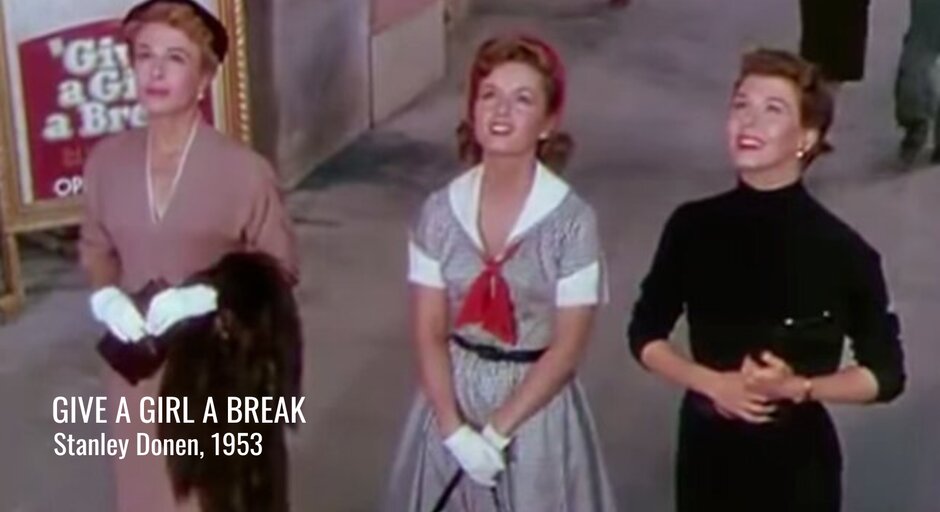
Give a Girl a Break (trailer here)is a US 1953 musical comedy film starring Debbie Reynolds and the dance team of Marge and Gower Champion. Helen Wood, Richard Anderson, Kurt Kaszner and a young Bob Fosse have featured roles. At only 88 minutes, Give a Girl a Break shows residual elements of the big project it started out to be, with a passable score by Burton Lane and Ira Gershwin, direction by Stanley Donen, and musical direction by Andre Previn.
Above Marge, Debbie and Helen: The overture to the 2012 Proms My Fair Lady, with John conducting The John Wilson Orchestra in his own arrangement of Andre Previn’s orchestration of the film score.
Another MGM musical, pre-Freed Unit. Music by Bob Wright, Chet Forrest and Herbert Stothart (adapted from “Chanson” by Rudolf Friml); lyrics by Bob Wright and Chet Forrest, who would go on to adapt the music of Rimsky-Korsakov for the 1953 Broadway musical Kismet.
Two years earlier Allan Jones made a big splash as Kitty Carlisle‘s tenor squeeze in the Marx Brothers romp A Night At the Opera.Here he is in a clip on my YT channel movie-romancing a reluctant Jeanette MacDonald, who was smack in the middle of a fraught but passionate affair with a baritone with a thrilling voice and a black temper—Nelson Eddy, who, upon learning that Jones was putting the real-life moves on MacDonald, crashed the cast party of Firefly, collared Jones and beat him to a bloody pulp. Now that’s love.
Played the violin part in this in my junior high school orchestra. Liked it more than Bach. Above: “Donkey Serenade” by Oscar-winning MGM musical director, Herbert Stothart. Stothart, recently deceased, was paid tribute to by incoming MGM musical director Johnny Green in his 1954 MGM Jubilee Overture, the signature tune of my beloved John Wilson and his Orchestra.
 Above Holden and Stanwyck: There are only a few genuine moments in the history of the televised Academy Awards. This is one of them.
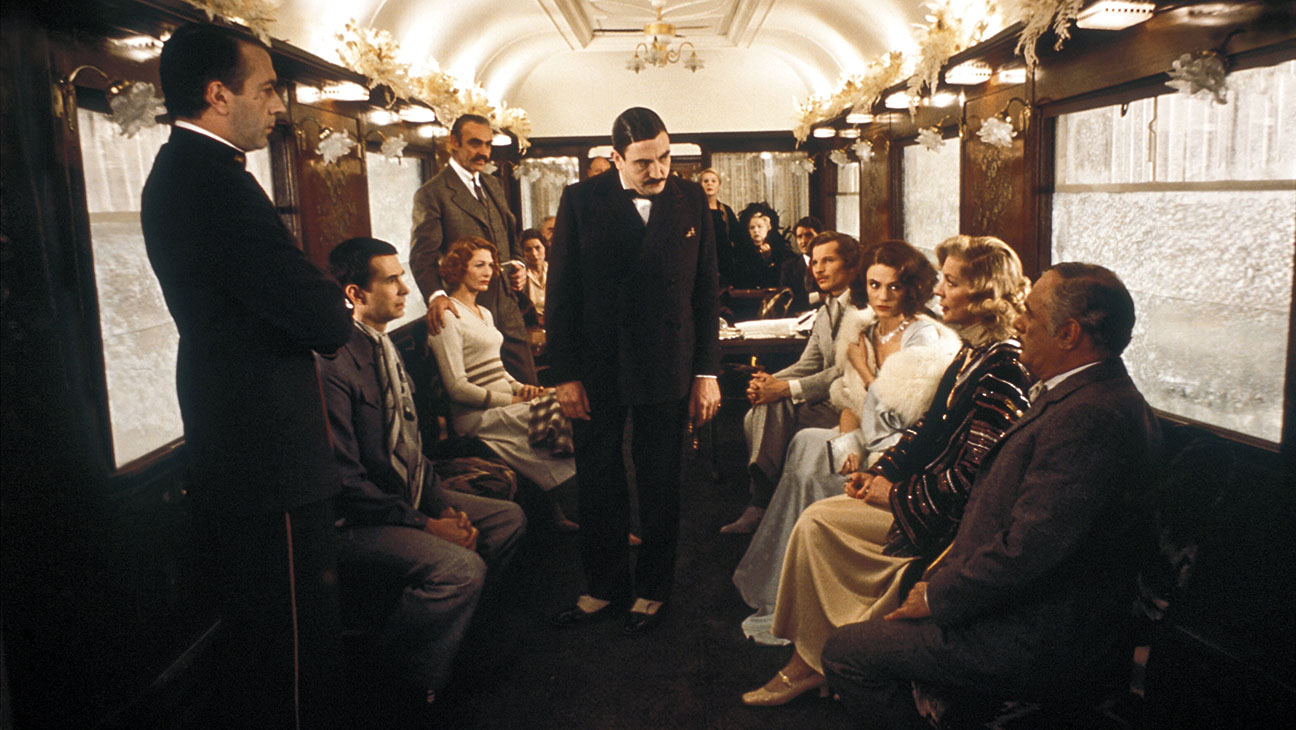 Directed by Sidney Lumet, whose first film was about another dozen people meting out justice, 12 Angry Men (United Artists, 1957). Above Jean-Pierre Cassel:
 What do you do when you’re a passionate actress still in love with a wounding bastard who’s a screen genius? You make the damn movie.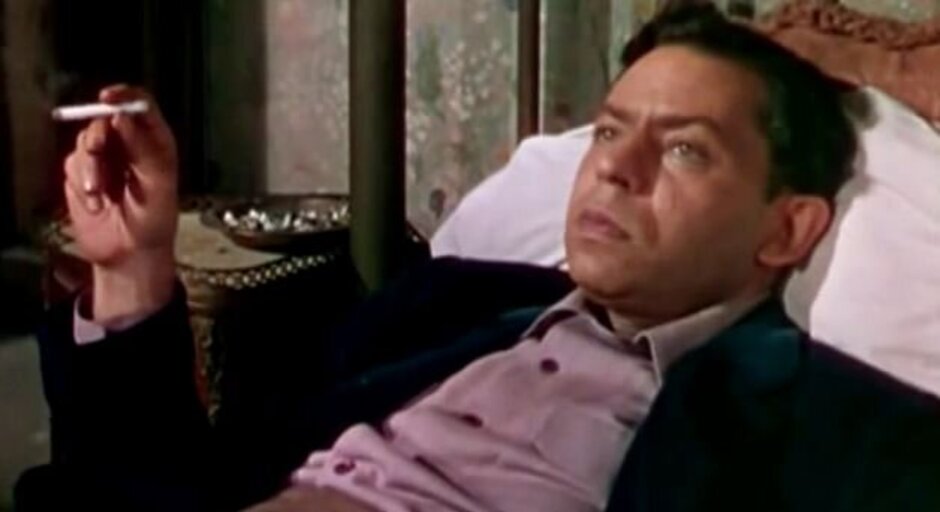

 Played the violin part in this in my junior high school orchestra. Liked it more than Bach. Above: “
 "I'll Be Dead Before You Break My Heart"