John Wilson Conducts Oklahoma at the 2017 BBC Proms, Rouben Mamoulian Howls In Protest from His Grave, 1

It was a late morning about six weeks into my work assignment and The Old Man hadn’t arisen yet, so there I was in the salon with nothing to do except quietly wait for his appearance and his orders for the day (which letters to answer, which bills to pay, which people to call, etc) before getting down to the primary purpose of my being there, which was, in the agency’s words, “to assist Mr Mamoulian in the writing of his memoirs”. None of that memoir writing actually did transpire in the nearly nine months I was with him, other things did, but let’s not jump ahead. Unsupervised, I was forbidden to handle/read books from his voluminous library, but you know what? He never expressly told me not to play the piano, that big black shiny intriguing baby grand in the middle of the room, and I couldn’t resist. Could you?
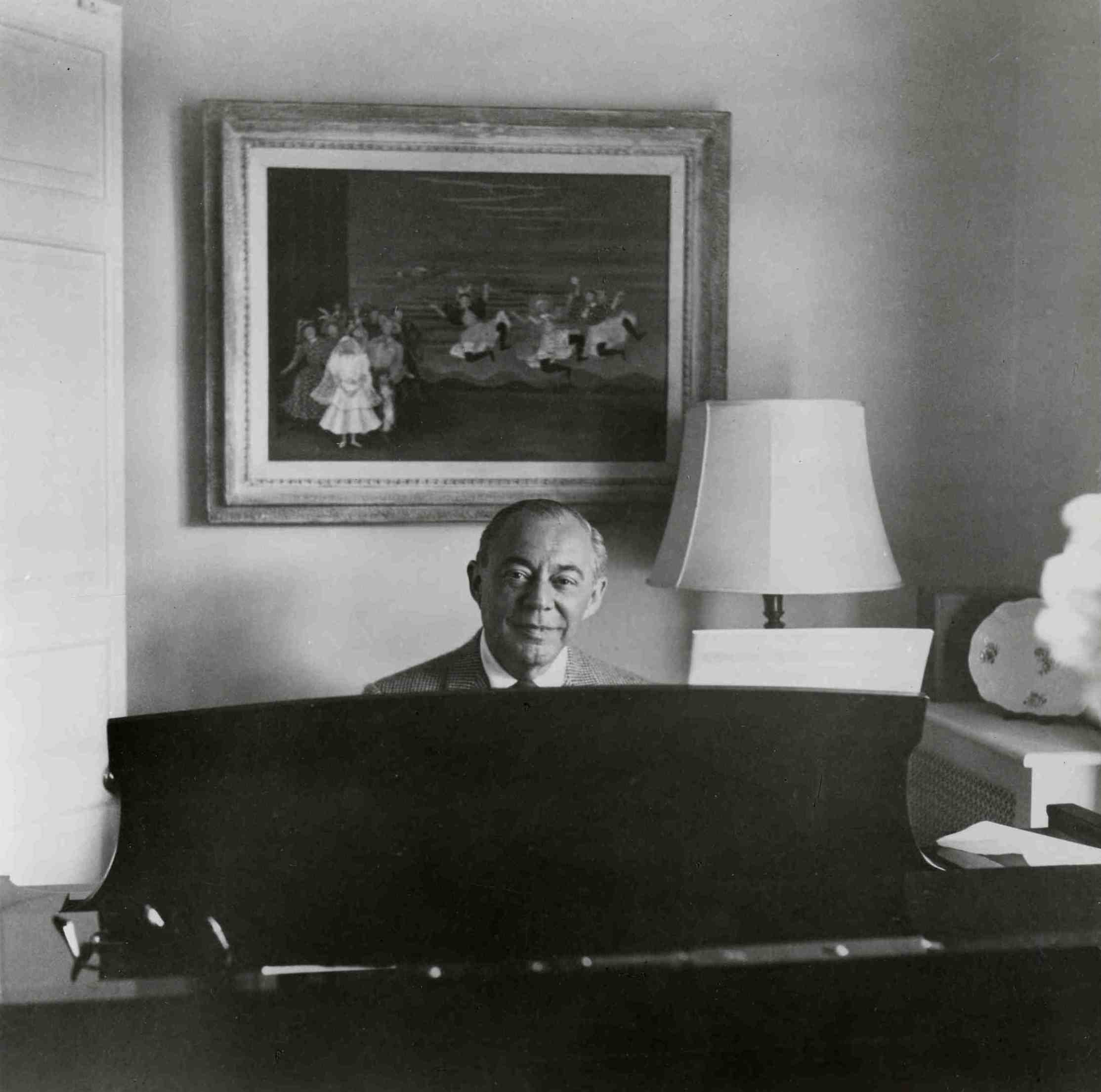
Richard Rodgers Piano

There wasn’t a sound coming from any part of the house, although I could faintly hear Henry the daily handyman moving his wheelbarrow out in the yard. I’d had enough of examining in painstaking detail the boring watercolors and Russian icons on the wall. I sat down on the bench.

Sense memory kicking in… At that point it was the closest I had gotten to this humongous piece of furniture. I remember the smooth feel of the wood as I ran my fingers on it, gently lifting up the fall board to get to the keys. The piano was a Steinway. That is, I remember it as a Steinway, because I don’t remember it not being a Steinway. I put the fingers of my right hand down in place and began, ever so softly, to tap out the first tune that came into my mind, which happened to be the waltz from Carousel. Three, four bars in I thought I heard a rustle from the back of the house and stopped cold, put the fall board down and stood up.

This was the first time my eye was caught by something on the right side of the music rack, some sort of writing actually carved into the wood of the music shelf that lay flat in the cabinet of the piano near the tuning wrench. It was in cursive—and it was a name:

Richard Rodgers

It still gives me goosebumps to remember I actually did that. When The Old Man finally did get up an hour later, I was sitting back at my desk in his alcove-cum-office, pretending to read one of the cheap Hollywood magazines I brought to pass the time, although my mind was still on the bars I’d played and where the bars were going musically, and I think I was humming. I must’ve been humming. Because as he came into the alcove I heard Mamoulian exclaim, “Hey, that’s from Carousel.

I looked up. Caught! I was about to apologize when he spoke again, this time it seemed almost wistfully. “You know, I directed that.”

I said softly, as if it were an apology, “I know.”

At that moment our relationship started to take a different turn.

[more later]

Part 2 “Agnes De Mille” here
Part 3 “Eugene O’Neill” here

FULL DRESS // A gifted mesmerist—a sinister composer—a naive young conductor from the north…inspired by an episode from the life of Rachmaninoff // DOWNLOAD FREE BOOK POSTER

At the End of the Year 2018: While I Still Have Conductor John Wilson In My Head

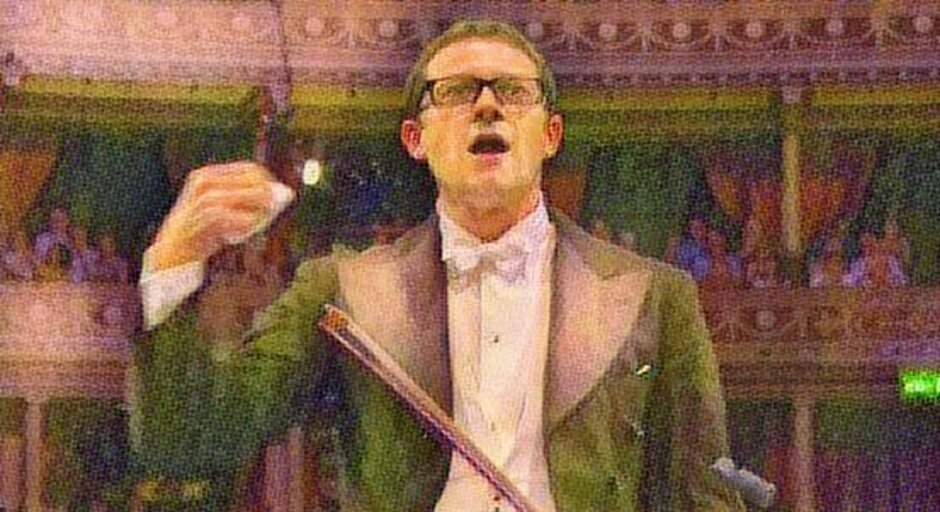
I’m still finding it mighty strange that John was born on the same day as my father’s final birthday, in 1972—on the 25th of May, which would make them both Geminis—but somehow it starts to make sense: There’s John of the BBC and Eric Coates and Ralph Vaughan Williams and the tra-la-boomy-boom that makes up English music; and then there’s John of the big-shouldered swaggering sweating bombastic vibrant American tune book. One (when he plays it well) makes me want to cook him a nice lamb stew with pearl onions swimming in the rich gravy; the other (again, when he plays it well, which is almost always) makes me want to—well, I was in The Business, you know, use your imagination.

John Wilson Album
Low Fell Lad Makes Good. Above: the Arlen-Kohler standard “Get Happy” was written for Ruth Etting but popularized by Judy Garland in the film, Summer Stock (MGM, 1951).


Only don’t be too sure which is which. Like I said, John almost always plays the music of his own country and heritage well, with a deep feeling that’s irresistible; whereas when he works out the great American tunes it turns out more often to be hit-and-miss, with many many many more misses than hits.

But oh! When he does hit!

When bonny John and his orchestra play “Get Happy” or “The Trolley Song” or “June Is Bustin’ Out All Over” or the MGM Jubilee Overture—or the absolute best of the lot, “Slaughter On Tenth Avenue“—it’s total heaven, and I’m not the only one to say this. Subtlety is not this lad’s forte when it comes to the American popular repertoire. But when John goes big, bright, busy and loud when the number actually calls for it, screams out for it, it’s so damn satisfying when he does it and does it brilliantly that I want to—how can I put this?—do something for my darling in gratitude…make him a nice meal…fatten him up a little… (Ess, kind, ess!)

For right now, though, I’ll settle for a natter on a quiet afternoon with you John, rather not in London, maybe when you get up to Gateshead again, mi amor, back to The Angel of the North


FULL DRESS // A gifted mesmerist—a sinister composer—a naive young conductor from the north…inspired by an episode from the life of Rachmaninoff // DOWNLOAD FREE BOOK POSTER

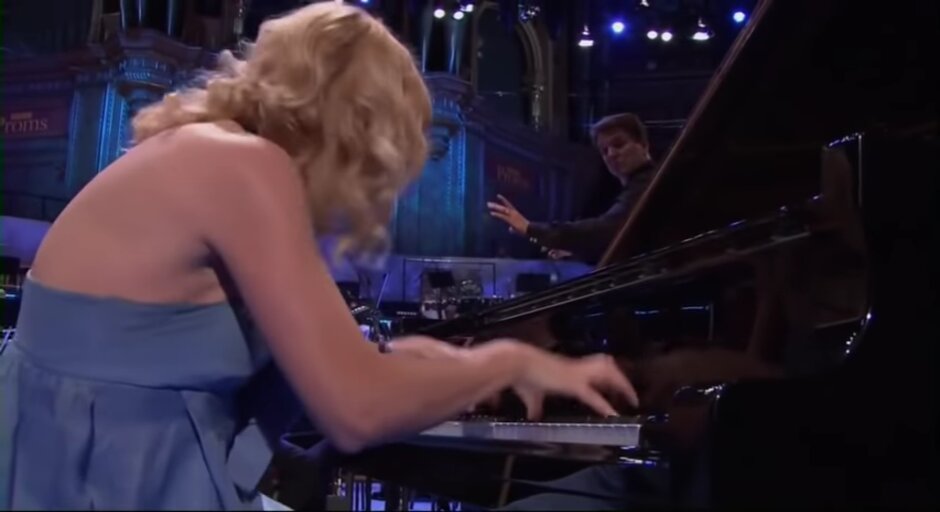
Warsaw Concerto by Richard Addinsell, Played by Valentina Lisitsa with the BBC Concert Orchestra Conducted by Keith Lockhart, BBC Proms 2013

Warsaw-Concerto-Lisitsa-Lockhart-2013
I love watching how Lockhart, official Guest Conductor of the BBC Concert Orchestra, scrupulously keeps in sync with not just his orchestra but with his soloist. It’s also a delight to watch at the beginning of the clip Lisitsa curtsying almost shyly to leader Cynthia Fleming.


Valentina Lisitsa, who started out as a YouTube sensation 12 years ago and is now counted as one of the foremost keyboard interpreters of the Eastern European Romantics, gives an intensely satisfying performance here of Addinsell’s “Warsaw Concerto“. The concerto was written for the movies—for, specifically, the 1941 movie Dangerous Moonlight, in which Polish concert pianist Anton Walbrook becomes a fighter pilot for the RAF, falls in love, gets amnesia, and composes some music. The movie, although a success from a propaganda viewpoint, was considered a potboiler by critics, and even the astute Anthony Burgess, who was an army sergeant and nascent composer himself at the time, looked down on the “Warsaw Concerto” as a cheap imitation of Rachmaninoff. Intellectual snobs have derided the piece, but it’s lingered in the memory for lo these many years, and is only now taking its permanent place in the Classic Repertoire.

For that we have to thank composer/film music restorer Philip Lane. It was to Lane that the musical estate of Richard Addinsell was entrusted and, like composer/orchestrator William David Brohn for Prokoviev’s Alexander Nevsky (Abbado with the LSO + full score here on YT) and my beloved John Wilson, Lane took on the task of reconstructing by ear written scores for film music whose manuscripts had been destroyed through carelessness or war. (Some suggest that the “Warsaw Concerto” was entirely the work of Addinsell’s orchestrator, Roy Douglas, who died in 2015 at the age of 107.) Addinsell’s—or Douglas’s—”Warsaw Concerto” was one of them. As Lane writes:

“The process of reconstruction does not get easier, but some films are more difficult than others. The biggest enemy is the combination of dialogue and sound effects over the music, and occasionally there are seconds of complete inaudibility when guesswork has to replace authenticity. The greater the composer, the more difficult the work, on the whole, since the melodic and harmonic language tends to be more adventurous. In the case of recent scores there are usually soundtrack CDs devoid of extraneous sounds to work from, but despite the change in status of film music, present day composers still mislay their scores. I have reconstructed music by Jerry Goldsmith, Randy Edelman and James Horner in the last year alone. If the composers are still alive I obviously encourage them to do the reconstruction themselves. So far, they have declined for various reasons.”

“The process of reconstruction does not get easier, but some films are more difficult than others. The biggest enemy is the combination of dialogue and sound effects over the music, and occasionally there are seconds of complete inaudibility when guesswork has to replace authenticity. The greater the composer, the more difficult the work, on the whole, since the melodic and harmonic language tends to be more adventurous. In the case of recent scores there are usually soundtrack CDs devoid of extraneous sounds to work from, but despite the change in status of film music, present day composers still mislay their scores. I have reconstructed music by Jerry Goldsmith, Randy Edelman and James Horner in the last year alone. If the composers are still alive I obviously encourage them to do the reconstruction themselves. So far, they have declined for various reasons.”


FULL DRESS // A gifted mesmerist—a sinister composer—a naive young conductor from the north…inspired by an episode from the life of Rachmaninoff // DOWNLOAD FREE BOOK POSTER

My Beloved John Wilson and The John Wilson Orchestra Bring Their Show That’s Entertainment—A Celebration of MGM Musicals to the Shaw Theatre in North London, 2008

From Playbill.com, 2008: Conductor, arranger and musical scholar[!] John Wilson will bring his 58-piece orchestra to the Shaw Theatre August 20-23 for That’s Entertainment!, an evening of music and song that celebrates the great MGM musicals.


The John Wilson Orchestra will perform original orchestrations and scores, many of which have been newly reconstructed by Wilson himself, to pay tribute to some of America’s greatest composers and songwriters, including George Gershwin, Irving Berlin, Cole Porter, Harry Warren, Jerome Kern and Richard Rodgers as well as the great Hollywood arrangers Conrad Salinger, Johnny Green and Nelson Riddle. The evening will feature music and songs from some of Hollywood’s best-loved MGM musicals: High Society, Singin’ in the Rain, An American in Paris, Ziegfeld Follies, Meet Me in St. Louis and The Wizard of Oz. Special guest vocalists are Matt Ford, Rachel Weston and Gary Williams.

As a conductor, Wilson works regularly with the Hallé, City of Birmingham Symphony, Royal Liverpool Philharmonic, BBC Scottish and BBC Concert orchestras. He is a frequent guest conductor in Europe: Recent visits have taken him to the RTE Concert Orchestra in Dublin, and to Scandinavia, Iceland and Bulgaria. Last year he made his Australian debut in Melbourne and Adelaide and his London Philharmonic debut at the Royal Festival Hall. He is also a musical arranger for film, radio and TV, where his credits include orchestrating Sir Richard Rodney Bennett’s score for the BBC production of Gormenghast, which won the Ivor Novello Award for Best Film Score; Howard Goodall’s score for the BBC/HBO film The Gathering Storm about Winston Churchill; and the soundtrack for Kevin Spacey’s Beyond The Sea biopic of singer Bobby Darin, which gained my brilliant, bonny John a Grammy nomination. He has also worked with Sir Paul McCartney and has orchestrated and conducted several of Sir Paul’s compositions with the London Symphony Orchestra.

He has also reconstructed the orchestrations of the major MGM musicals High Society, Singin’ in the Rain, The Band Wagon, and An American in Paris. In January he gave the first European performances of his orchestrations of The Wizard of Oz with the Royal Liverpool Philharmonic, synchronized with the film.


FULL DRESS // A gifted mesmerist—a sinister composer—a naive young conductor from the north…inspired by an episode from the life of Rachmaninoff // DOWNLOAD FREE BOOK POSTER

John Wilson Interview (with Music!) at the BBC Studios in Salford, 12 November 2018

“I think I’ve done my last batch of film music,” says bonny John. Interview starts at 9:50. (Update 5 March 2019: Damn, the Beeb yanked this podcast! Will replace the link if they ever bring it back. To make up for it below are some downloadables.)

Included with the interview in their entirety: Met soprano Joyce DiDonato sings “You’ll Never Walk Alone” (Rodgers & Hammerstein); the famous barn-raising dance in Seven Brides for Seven Brothers (Gene de Paul, Alexander Courage), and “I Got Rhythm” (George and Ira Gershwin), all played in that ineluctable John Wilson Orchestra way.

John Wilson Working Bloodily HardAbove bloodily hardworking John: Kim Criswell, the Maida Vale Singers and The John Wilson Orchestra tear into the Gershwin brothers’ “I Got Rhythm”.

From a 15 June 2016 article in The Sydney Morning Herald:

It’s rare, if ever, to hear a kind word said about James T Aubrey, the ruthless former CBS executive hired in 1969 to turn around the stuttering fortunes of the MGM movie studio. In a four-year reign he slashed staff numbers, cancelled many projects and sold off the company’s archive in a sale that, famously, included Judy Garland’s iconic ruby slippers from The Wizard of Oz.

“They had no intrinsic value,” was Aubrey’s icy comment at the time.

And along with that brutal act, incredibly, he also ordered the destruction of many of the film scores in the company’s archive, trashing music from legendary films including The Wizard of Oz, High Society and Singin’ In the Rain.

These gems might have been lost forever were it not for the passion and dedication of English conductor John Wilson, who for the past 15 years has dedicated much of his time to re-creating them.

Now he has re-scored some 200 separate numbers from MGM musicals from the 1930s to the early ’60s purely by ear, a task he was driven to largely out of necessity—he loves the music and wanted his orchestra, the John Wilson Orchestra, to play it.

“I had to do it,” he says simply.

He’s also quite frank about the tedium of minutely reconstructing each part.
“First and foremost, I’m a conductor—it’s all I do really,” he says. “I don’t like writing music out but I have to. It’s a pain in the arse! It’s hours of toil.

“I do love hearing it back—I only do the numbers I think are really sensational—but sitting listening to four seconds of music on a loop for half an hour just to get one bass clarinet part—is that going to be anything other than just necessary?”

One might then expect Wilson to join the chorus of Aubrey critics but he is surprisingly generous towards the man who presented him with a lifetime’s work.

“It would be easy to say James Aubrey was a vandal but I think there were a lot of people around then who had no idea that this was worth keeping,” he says.

The pace at which the studio system turned out films left little time for those involved to consider their longer term significance.

“If you had said to anyone in the 1930s that what they were creating was art they would have laughed at you,” says Wilson. “It was entertainment designed to make a profit. Nobody was archively minded. A lot of the scores were an unfortunate casualty of that prevailing attitude. It would have been a case of, ‘Who wants a load of old crumbly pages’?”

Wilson’s passion for “good quality light music” sprang from listening to the TV and radio when he was growing up in Gateshead in the 1970s-80s.

After an extensive apprenticeship playing piano, arranging music and conducting for amateur dramatics, pantomimes and other productions he went on to study in London.

“By the time I arrived at the Royal College of Music at 18 I was fairly hands-on and practical,” he says. “There were never any divisions for me between David Raksin, Max Steiner and Erich Korngold and Strauss, Mozart and Brahms.”

Now he is working alongside his long-time friend and collaborator, Sydney Symphony Orchestra co-concertmaster Andrew Haveron, bringing his favourite light music to Sydney audiences.

Haveron has led the John Wilson Orchestra since its inception.

“Andrew knows how to play this music better than anyone on the planet. That’s a real game changer,” says Wilson.

On a program that also includes music from Citizen Kane, Gone With The Wind and Star Wars will be Erich Korngold’s music for 1938’s The Adventures of Robin Hood, starring Errol Flynn.

Wilson’s face lights up. “It is,” he says, “the greatest movie score that has ever been written. I never get past how impressive it is.”

FULL DRESS // A gifted mesmerist—a sinister composer—a naive young conductor from the north…inspired by an episode from the life of Rachmaninoff // DOWNLOAD FREE BOOK POSTER

Conductor John Wilson’s First Appearance in the Royal Albert Hall, British Film Music, BBC Proms, 2007

My beloved John Wilson‘s very first time on the podium in the Royal Albert was not with his eponymous orchestrathat was in 2009but, at age 35, conducting the 50-piece BBC Concert Orchestra in their program, “British Film Music” (entire program available here in 14 parts). First up is William Walton‘s* score from the unseemly gorgeous (all blue skies and puffy white clouds) 1969 war picture Battle of Britain. “Battle in the Air” (in part 1 @00:01:20) is spirited, ravishing and very dramatic. I saw the film first-run back home in Minneapolis, then again a few years later in London and then again in, of all places, Patras, Greece, but it’s the music I remember most.

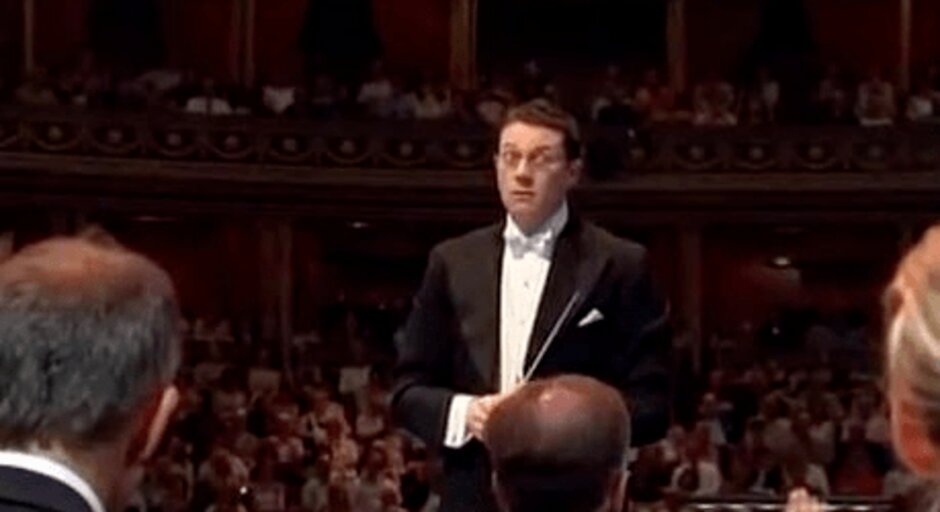
John-Wilson-Battle 940x512Yes love, that overtone did seem to go on forever, didn’t it?
Here’s the entire program:

  • Battle In the Air” from Battle of Britain (1969) / William Walton
  • Suite from Anna Karenina (1948) / Constant Lambert
  • Prelude from The 49th Parallel (1941) / Ralph Vaughan Williams
  • Waltz from Genevieve (1953) / Larry Adler
  • Theme from Lawrence of Arabia (1962) / Maurice Jarre
  • Suite from The Red Shoes (1948) / Brian Easdale
  • March from The Bridge On the River Kwai (1957) / Malcolm Arnold
  • Love Theme from Yanks (1979) / Richard Rodney Bennett
  • Medley from the Carry On film series (1958-1992) / Eric Rogers (arr Sutherland)
  • Overture from Much Ado About Nothing (1993) / Patrick Doyle
  • “Shakespeare In Love” from the film (1998) / Stephen Warbeck
  • Suite from Wilde (1997) / Debbie Wiseman
  • “Chicken Run” from the film (2000) / John Powell, Harry Gregson-Williams
  • “Shadowlands” from the film (1993) / George Fenton
  • “A Bridge Too Far” from the film (1977) / John Addison
  • “Harry’s Wondrous World” from the Harry Potter film series (2001-2011) / John Williams
  • March from The Dam Busters (1955) / Eric Coates

Cynthia Fleming, leader. Philip Achille, Cynthia Millar, soloists. Maida Vale Singers, chorus. Richard E Grant, host. Appearance by Sir Richard Attenborough.

** Because of his advanced age, Sir William Walton turned to friend Sir Malcolm Arnold for assistance with the orchestrations (which Arnold supplied, as well as writing additional cues). Harry Saltzman rejected the score, saying it wasn’t long enough. Ron Goodwin (who composed for Where Eagles Dare) wrote the replacement score, but Sir Laurence Olivier threatened to have his name removed in the credits if none of Walton’s original was used. For this reason, Walton’s original music for the “Battle In the Air” sequence was used in the climactic closing of the film.


FULL DRESS // A gifted mesmerist—a sinister composer—a naive young conductor from the north…inspired by an episode from the life of Rachmaninoff // DOWNLOAD FREE BOOK POSTER

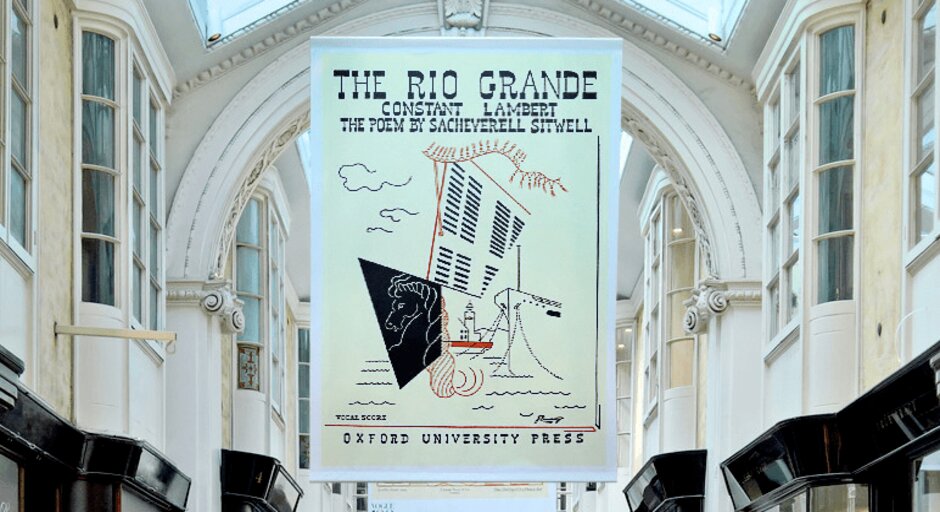
The Rio Grande by Constant Lambert, Broadcast Live from the Royal Albert Hall, 12 September 1959

A very nifty, lively, jazzy modernist piece written by Constant Lambert (The Who manager Kit Lambert’s dad) in 1927. Australian virtuoso Eileen Joyce, who famously played the heart-wrenching Rachmaninoff in the film Brief Encounter (entire film here), is at the piano here. County Antrim-born Jean Allister, contralto soloist, joins her with the BBC Symphony Orchestra and the BBC Chorus. At the podium is Sir Malcolm Sargent.

Lambert Picadilly Arcade 940x512

Composer-novelist Anthony Burgess, in his autobiography Little Wilson and Big God (Burgess’s original name was John Wilson; his middle family name was Burgess and his confirmation name was Anthony) wrote,“Lambert, who admired Duke Ellington and proclaimed his harmonic roots in Frederick Delius (who in his turn had taken them from Debussy), was a fearless reconciler of what the academies and Tin Pan Alley alike presumed to be eternally opposed. I was present at that first performance, and so was my father. And, in 1972, on a plane from New York to Toronto, I found myself sitting next to Duke Ellington, who spoke almost with tears of the stature of Lambert, admitted that he had learned much from both Delius and Debussy, and expressed scorn for the old musical division, which had been almost as vicious as a colour bar. He had lived to see it dissolve and jazz become a legitimate item in the academic curricula.” [More Burgess on Lambert here.]


FULL DRESS // A gifted mesmerist—a sinister composer—a naive young conductor from the north…inspired by an episode from the life of Rachmaninoff // DOWNLOAD FREE BOOK POSTER

Bernstein’s On the Town, Performed at the BBC Proms by the LSO, Conducted by John Wilson, 25 August 2018

The on-demand streamcast on BBC3 was actually pretty good—straightforwardly sung, acted and played; no John going meshugena with the tempi like he did two weeks ago with his own orchestra’s “concert” version of West Side Story. (In contrast, you do not mess around with the London Symphony Orchestra.) And is that the venerable UK-based American actor Kerry Shale doing the narrating?

On the TownAbove: “New York, New York” from the 2015 Broadway production of On the Town. All album cuts available for listening/download here.

As it was in West Side Story two weeks ago, I am theorizing that the terrifying foot-stomping in the audience that occurred when my lovely John stepped forward to take his bow at the end was started by fellow classmates of the youth chorus onstage, and not a biker gang.


The entire BBC 2018 Proms ON THE TOWN is available to watch here


FULL DRESS // A gifted mesmerist—a sinister composer—a naive young conductor from the north…inspired by an episode from the life of Rachmaninoff // DOWNLOAD FREE BOOK POSTER

The Story So Far, with Conductor John Wilson

From August, 2018. Cantara, former ASCAP solfeggist and 70s porn actress turned memoirist, has fallen hopelessly in love with a man at the other end of the world, an English, middle-ranking orchestra conductor—who plays, on the side, Golden Age of Hollywood music and The Great American Songbook—by the name of John Wilson.

The Queen of Heaven has her eye on you, John

Not because he’s a fellow creator (he doesn’t create, but reconstructs, orchestrates and arranges the music of others)—not because of his looks (he’s peaky, scrawny, blinky; his gray-green eyes lack luster; he’s got a facial tic, pores like craters, lousy posture, enormous feet, the limbs of a stick insect and the hands of a hod carrier; his nose is an equilateral triangle; his famous cleft chin, supposedly his best feature, always looks slightly askew; his ultra-short mousy hair can’t conceal the fact he’s already going gray; he sweats like a stevedore on the podium; and for the past few years he’s taken to wearing geek glasses)—and certainly not for his intellect (his fatuous pronouncement about the needlessness of lyrics in The Great American Songbook makes me want to smack the back of his head like the whippersnapper he is and send him home with a note).

So what is it about him?* I’ve only been aware of his existence since 30 April and in love with him since 4 May, 2018; since then my feelings have been an insane mixture of tenderness, gratitude, annoyance, and lust. The tenderness I understand: I’ve spent enough time in Hollywood to understand the position he’s in… As far as gratitude, here’s his concert version of “The Trolley Song” using the original 1944 orchestration(!)— thank you thank you thank you, John. Even the raging lust I get.

But whenever John gets himself in the way of the music it drives me nuts. It’s crystal clear to me the times he does this because I’m in love with him, dammit, and because he’s a musician I pay attention to the music. Truth to tell, the only times John really gets himself in the way are when he’s conducting his own hand-picked group which is dedicated mostly to music from Golden Hollywood & The Great American Songbook, and cannily named The John Wilson Orchestra.


Listen to John’s new orchestra the SINFONIA OF LONDON here


Whether he gets himself in the way indeliberately or on purpose I cannot entirely tell, but I’m starting to. With a little patience he isn’t that hard to read, my bonny John Wilson. After countless times listening to his recordings and broadcasts; pouring over his interviews; watching him conduct (in video clips, mainly from the annual BBC Proms); watching him conduct other orchestras besides his own (ditto); and, most important, learning to separate the showman from the musician, I’m starting to understand his type of intelligence and his musical capability, which is actually pretty sizeable. His ear (the way he hears things, not his purported perfect pitch) is intriguing and his industriousness is admirable. I am definitely not buying into the PR excess—he is not “a superstar”, “a guru”, “charismatic”, “legendary”, “a conducting icon” or, God help us, as proclaimed by the BBC, “the nation’s favorite” (!!!). But his musicianship at times is kiiind of brilliant.

* Update 10 August 2019: I’ve just read up on what it is about him, and now I’ve got science to back me up. It’s John’s fault.


FULL DRESS // A gifted mesmerist—a sinister composer—a naive young conductor from the north…inspired by an episode from the life of Rachmaninoff // DOWNLOAD FREE BOOK POSTER

Gershwin Plays Gershwin: 3 Preludes

I don’t think a clip exists, but 3 Preludes was on the program of The John Wilson Orchestra’s 2015 BBC Proms show Salute to Sinatra—yes I swear, that was the theme of that show which featured Seth MacFarlane, on account of he can sing like Brian the Dog. The connection is that the version my clever John and his orchestra played is the Nelson Riddle arrangement of Gershwin’s 3 Preludes, Nelson Riddle having been one of Frank Sinatra’s most important musical collaborators. Such a stretch, pet.

But here’s Riddle’s arrangement…and here’s George Gershwin himself. Compare and contrast.

Gershwin at Piano


FULL DRESS // A gifted mesmerist—a sinister composer—a naive young conductor from the north…inspired by an episode from the life of Rachmaninoff // DOWNLOAD FREE BOOK POSTER

My First Music: Catholics Surrounded by Lutherans and Some Conducting by John Wilson, BBC Proms 2013

On this day, 25 May, 2018—what would have been my dad’s 113th birthday—I’d like to remember one of the few times he and I actually went to the movies together. This time we went to see, first-run, the warrior epic Taras Bulba (United Artists, 1962; screenplay by blacklisted writer Waldo Salt) on the recommendation of my girlfriend Tamara’s mother, who emigrated from Lviv after the war and was a booster for All Things Ukrainian. (A survivor of Axis bombingsshe had that in common with my mom.) Our Minneapolis neighborhood was made up mostly of first- and second-generation Ukrainians, Italians, Guatemalans, Poles, Irish, and of course Filipinos, Catholics all. Of course the Lutherans surrounded us but being mostly Swedes, they had their own heritage too. And at Christmas, all that pepparkakor…num.

As for Franz Waxman’s “Ride of the Cossacks, there’s a rather thrilling ostinato toward the end.

A pretty inspired choice for your Proms, John. It isn’t played too often (there’s more Ben Hur out there than Taras Bulba); my guess is because most conductors just can’t hear the “kinetic” qualities in this piece of music or they interpret it as more “memetic”, and so what comes out when they conduct sounds just awful, artificial… But you, my bonny lad, got it right. I’m starting to recognize your ear more and more, and it’s a wondrous thing.


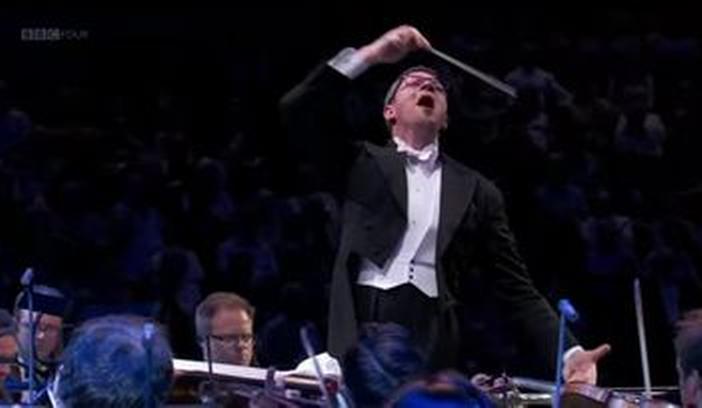
John Wilson Taras BulbaWishing you two clean and ready handkerchiefs every concert day, John.

FULL DRESS // A gifted mesmerist—a sinister composer—a naive young conductor from the north…inspired by an episode from the life of Rachmaninoff // DOWNLOAD FREE BOOK POSTER

Casablanca Suite Composed and Orchestrated by Max Steiner, Played by The John Wilson Orchestra and Conducted by My Beloved John Wilson, 2013

Steiner’s suite (written score here) is clearly patched together from various melodies in the film Casablanca, including the Nazi drinking song “Die Wacht am Rhein” (Schneckenburger/Wilhelm, 1853); “La Marseillaise” (de Lisle, 1792); and, of course, “As Time Goes By” (Herman Hupfeld, 1931). And is that a little of Steiner’s own King Kong? The Warner Bros Pictures music theme at the beginning is entirely Steiner’s composition. (Most of the) orchestration by Steiner’s frequent collaborator, Murray Cutter.

John Wilson 2019-1
I feel a raging, yearning, unchaste tenderness for my beloved John Wilson when he conducts schmaltzy pieces like this, which sort of makes up, as I say, for the times his fatuous pronouncements exasperate me. Above John: Steiner’s Casablanca Suite.

Click here to see John in action with The JWO in 2013.


The entire 2013 BBC Proms concert Hollywood Rhapsody with The John Wilson Orchestra is available here


FULL DRESS // A gifted mesmerist—a sinister composer—a naive young conductor from the north…inspired by an episode from the life of Rachmaninoff // DOWNLOAD FREE BOOK POSTER