There were some particularly strong singers in the BBC Proms concert at the Royal Albert back in 2011 I take pleasure in remembering, on this gray Monday two days before The Inauguration. “Serenade” from The Student Prince was one of my mother’s favorite numbers, she just thrilled to it, especially when Mario Lanza was singing. “Can’t Help Singing” was in my Deanna Durbin Songbook when I was a teenager. “The Man That Got Away” was sung at my friend’s funeral—the friend who left me all his Andre Previn records—by his grieving lover. And then there’s “Secret Love”.
CANCELLED: During Easter Week, the holiest week of the year for observing Catholics, John in Santiago, Chile conducting a me-tic-ulously chosen student orchestra, culminating in a concert on Easter Sunday consisting of the always-favorite Tchaikovsky’s Symphony No 4 and Rachmaninoff’s Piano Concerto No 3.
RECORDED: Lastly, re “Meditation” above, that short symphonic intermezzo between the scenes in Act 2 in the opera Thaïs (1893) by Jules Massenet, which my beloved John conducts on his February 2020 album from Chandos (10th cut) and in which Andrew Haveron performs his violin solo like an angel…
Gazing now at John with love and longing and taking this to a private place. Everybody, go away.
Barbara Stanwyck was 32 and a box-office star when Paramount contract player William Holden, 21, was personally cast by director Rouben Mamoulian as the lead in his film based on Clifford Odets’s Broadway melodrama of art vs fleeting fame and riches, Golden Boy. Holden was nervous, awkward, and about to be replaced when something about the young player touched Stanwyck’s heart. She took him in hand, coached him personally and kept him from distractions (like studio publicity)…
Thity-nine years later, at the Oscars Holden had this to say to the world:
Above Holden and Stanwyck: There are only a few genuine moments in the history of the televised Academy Awards. This is one of them.
Gimadieva made her UK debut at the Proms with John and the John Wilson Orchestra in their program Hollywood Rhapsody, which included pieces by my favorite screen composer Bernard Herrmann. I’ve been a fairly knowledgeable fan of Herrmann since my teen years, but somehow I never got around to hearing the entire aria until—yes! yes! are you getting bored hearing this again?—I fell in love totally and completely with English conductor John Wilson and craved to hear all the music that he’s part of. To my delight, he backed this brilliant singer well.
Above my bonny John making nicey-nice with a soprano for once: “O cruel!” (Salammbo’s aria) from the film Citizen Kane. Herrmann planned to write an entire opera based on this scandalous Flaubert novel but, daunted by the task, as Mussorgsky and Rachmaninoff before him, never got around to it.
And for good measure, here’s Gimadieva doing Donizetti’s “O luce di quest anima” with The Hallé the way I’d like to have sounded in my last trimester jury at music school.
Dearest John Wilson, Conductor, it makes me happy to be in your audience and I don’t require you at all to be in mine—mostly because, as Mister Grumble just pointed out, my flicks would probably give you a heart attack. It also makes me happy that you’re going to be concentrating more on the Classic Repertoire this season, although it means leaving your faithful John Wilson Orchestra fans for a time—and only because when you’re not playing American film music, you’re not on the podium making the kind of quasi-witty comments that would make even me wince, and I used to be Arthur Godfrey’s gag man back in the fifties.
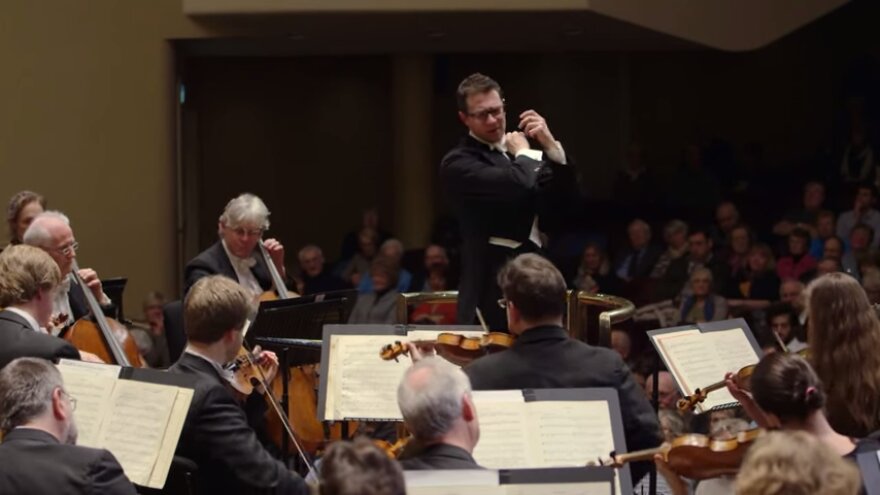
Now, Voyager (1942): Bette Davis as brave Charlotte Vale and Paul Henreid as her handsome weenie of a lover in this BBC2 Saturday Afternoon Movie I’ll bet John saw once upon a rainy day when he was a kid and couldn’t make head nor tail of, except for the music. Above: That’s my beloved John conducting the Sinfonia of London in this Max Steiner score, including the Warners Bros studio theme, which Steiner also wrote. Orchestration by Hugo Wilhelm Friedhofer.
By the way John my sweet Geordie lad, I’m getting a kick out of imagining you form the word “porn”. Pohhhrnnn.
On that note, I just want to let all of you know that I realize it’s not hard to find me. Really. I’m in the IMDb. I don’t even have to fill you in on what my screen name is because IMDb seems to have switched pretty much every one of my credits back to my legal name anyway, so it would be kind of pointless… All right. It’s Simona Wing. My castmates in my first movie, Dork & Sindy aka Playthings, gave it to me, and I consider it quite a lagniappe. Mister Grumble used it for my character’s name in his first novel (Tales from the Last Resort, Brave New Books, 2002) and no one has been able to get better use out of it since.
I have pleasant memories of that shoot. For one thing, it was shot in Marin County. In Sausalito! In a house overlooking the Bay. Do you see in that pic those houses up in the hills? The white house above the red roof, that’s where we shot.
For another thing, Craft Services was fantastic. You could graze all day.
And it was a friendly, clean shoot. Does anyone here who saw the flick remember what I was wearing before the guy in sunglasses stripped me naked, threw me into the hot tub and started chewing on my behind? That white blouse, that long black skirt, those pumps? That was my secretarial outfit, the one I wore a few months earlier in Beverly Hills when I worked for Rouben Mamoulian. Practically every day, I was that poor (took Sunset bus to foot of Schuyler Road, got off, wearing sneakers climbed hill, at Mamoulian’s door removed sneakers, put on pumps which I carried in my handbag). I remember I had one line which has since been coming back to me regularly, because whenever I run into an occasional fan, he (and it’s always a he) tends to quote it to me:
Now, you have to be a real Saturday Night Live geek to recognize that line, and I’m not going to decipher it for you. But I suppose this showed people I could do voices, because I got a lot of work from this film, almost all of it involving fakey foreign-sounding accents. Like Fatima, woman of Borneo, in the softcore version of Sadie Thompson aka Rain by Somerset Maugham. I’m not kidding.
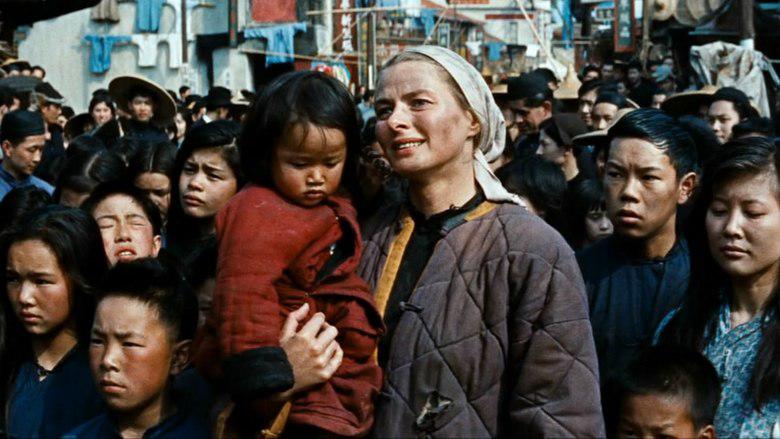
There must be something in the English character that enables the better artists among them to depict situations of unassuming, steady bravery with superior deftness, which is probably why their World War II pictures are better than ours. One of them, The Inn of the Sixth Happiness (20th Century Fox, 1958), doesn’t technically qualify either as a UK picture—Fox produced it; or as a WWII picture—it’s set during the Sino-Japanese War of 1938; but it does have unarmed peasantry scattering to the hills under Japanese gunfire, which is a theme that ran through my mother’s life starting with Pearl Harbor and ending in March, 1945 when American troops marched through the rubble-strewn streets of Manila, hunky victorious good guys. My mother’s first teenage romance was with a private in the 31st Infantry Regiment named Kelly, come to think of it.
Now, when I refer to better artists of English character I don’t mean the film’s producer, director, writer (American, American, American), or stars (Swedish, Austrian). But it’s because of: one, the true-life heroine the story was based on; two, the location shooting; three, the non-lead casting; and four and most importantly, the music, that I think of Sixth Happiness as an English film. The true-life heroine of the story was English-born, not to mention the film has Snowdonia standing in for the daunting terrain around Yangcheng and pretty near the entire Chinese heritage population of Liverpool standing in for Chinese nationals, with supporting roles portrayed by stalwarts of UK stage and screen. This is the first thing I ever saw Burt Kwouk in.
But to the music. This is not Malcolm Arnold’s finest score—Bridge On the River Kwai (Columbia, 1957) really is a superior composition—but it rates higher with me becauuuse, you guessed it, The Inn of the Sixth Happiness has a gorgeous Love Theme, which you can hear below as the Royal Academy of Music performed the suite back in 2014. You’ll also hear the bright, high fanfare brass that Arnold used in a few other of his movies, River Kwai and the one below, for examples. Also, I’m starting to develop a theory to satisfy myself that certain intervals, played with conviction, are the real sinews of English music: they make for that sound of “rightness”, which you can take one way or another, depending on the mood—or your mood, for that matter. Sixth Happiness has plenty of those.
Besides the satisfying fanfare brass, Sixth Happiness shares with the satirical The Belles of St Trinian’s (British Lion, 1954) a bit in the score where there’s a song meant to be sung by children—in Sixth Happiness it’s “This Old Man”; in St Trinian’s it’s the school’s hilarious “Battle Cry”. I’m not posting the lyrics here, so click on the link in red to listen to those cheerfully bloodthirsty oaths. But can you imagine what a liberating tonic this ferocious roar from the depths of The Untamed Female Soul was to a little girl in the Catholic part of Minneapolis, watching this on Saturday matinee TV (a tonic, incidentally, I would not imbibe again till I heard Bernadine Dorhn mouth off a few years later)—?
Here’s the BBCCO doing the St Trinian’s suite at the Proms (Timothy West, narrator) bringing back almost all the familiar, funny-music leitmotifs to smile at, like George Cole’s character’s “Flash Harry”, a loping, rattling kind of tune (although lamentably there’s no sign of Joyce Grenfell’s scurrying “Ruby Gates”) before returning to that ghoulish school pageant march, lyrics I believe provided by Arnold himself.
In contrast, “This Old Man” is meant to be a “found” song, purportedly a children’s counting song, heard on the playground since the 19th century, and in a way that’s right, as the first time I heard “This Old Man” was on the playground—but only because it had become a hit on US radio first in 1959. It’s still impossible for me not to hear “This Old Man” and not think of the climactic scene in Sixth Happiness: the hundred children crossing the Yellow River into safe territory, ragged and exhausted but alive, marching into the unoccupied city to cheering crowds, loudly singing this song. Invariably it brings tears to my eyes, immigrants’ daughter that I am, and I remember the first time I watched—and heard—this film on TV with my mother, my mind nearly forming the question I never asked her, not then, not ever: “What happened to you in the war, mom?” Because the music was so ravishing, the love story was so satisfying, and my mother just wanted to enjoy an Ingrid Bergman film.
Mannix (1967-1975) was a long-running private-eye American TV show from the dynamo team of Geller-Link-Levinson. It was popular for several reasons, one being Mike Connors’s Hirsute Sex Appeal (here pictured); not to mention the show’s viscerally satisfying action scenes (Mister Beefcake gets beaten up a lot); its swingy, sexy theme composed by none other than Lalo “Mission: Impossible” Schifrin; and, not least, for Joe Mannix’s lovely secretary, Peggy Fair.
Peggy Fair (Gail Fisher) was a character very much in the tradition of capable cool-headed female helpmeets to the main investigator guy (think Della Street or Effie Perrine). In the mid-60s there was a bouquet of gorgeous black actresses in regular roles on prime time: Fisher; Diahann Carroll starring as Julia; and of course, Nichelle Nichols as Uhura in Star Trek. Not to mention there were frequent small-screen guest appearances by stage stars like Ruby Dee and Diana Sands and TV stalwarts like Mimi Dillard. And you know, looking back, I think I noticed these actresses particularly because they all reminded me of one particular black girl I had a crush on from her photos and her work, who’d died in the mid-60s only a few years after her historic stage triumph:
Remembering the TV show Mannix also brings me back to something I quickly realized after moving to the Golden State: When you come to California, more sooner than later you will run into an Armenian. Heck, one of my first secretarial jobs in LA was for Tbilisi-born Rouben Mamoulian. Connors (1925-2017), who was born Krekor Ohanian in Armenian-strong Fresno, claimed to be a distant cousin of William Saroyan, author of The Time of Your Life and The Human Comedy, among other classic dramas of mid-20th century America.
Saroyan once made a memorable statement, “Wheresoever two Armenians meet, there is Armenia.” Which is something I’d like to apply to Filipinos as well.
Originally drawn from music composed as incidental accompaniment to a play, Copland’s “Quiet City” has gained much more popularity as a concert work for orchestra.
John recorded this and other Copland standards for Chandos a couple of years ago but this rendition, performed by the next generation at RCM, is closer to my heart.
Was thrilled to find on YouTube the full first season [https://bit.ly/room222season1] of a TV show I adored in high school, Peabody Award-winning Room 222; was doubly thrilled to hear again prolific Hollywood composer’s Jerry Goldsmith’s sweet simple theme in ear-catching 7/8 time.
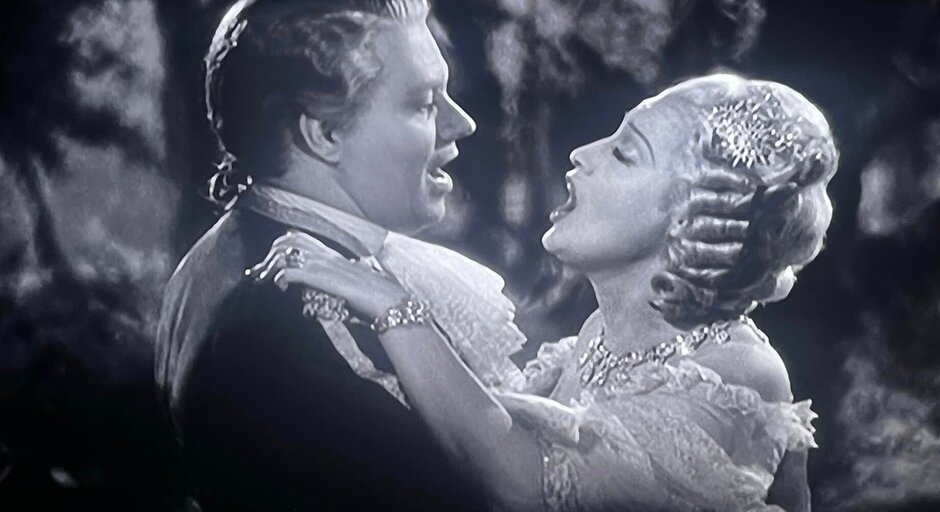
Another MGM musical, pre-Freed Unit. They were such a handsome couple and sang like angels, Jeanette MacDonald and Nelson Eddy. Who in their audience could have realized when watching such a mannered scene that they were in the middle of a chaotic on-again off-again love affair and that right after filming this number—that very night in fact when everyone had gone home—the two of them would be under that very tree having furious make-up sex?
Thanks to fellow MacDonald-Eddy fan Sharon Rich (as related to her by Jeanette’s sister Blossom) for that lovely bit of info.
To my mind, Star Trek IV and Galaxy Quest are the two movie scores which best convey the whole Star Trek ethos: the jaunty energy of military adventure + the thrilling, life-changing mix of wonder and belief… A very 1960s spirit and I doubt we’ll ever be able to return to it, but anyway. Leonard Rosenman, incidentally, was a pupil of Schoenberg.


 Above Holden and Stanwyck: There are only a few genuine moments in the history of the televised Academy Awards.
  Above my bonny John making nicey-nice with a soprano for once:
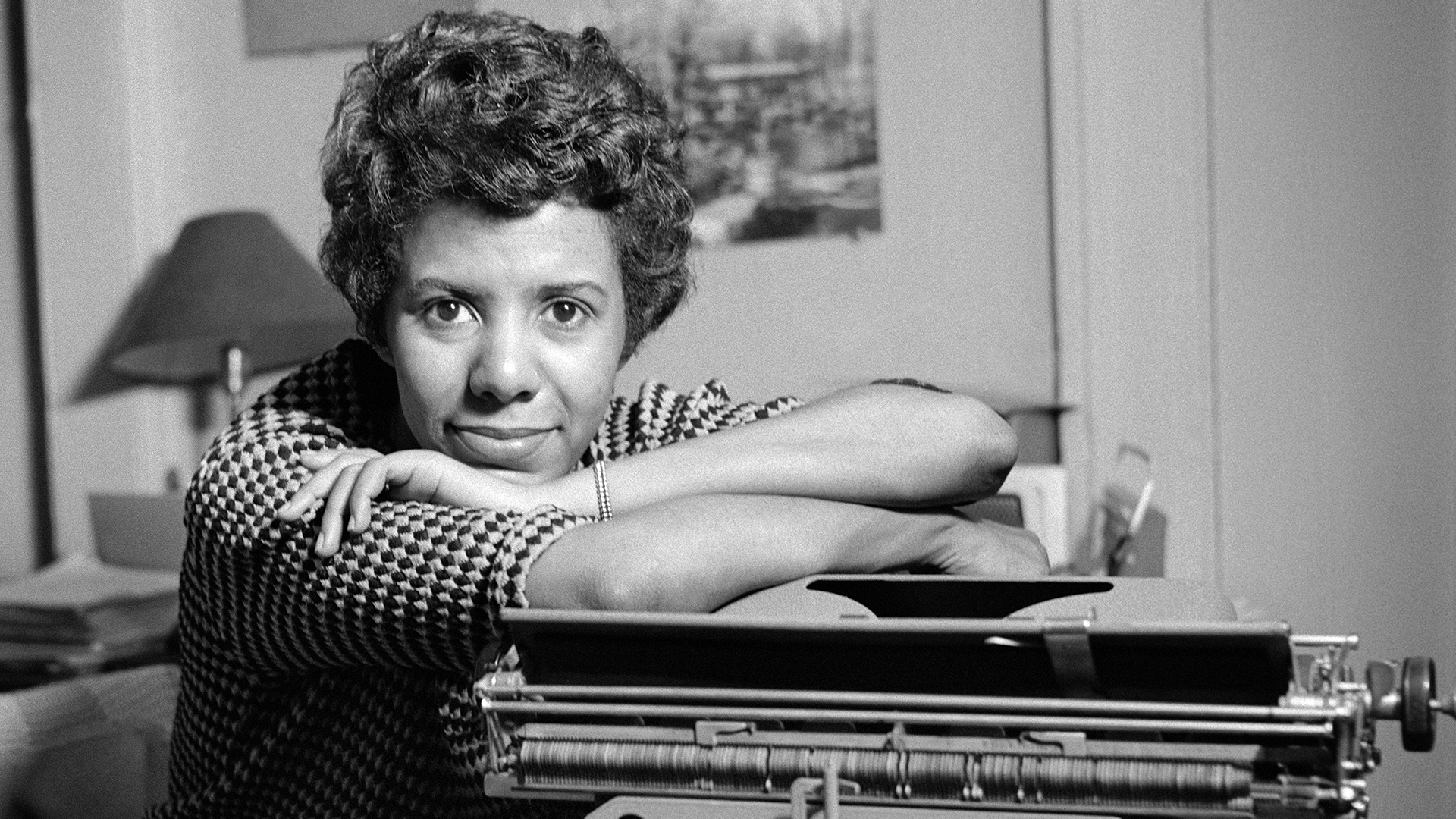 Above sweet Lorraine Hansberry (1930-1965), playwright, author of the seminal American stage drama,
  Above: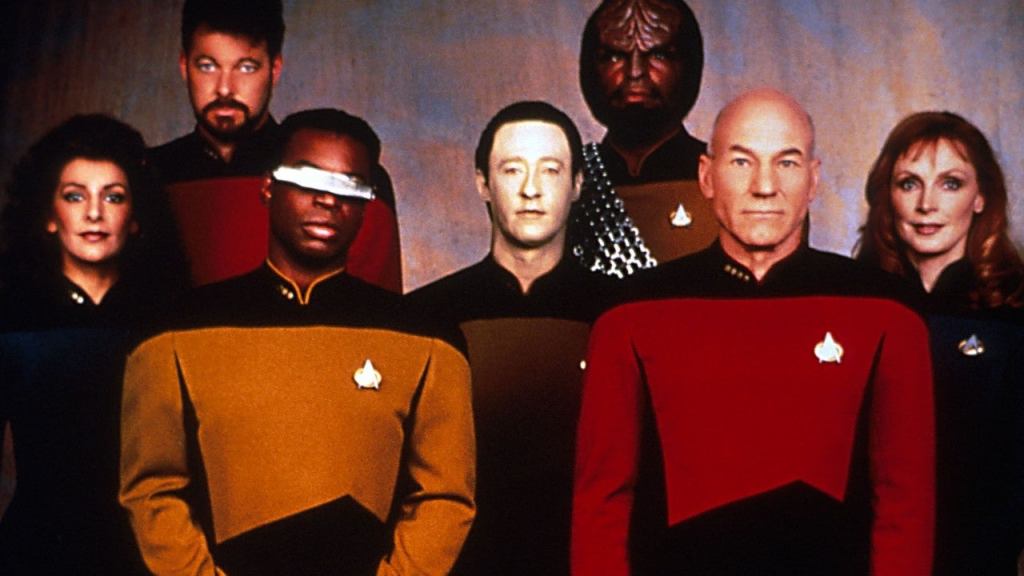
 Above
Above 
 Above Missi Pyle, Tony Shalhoub, Tim Allen, Alan Rickman, Ted Rees, Sigourney Weaver, Sam Rockwell, and Darryl Mitchell:
  "I'll Be Dead Before You Break My Heart"