My First Music: Catholics Surrounded by Lutherans and Some Conducting by John Wilson, BBC Proms 2013

On this day, 25 May, 2018—what would have been my dad’s 113th birthday—I’d like to remember one of the few times he and I actually went to the movies together. This time we went to see, first-run, the warrior epic Taras Bulba (United Artists, 1962; screenplay by blacklisted writer Waldo Salt) on the recommendation of my girlfriend Tamara’s mother, who emigrated from Lviv after the war and was a booster for All Things Ukrainian. (A survivor of Axis bombingsshe had that in common with my mom.) Our Minneapolis neighborhood was made up mostly of first- and second-generation Ukrainians, Italians, Guatemalans, Poles, Irish, and of course Filipinos, Catholics all. Of course the Lutherans surrounded us but being mostly Swedes, they had their own heritage too. And at Christmas, all that pepparkakor…num.

As for Franz Waxman’s “Ride of the Cossacks, there’s a rather thrilling ostinato toward the end.

A pretty inspired choice for your Proms, John. It isn’t played too often (there’s more Ben Hur out there than Taras Bulba); my guess is because most conductors just can’t hear the “kinetic” qualities in this piece of music or they interpret it as more “memetic”, and so what comes out when they conduct sounds just awful, artificial… But you, my bonny lad, got it right. I’m starting to recognize your ear more and more, and it’s a wondrous thing.
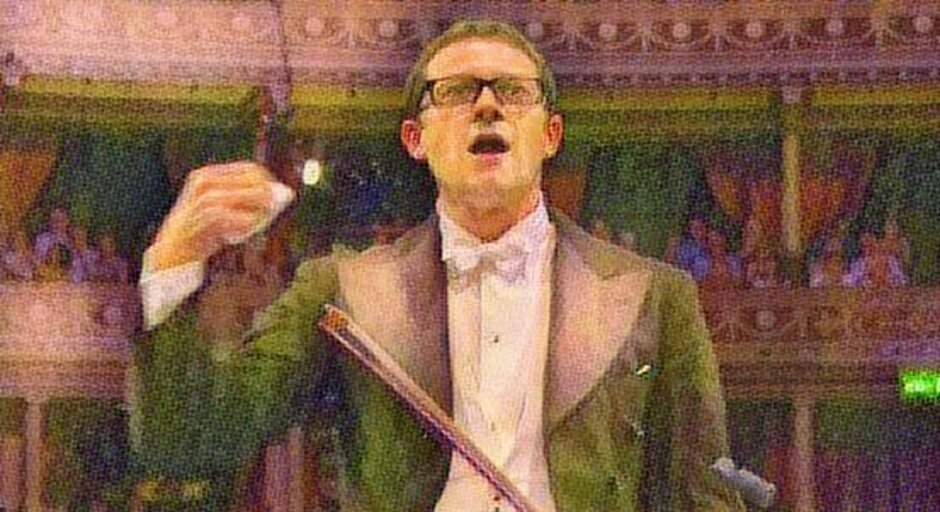

John Wilson Taras BulbaWishing you two clean and ready handkerchiefs every concert day, John.


FULL DRESS // A gifted mesmerist—a sinister composer—a naive young conductor from the north…inspired by an episode from the life of Rachmaninoff // DOWNLOAD FREE BOOK POSTER

The Hollywood String Quartet and the Hollywood Sound

John’s striving for “The Hollywood Sound” may be a new thing for his popular audience in England, but over here it’s been part of our musical history since before the Second World War. In 1939 violinist Felix Slatkin and his wife, cellist Eleanor Aller Slatkin, founded the Hollywood String Quartet. Their uniquely American style of playing strings quickly won the HSQ recognition and praise from critics around the world when they essayed works from the Classic Repertoire.

Said the Gramophone Classical Music Guide of their 1951 recording of Arnold Schoenberg‘s piece: “This was the first ever recording of ‘Verklärte Nacht‘ in its original sextet form and it remains unsurpassed.”

Hollywood String Quartet

In the liner notes of one of their other recordings, Paul Shure remembered: “Dynamics were a very big part of our work. Our discussions were always about dynamics and a little bit about tempi, and nothing else. We played with vibrato except where there was a particular effect to be had—no dead left hands were allowed.” This sounds so similar to what JWO concertmaster John Mills said in the web series Sarah’s Music: “John asks us, the strings, to play with so much vibrato that people’s family photos should fall off the TV sets. We’re effectively trying to recreate the sound of the studio orchestra.”


FULL DRESS // A gifted mesmerist—a sinister composer—a naive young conductor from the north…inspired by an episode from the life of Rachmaninoff // DOWNLOAD FREE BOOK POSTER

Obsession, Directed by Brian De Palma and Scored by Bernard Herrmann

Saw this first run in New York in 1976 with my boyfriend, another huge Brian De Palma fan. The loopiest, nuttiest romance in all of moviedom. In fact I like this movie better than Vertigo, another nutzoid Bernard Herrmann-scored love story: this one’s much more sexually transgressive, always a sure-fire turn-on for me.


Here’s the giddily overwrought ending. If you haven’t seen Obsession it’s not going to make any sense, so just close your eyes and listen to Herrmann’s ravishing score, the next-to-last one he ever wrote before his death at the age of 64.


FULL DRESS // A gifted mesmerist—a sinister composer—a naive young conductor from the north…inspired by an episode from the life of Rachmaninoff // DOWNLOAD FREE BOOK POSTER