Schelomo by Ernest Bloch, Played by George Neikrug (1919 – 2019) and the Symphony of the Air, Conducted by Leopold Stokowski

Counted among one of the greatest cellists in the Golden Age of String Players, George Neikrug has died, the day after turning 100.

Born in New York, at age 24, Neikrug met D.C. Dounis, a Greek pedagogue, whose revolutionary approach had a profound influence on the young cellist. “Trying to tell you about Dounis’s teaching is like asking me to tell you about a whole science like biology,” Neikrug said. “Dounis put very much emphasis on the most basic things I did like how I played a down bow and an up bow. He would show me how to play a down bow and an up bow and then I would play through a whole piece and he would sit there and practise with me. If he caught me doing one thing wrong I’d have to do it over again so I learned this tremendous amount of concentration…”

It was thanks to his studies with Dounis that Neikrug resolved to devote his life to teaching at schools including Detmold, Oberlin, the University of Texas-Austin and Boston University, whose arts faculty he joined in 1971.

In 1960, Neikrug performed “Schelomo: Rhapsodie Hébraïque“, the final work in Swiss composer Ernest Bloch’s 1916 Jewish Cycle.  with the NBC Symphony at Carnegie Hall and Leopold Stokowski, who described the cellist’s performance as “unforgettable”.
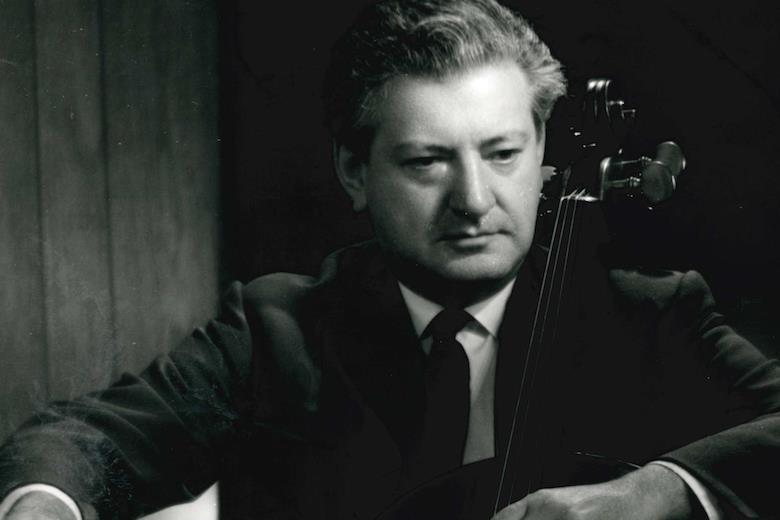
George NeikrugPart 1 “Schelomo” [duration 9:46] / Part 2 “Schelomo” [duration 11:49]

Thanks to old friend, violist Vivi Erickson, for remembering her former Boston University teacher for me.


FULL DRESS // A gifted mesmerist—a sinister composer—a naive young conductor from the north…inspired by an episode from the life of Rachmaninoff // DOWNLOAD FREE BOOK POSTER

A Rodgers & Hammerstein Moment 3: Jack Benny Plays “Getting to Know You” with Giselle MacKenzie

jack-benny-giselle-mackenzie.jpegReally you mooks, in case you miss it below, HERE’s the clip on YT.

The audience didn’t even need the words to get the humor in this bit, so well-known is this song from The King and I (Broadway 1951, film 1956). From somewhere in the mid-50s on Jack’s TV show.


FULL DRESS // A gifted mesmerist—a sinister composer—a naive young conductor from the north…inspired by an episode from the life of Rachmaninoff // DOWNLOAD FREE BOOK POSTER

The Hollywood String Quartet and the Hollywood Sound

John’s striving for “The Hollywood Sound” may be a new thing for his popular audience in England, but over here it’s been part of our musical history since before the Second World War. In 1939 violinist Felix Slatkin and his wife, cellist Eleanor Aller Slatkin, founded the Hollywood String Quartet. Their uniquely American style of playing strings quickly won the HSQ recognition and praise from critics around the world when they essayed works from the Classic Repertoire.

Said the Gramophone Classical Music Guide of their 1951 recording of Arnold Schoenberg‘s piece: “This was the first ever recording of ‘Verklärte Nacht‘ in its original sextet form and it remains unsurpassed.”

Hollywood String Quartet

In the liner notes of one of their other recordings, Paul Shure remembered: “Dynamics were a very big part of our work. Our discussions were always about dynamics and a little bit about tempi, and nothing else. We played with vibrato except where there was a particular effect to be had—no dead left hands were allowed.” This sounds so similar to what JWO concertmaster John Mills said in the web series Sarah’s Music: “John asks us, the strings, to play with so much vibrato that people’s family photos should fall off the TV sets. We’re effectively trying to recreate the sound of the studio orchestra.”


FULL DRESS // A gifted mesmerist—a sinister composer—a naive young conductor from the north…inspired by an episode from the life of Rachmaninoff // DOWNLOAD FREE BOOK POSTER