In an episode of this television series (available on my YT channel here), originally broadcast exclusively in New York City, Sondheim speaks before a workshop of NYC high school students, discussing the genesis of such songs as “Small World”, “I Feel Pretty”, and “One Hand, One Heart,” which are performed by Martha Wright and Ralph Curtis.
This show also includes question and answer period with Irwin Kostal, arranger and conductor for West Side Story. Hosted by Earl Wrightson. Produced by Ned Cramer. Directed by Neal Finn.
- Everything’s Coming Up Roses – The CBS Orchestra
- Small World – Martha Wright
- Maria – Ralph Curtis
- I Feel Pretty – Martha Wright
- Tonight (Balcony Scene) – Ralph Curtis and Martha Wright
- One Hand, One Heart – Ralph Curtis and Martha Wright
- Mambo – The CBS Orchestra
- Cool (Fugue) – The CBS Orchestra
- Everything’s Coming Up Roses (reprise) – The CBS Orchestra
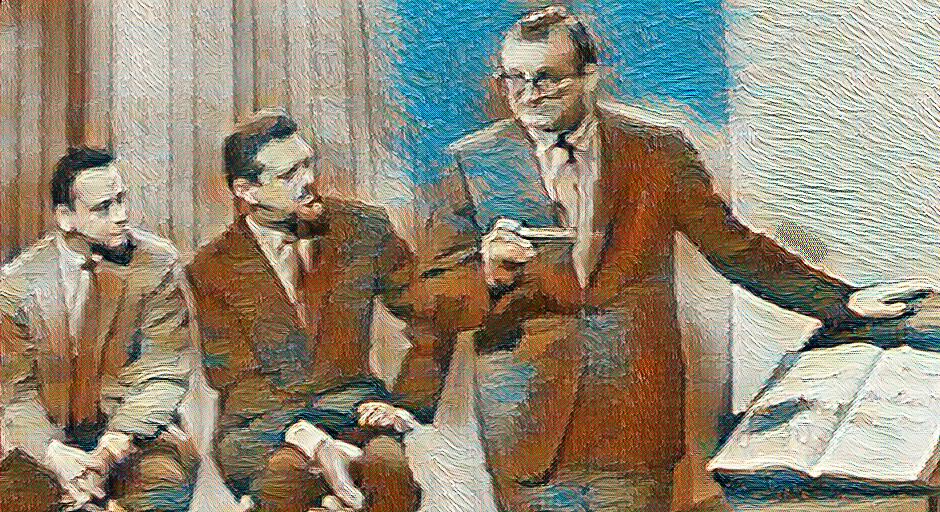 Above: Lyricist-Composer Stephen Sondheim, Baritone/Host Earl Wrightson, Orchestrator-Conductor Irwin Kostal. Again, here’s the clip on YT that provides a rare glimpse into the creative life of Sondheim and Kostal.
Here’s an excerpt transcription:
Mr Kostal, what is the difference between an orchestrator and an arranger?
It refers specifically to what you find on the music. When a composer composes a piece of music, we hope that it’s a complete piece of music, and when a man like Mr Bernstein composes the music (short laugh) it is. So all you do, you just discuss with him what he’d like to hear, flutes, violins…and you follow exactly what is written on the paper. This is what I call orchestration. Now, I get to do very little of that kind of work…because nowadays composers don’t bother with too much detail…
Steve [Sondheim] here is the kind of man we need because he’s studying music, and believe me that is a rarity on Broadway, because most composers don’t… At one time in history, composers actually did their own orchestration. They had the time in those days…but also, they could do it. For instance, Victor Herbert was a tremendous orchestrator. On one television show I did recently I actually used Mr Herbert’s scores as he wrote them in 1916—I couldn’t do ‘em any better. He knew what he was doing. Kurt Weill was the last one to do this. George Gershwin never did it on Broadway, but he—after he became a successful songwriter—studied music and learned how to orchestrate so that by the time he did Porgy and Bess he was able to do a very good job on the orchestrations.
Now, in arranging—if the composer does not do his job properly, the orchestrator has to come in and finish the job for him. Now, you’d be surprised how many times I do Broadway shows where I get roughly a one-line melody, a lead sheet, and I have to add the bass line, the harmony, the chords, and if it goes on for four minutes or a routine I have to think of things for the flutes to play and the violins to play etcetera, and it becomes a hefty job and I really feel like I am a composer’s partner when I do this*… You know, the more you do of this sort of work, the less the composer likes it. Because he’s kind of mad at you because he didn’t do it himself, I think anyway. And it serves him right. He should do it himself. I think he should go to school himself and learn. We have too many lead sheets—sure, the melody is the most important thing in music, but too many of our composers have decided to write only the melody. They have separated melody from music. Now, the art of melody writing is not a separate art from music, it’s a part of music. And when they have written this top line and leave the rest to me, they’ve got to be dissatisfied because they didn’t do it themselves. Let them get down to their business and go to school and learn to write!
[*I wonder who’s he’s talking about. Shinbone Alley’s George Kleinsinger? Fiorello’s Jerry Bock? Surely not The Music Man’s Meredith Willson—Willson went to Juilliard.]
FULL DRESS // A gifted mesmerist—a sinister composer—a naive young conductor from the north…inspired by an episode from the life of Rachmaninoff // DOWNLOAD FREE BOOK POSTER
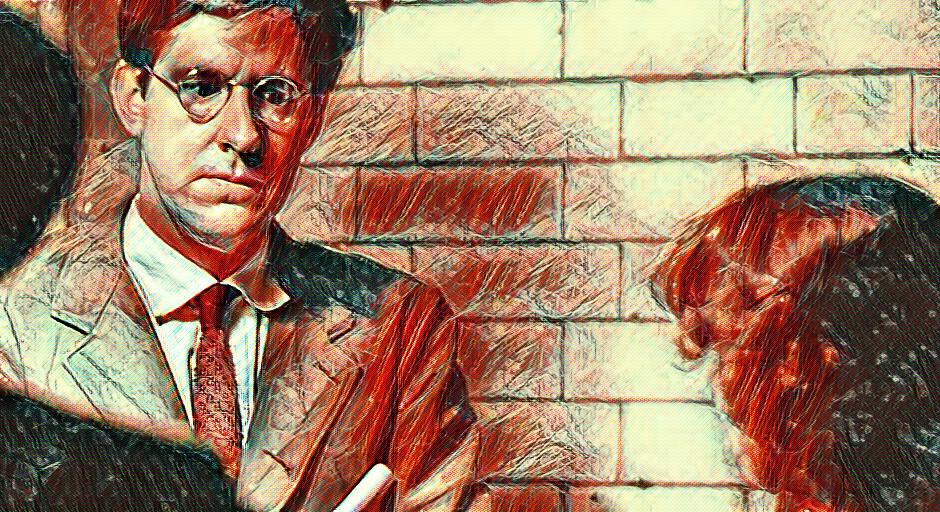
 Above Carol and Bronson: Jason Alexander and LA cast sing
  "I'll Be Dead Before You Break My Heart"