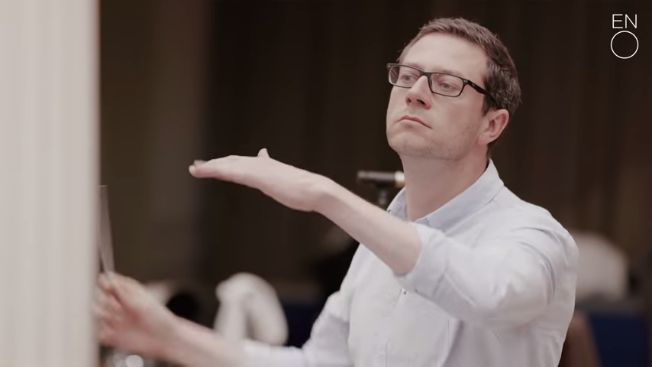
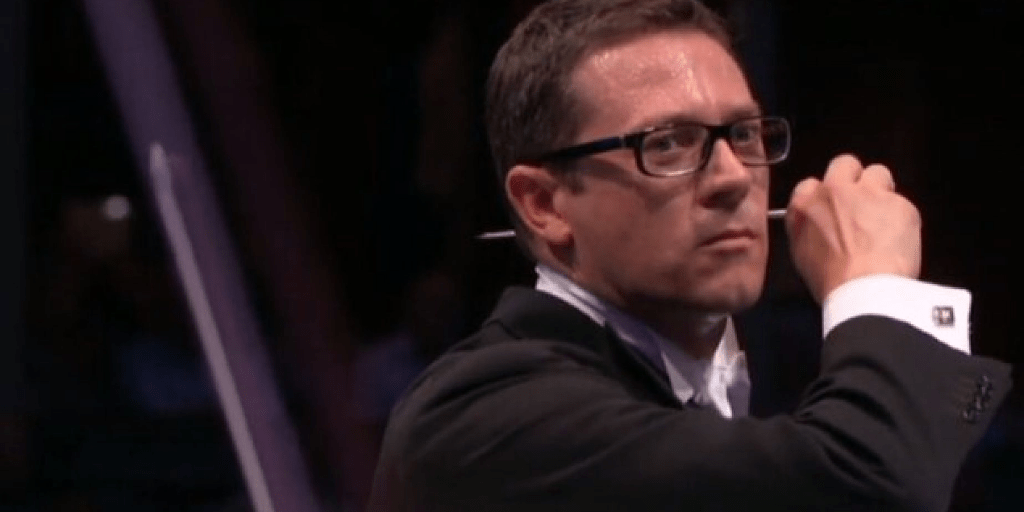
John Wilson Interview (with Music!) at the BBC Studios in Salford, 12 November 2018

“I think I’ve done my last batch of film music,” says bonny John. Interview starts at 9:50. (Update 5 March 2019: Damn, the Beeb yanked this podcast! Will replace the link if they ever bring it back. To make up for it below are some downloadables.)

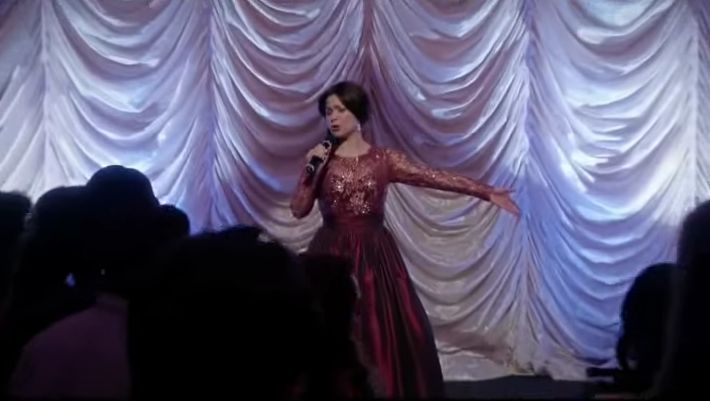
Included with the interview in their entirety: Met soprano Joyce DiDonato sings “You’ll Never Walk Alone” (Rodgers & Hammerstein); the famous barn-raising dance in Seven Brides for Seven Brothers (Gene de Paul, Alexander Courage), and “I Got Rhythm” (George and Ira Gershwin), all played in that ineluctable John Wilson Orchestra way.

John Wilson Working Bloodily HardAbove bloodily hardworking John: Kim Criswell, the Maida Vale Singers and The John Wilson Orchestra tear into the Gershwin brothers’ “I Got Rhythm”.


From a 15 June 2016 article in The Sydney Morning Herald:

It’s rare, if ever, to hear a kind word said about James T Aubrey, the ruthless former CBS executive hired in 1969 to turn around the stuttering fortunes of the MGM movie studio. In a four-year reign he slashed staff numbers, cancelled many projects and sold off the company’s archive in a sale that, famously, included Judy Garland’s iconic ruby slippers from The Wizard of Oz.

“They had no intrinsic value,” was Aubrey’s icy comment at the time.

And along with that brutal act, incredibly, he also ordered the destruction of many of the film scores in the company’s archive, trashing music from legendary films including The Wizard of Oz, High Society and Singin’ In the Rain.

These gems might have been lost forever were it not for the passion and dedication of English conductor John Wilson, who for the past 15 years has dedicated much of his time to re-creating them.

Now he has re-scored some 200 separate numbers from MGM musicals from the 1930s to the early ’60s purely by ear, a task he was driven to largely out of necessity—he loves the music and wanted his orchestra, the John Wilson Orchestra, to play it.

“I had to do it,” he says simply.

He’s also quite frank about the tedium of minutely reconstructing each part.
“First and foremost, I’m a conductor—it’s all I do really,” he says. “I don’t like writing music out but I have to. It’s a pain in the arse! It’s hours of toil.

“I do love hearing it back—I only do the numbers I think are really sensational—but sitting listening to four seconds of music on a loop for half an hour just to get one bass clarinet part—is that going to be anything other than just necessary?”

One might then expect Wilson to join the chorus of Aubrey critics but he is surprisingly generous towards the man who presented him with a lifetime’s work.

“It would be easy to say James Aubrey was a vandal but I think there were a lot of people around then who had no idea that this was worth keeping,” he says.

The pace at which the studio system turned out films left little time for those involved to consider their longer term significance.

“If you had said to anyone in the 1930s that what they were creating was art they would have laughed at you,” says Wilson. “It was entertainment designed to make a profit. Nobody was archively minded. A lot of the scores were an unfortunate casualty of that prevailing attitude. It would have been a case of, ‘Who wants a load of old crumbly pages’?”

Wilson’s passion for “good quality light music” sprang from listening to the TV and radio when he was growing up in Gateshead in the 1970s-80s.

After an extensive apprenticeship playing piano, arranging music and conducting for amateur dramatics, pantomimes and other productions he went on to study in London.

“By the time I arrived at the Royal College of Music at 18 I was fairly hands-on and practical,” he says. “There were never any divisions for me between David Raksin, Max Steiner and Erich Korngold and Strauss, Mozart and Brahms.”

Now he is working alongside his long-time friend and collaborator, Sydney Symphony Orchestra co-concertmaster Andrew Haveron, bringing his favourite light music to Sydney audiences.

Haveron has led the John Wilson Orchestra since its inception.

“Andrew knows how to play this music better than anyone on the planet. That’s a real game changer,” says Wilson.

On a program that also includes music from Citizen Kane, Gone With The Wind and Star Wars will be Erich Korngold’s music for 1938’s The Adventures of Robin Hood, starring Errol Flynn.

Wilson’s face lights up. “It is,” he says, “the greatest movie score that has ever been written. I never get past how impressive it is.”

FULL DRESS // A gifted mesmerist—a sinister composer—a naive young conductor from the north…inspired by an episode from the life of Rachmaninoff // DOWNLOAD FREE BOOK POSTER

Joan Diener Sings “Pourquoi fait-il toutes ces choses” from Man of la Mancha, 1968

Three years after Man of La Mancha was a major hit on Broadway, Belgian music legend Jacques Brel licensed the staging rights, adapted the book, translated the lyrics, directed the production, and starred as Don Quixote with the original Dulcinea herself, Joan Diener.

Man of La Mancha

Here’s a song that’ll tear your heart out (English lyrics by Joe Darion; music by Paul Hindemith-trained Mitch Leigh; French lyrics by Jacques Brel):

Pourquoi fait-il toutes ces choses?


FULL DRESS // A gifted mesmerist—a sinister composer—a naive young conductor from the north…inspired by an episode from the life of Rachmaninoff // DOWNLOAD FREE BOOK POSTER

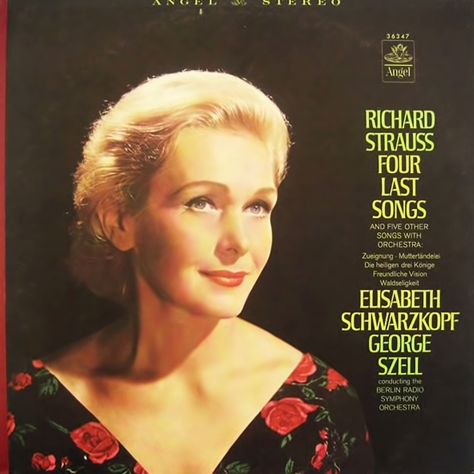
Four Last Songs by Richard Strauss: Elisabeth Schwarzkopf, Soprano, with George Szell Conducting the Berlin Radio Symphony Orchestra

The Four Last Songs are “Frühling” (Spring), “September”, “Beim Schlafengehen” (When Falling Asleep) and “Im Abendrot” (At Sunset). All of the songs but “Frühling” deal with death and all were written shortly before Strauss himself died. They are suffused with a sense of calm, acceptance, and completeness. The settings are for a solo soprano voice given soaring melodies against a full orchestra, and all four songs have prominent horn parts. The combination of a beautiful vocal line with supportive horn accompaniment references Strauss’s own life: His wife Pauline de Ahna was a famous soprano and his father Franz Strauss a professional horn player.

schwarzkopf-last-songs-strauss.jpeg

My beloved John Wilson lived in this ravishing music when he conducted the Swedish Radio Symphony Orchestra late in March 2019, in a program that included Korngold and the Emperor Waltz.


FULL DRESS // A gifted mesmerist—a sinister composer—a naive young conductor from the north…inspired by an episode from the life of Rachmaninoff // DOWNLOAD FREE BOOK POSTER

Joan Sutherland Sings “When William, at Eve” by Composer William Shield, Local Swalwell Lad Made Good

From November 2018: There’s a memorial cross in the churchyard of St Mary the Virgin, Church Clare, Whickham, in memory of the composer William Shield, one of Gateshead’s most illustrious sons.

Dame Joan was the one who got me interested in classical singing, if not doing it myself then listening to and appreciating it. This really tasty ditty comes from the pen of William Shield of Swalwell (which is right next door to my bonny John Wilson‘s childhood neighborhood of Low Fell), Gateshead, who rose to be the king’s Master of the Musicians and was buried in Westminster. “When William, at Eve” is from his comic opera Rosina (1782).

Shield was born in the village of Swalwell on 5 March 1748 and baptized in this church. The house in which he was born, opposite the Three Tuns pub (now in Low Fell), was demolished in 1936. Apprenticed to a boat builder, Shield studied music with Newcastle-born composer and church organist, Charles Avison (1709-1770), was heard playing violin by Italian composer and violinist Felice Giardini (1716-1796) and encouraged to take up music professionally.

On Giardini’s invitation, he became a member of the Italian Opera (aka The Haymarket Opera House / His Majesty’s Theatre) in London and one of London’s leading viola players. He was also a friend of Haydn. He wrote many successful pieces and songs, and in 1817 was appointed Master of the King’s Musick.

Shield’s main claim to fame, however, is that it has now been proven he wrote the tune of “Auld Lang Syne”. It was supposed that Robert Burns, who wrote the words, had also written the music, basing it on a folk song. Indeed, Burns claimed to have written it in 1788, inspired by a man singing in a pub. Recent research shows, however, that the tune comes from the Overture to Rosina, a music drama written by Shield five years earlier.

The original score for Rosina is in Gateshead Central Public Library. He also provided the music for another Burns song: “Comin’ Thro the Rye”. Shield died at his home in Berners Street on 25 January 1829 and is buried in Westminster Abbey.

~ from The Classical Map of Musical Britain by Richard Fawkes


FULL DRESS // A gifted mesmerist—a sinister composer—a naive young conductor from the north…inspired by an episode from the life of Rachmaninoff // DOWNLOAD FREE BOOK POSTER

Two “Summertimes” from The Gershwins’ Porgy and Bess, One Conducted by John Wilson, 2018

…The other conducted by John Mauceri in 2006 with the Nashville Symphony & Chorus, in a production based (in part) on the original score markings of composer George Gershwin:

“For those who are familiar with the score, the very opening will seem slower. It is clear from Gershwin’s metronome markings and from the articulations in the orchestral parts that he intended the opening to be moderately fast (marked ‘Risoluto e Ben Marcato’ in the composer’s hand), exposing its inner syncopation and then accelerating. ‘Summertime’ is faster than we are accustomed. It is not a sad song, after all, and ‘A Woman is a Sometime Thing’ is slower. In fact, these two ‘lullabies’ by the mother and the father of their nameless child, are at the same metronome marking. In other words, Gershwin wanted to link the daddy and the mommy to each other by the speed of their music, even if their words and styles are quite (humorously) different.” On Porgy & Bess ©John Mauceri

john-wilson-conducts-porgy-and-bess

Anthony Tommasini in his New York Times review of the English National Opera’s production of Porgy and Bess described my bonny as the “excellent John Wilson, who led a performance that had sweep, shape and vitality, as well as rarer qualities: precision and restraint”. Here’s our John from this past summer rehearsing “Summertime“. Performances of ENO’s Porgy and Bess run to 17 November.

More about Gershwin and Porgy & Bess:


FULL DRESS // A gifted mesmerist—a sinister composer—a naive young conductor from the north…inspired by an episode from the life of Rachmaninoff // DOWNLOAD FREE BOOK POSTER

Lea Salonga Sings “In One Indescribable Instant” from Crazy Ex-Girlfriend by Rachel Bloom, Jack Dolgen and Adam Schlesinger

Why yes, I am a Crazy Ex-Girlfriend fan, and thank you for asking.

Lea Salonga Crazy Ex-Girlfriend.jpeg

Season 1, episode 18, 2016. Lea Salonga, as heroine Rebecca Bunch’s object of romantic desire Josh Chan’s singing-star aunt, sings a lovely but so over the top Disney Princess Song. This is before all hell breaks loose in seasons 2 and 3.


FULL DRESS // A gifted mesmerist—a sinister composer—a naive young conductor from the north…inspired by an episode from the life of Rachmaninoff // DOWNLOAD FREE BOOK POSTER

“Chanson de Maxence” from Les Demoiselles de Rochefort by Jacques Demy and Michel Legrand, Sung by Anne Sofie von Otter

Cleansing my aural memory of John Wilson’s recording of Legrand’s “Chanson de Maxence” (in English clumsily rendered as “You Must Believe in Spring” or some such) in his awful 2000 album, Orchestral Jazz, with Anne Sofie van Otter‘s 2010 version (Brad Mehldau, pianist). Bonny John conducts his eponymous orchestra in an arrangement by Richard Rodney Bennett, who had absolutely no feel for this song. With such a strong melody (reminiscent of Fauré) and strong lyrics, all it needs is a strong emotive singer and a backup piano. I note with some distress that John himself did some other arrangements in this album, particularly for “Miss Otis Regrets”. With no lyrics! What the hell good is such a hilarious song without the words???

Je l'ai cherchée partout j'ai fait le tour du monde
De Venise à Java de Manille à Angkor
De Jeanne à Victoria de Vénus en Joconde
Je ne l'ai pas trouvée et je la cherche encore

Je ne connais rien de lui et pourtant je le vois
J'ai inventé son nom j'ai entendu sa voix
J'ai dessiné son corps et j'ai peint son visage
Son portrait et l'amour ne font plus qu'une image

Anne Sofie von OtterJohn and The JWO are okay, but just okay. I suppose when he was 28 my bonny’s loftiest ambition was to be the next Sidney Torch.


FULL DRESS // A gifted mesmerist—a sinister composer—a naive young conductor from the north…inspired by an episode from the life of Rachmaninoff // DOWNLOAD FREE BOOK POSTER

Julie and Carol at Carnegie Hall, 11 June 1962, Directed by Joe Hamilton and Written by Mike Nichols

This nine-minute medley sung by Julie Andrews and Carol Burnett, called “History of Musical Comedy”, is a variety-show tour de force enough for the first six minutes; then at 6:00 it rises to high art in the most affecting soprano duet in the repertoire of American lyric theater.

Julie and Carol at Caarnegie Hall 2.jpeg


FULL DRESS // A gifted mesmerist—a sinister composer—a naive young conductor from the north…inspired by an episode from the life of Rachmaninoff // DOWNLOAD FREE BOOK POSTER

The Music I Hear When I Gaze Upon Conductor John Wilson: “Glück das mir verblieb” from Erich Korngold’s Die tote Stadt, Sung by Beverly Sills

4 May, 2018. Everybody, go away. I’ve fallen in love with this man.

Glück, das mir verblieb,
rück zu mir, mein treues Lieb.
Abend sinkt im Hag
bist mir Licht und Tag.
Bange pochet Herz an Herz
Hoffnung schwingt sich himmelwärts.

Wie wahr, ein traurig Lied.
Das Lied vom treuen Lieb,
das sterben muss.

Ich kenne das Lied.
Ich hört es oft in jungen,
in schöneren Tagen.
Es hat noch eine Strophe—
weiß ich sie noch?

Naht auch Sorge trüb,
rück zu mir, mein treues Lieb.
Neig dein blaß Gesicht
Sterben trennt uns nicht.
Mußt du einmal von mir gehn,
glaub, es gibt ein Auferstehn.

FULL DRESS // A gifted mesmerist—a sinister composer—a naive young conductor from the north…inspired by an episode from the life of Rachmaninoff // DOWNLOAD FREE BOOK POSTER

Antoni Mendezona Sings “Awit ng Gabi ni Sisa” from the Opera Noli Me Tangere

Music by Felipe de Leon, libretto by Guillermo Tolentino. Noli Me Tangere is based on Dr. Jose Rizal’s 1887 classic novel of the same name. It follows the story of Juan Crisóstomo Ibarra y Magsalin, who returns home to the Philippines after pursuing scholarly studies in Europe. He plans to open a school and marry his sweetheart, Maria Clara (where we get the name of the dress I’d love to make and wear again), but Padre Damaso, arch-enemy of the Ibarras, sets out to thwart Crisostomo’s plans, creating the dramatic—and very operatic—storyline of forbidden love, betrayal, and revenge. “Awit ng Gabi ni Sisa” is one of the great soprano mad scenes in opera.

Awit ng Gabi ni Sisa from Noli Me Tangere (Felipe De Leon)

From the 2011 University of the Philippines production. Info on Cebuana coloratura Mendezona can be found at her website here.


FULL DRESS // A gifted mesmerist—a sinister composer—a naive young conductor from the north…inspired by an episode from the life of Rachmaninoff // DOWNLOAD FREE BOOK POSTER