We certainly all need some tenderness and a couple laughs right now. Below, the wonderful, luminous Molly Picon—who worked with legendary actor-producer-director-impressario-rival-to-Jacob-Adler-Stella’s-dad-model-for-Max-Bialystock-grandfather-of-Michael-Tilson-Thomas Boris Thomashevsky—sings “Oyfen Pripetchik” (MM Warshawsky 1848–1907), an enduring, evocative song from the past that everyone at a certain time, in a certain place, seems to have known the melody and all the words to. From season 2, episode 6 of the TV comedy masterpiece, Car 54, Where Are You? (Entire episode on my YT channel here. And really, dig the punch line ending.)
Below, a lovely rendition from Israeli singer Chava Alberstein.
Oyfn pripetchik brent a fayerl,
Un in shtub is heys.
Un der rebe lernt kleyne kinderlekh
Dem alef-beyz.

Zet zhe kinderlekh,
Gedenkt zhe, tayere, vos ir lernt do.
Zogt zhe nokh a mol un take nokh a mol:
"Komets-alef: o!"

Lernt kinderlekh, lernt mit freyd,
Lernt dem alef-beyz.
Gliklekh is der Yid, wos kent die toyre
Un dos alef-beyz.
Connection number one: The star of the classic TV show Frasier, Kelsey Grammer, starred in Man of La Mancha at the London Coliseum in 2019. His co-star in that show was popular British TV actor Nicholas Lyndhurst, who played his Sancho Panza and now plays his “old Oxford pal” on the new Frasier show. The Joe Darion-Dale Wasserman-Mitch Leigh stage musical was co-produced by venerable (and gorgeous then, gorgeous still and always) talent agent-turned-producer Michael Linnit, who gave me my first orgasm one July night in 1973 at the St Regis Hotel in New York City, New York.
Connection number two: Also in the cast of the Coliseum’s La Mancha was soprano Danielle de Niese. De Niese’s married to the chairman of the Glyndebourne Festival Opera. Just like late Met mezzo Maria Ewing who was also married to a bigwig (and not just any old bigwig but the hoity-toity SIR Peter Hall which made her a lady, Lady Hall), the ladies like John well enough. And he likes them well enough.
Oh, who am I kidding? Hold my jacket, Vinny. [more after dinner, making Romanian goulash…]
Okay, I’m back. The trick to making good Romanian goulash, by the way, is to let the carrots boil long enough to get soft as stew. Cheap paprika is fine to use but dump it in, it’s never strong enough for the recipe.
Now to fighting for the man I love. After satisfying myself thoroughly, body and soul, with that very lively fantasy (taking place—this is where it went in my head—on the Mean Streets of the Lower East Side—between Vinny the Sardine’s kid sister Teresa, a girl sporting a crucifix and a great right hook—and a bottle blonde puttana, calls herself Lolita) I need to point out John’s propensity for let’s say not being at one with his female singers.
I have here, case in point, a young one named Sierra Boggess in her rendering of that classic song of girl power we all sang while bounding youthfully down the street—from the BBC Proms, 2010: “I Have Confidence”. You stay and listen. I can’t even listen all the way to the end, John and his O just drown out pobrecita, who I have enough sympathy for already, as back in 2018 she had to play the fall guyin the BBC’s cockamamie plan to appear racially woke—while being able to stock their shows with free, unseasoned talent from the local inner city arts school (a very common tactic in the States) for that West Side Story debacle of theirs.
In fact, this subject is making me so mad I need to sweeten the moment—so I’ve decided to sic one of the girls on my darling… Which one will it be? Petula…? Dusty…? Okay, here’s a song by a particular girl singer I get a particular kick out of: side B of “To Sir, With Love”—Neil Diamond’s “The Boat That I Row” sung by Lulu! I’m singing this song dancing to your picture, mi amor.
Now, about the 2019 Cendrillon: At the intermission talk with Cendrillon‘s director Fiona Dunn, my beloved John Wilson, mezzo Kate Lindsey, and soprano Danielle de Niese, the topic of debate was, What should Prince Charming look like in the 21st century?
Says John to the lovelies pictured above: “I think having Prince Charming as Massenet stipulated, it fits beautifully within the whole kind of sonic picture of the whole thing. It’s not a piece that you could say fits on one musical plane, it’s got lots of colors. It’s one of the most colorful pieces he ever wrote… When I said I was doing this piece to people, they would say, Oh yeah, that’s a nice light sort of sweet little piece. It’s not a sweet little piece, it’s a big piece, there’s always another layer to get to and there’s always more detail to explore, always more depth every time. It’s not lightweight…”
EXTRA! The most John Wilsonish piece in Cendrillon.
“Marche des princesses” from Cendrillon, Act IV Jules Massenet, composer Academy of St Martin in the Fields Neville Marriner, conductor Capriccio, 1997
I was 17 and my voice was not going to get me to the Met, but I enjoyed singing to the tiny group that gathered on Friday afternoons in Room 204 of Northrup Auditorium at the U in Minneapolis. The month my draftee boyfriend Jesse got out of the army (May 1972, just before he joined the Black Panthers) my teacher lent me an album of Teresa Stich-Randall and I picked out this number to do. It’s not a hard piece to learn but whoa, that breath control… That I managed to make it to the very end with some grace is due to Bach’s blessing to singers—all that forward motion impels you. But the effort was worth it. What a high!
Bach composed BWV 51 during a period when he composed church cantatas only irregularly, some of them to complete his earlier cycles. Both the soprano part, which covers two octaves and requires a high C, and the solo trumpet part, which at times trades melodic lines with the soprano on an equal basis, are extremely virtuosic. The cantata is one of only four sacred cantatas that Bach wrote for a solo soprano. The first aria, “Jauchzet Gott in allen Landen” (“Exult in God in every land”), is in da capo form, with extended coloraturas. The theme, with a beginning in a triad fanfare, is well suited to the trumpet. It is first developed in a ritornello of the orchestra and then constantly worked in the soprano part. At least, that’s what I remember.
Here’s Stokowski, international maestro (and, like my beloved John Wilson, a graduate of the Royal College of Music) in my second favorite Deanna Durbin movie: 100 Men and a Girl. Directed by Henry Koster. Universal, 1937. Andre Previn‘s great-uncle Charles Previn, musical director, arranger, composer and conductor at Universal, won an Oscar for his score for 100 Men and a Girl. While at Universal, Previn accumulated over 225 films to his credit, including most of Deanna Durbin’s films.
The bass-baritone in the Bugs Bunny classic “Long-Haired Hare” (Warner Bros 1949), where the title of this posting comes from, is voiced by bass-baritone SF native (and, like my son, a former pupil at Mission High School) Nicolai Shutorev.
Mahler’s “Resurrection” was voted the fifth-greatest symphony of all time in a survey of conductors carried out by BBC Music Magazine. (I wonder if my beloved conductor John Wilson voted.)
Above Cebuana New York-based soprano Evelyn Mandac (b 1945), who remains one of my role models (listen to her float over the fifth movement), the only Filipino singer ever to play the Met: Mahler’s entire glorious second symphony.
Although now lauded as monuments of vision and creativity, in their time Mahler’s symphonies were occasionally reviled but more often dismissed as a conductor’s egotistical indulgence. A critic of the time called his work “one hour or more of the most painful musical torture” (and that assault was directed toward his lovely pastoral Symphony no. 4!). As late as 1952, a detractor still moaned that “an hour of masochistic aural flagellation, with all of its elephantine forms, fatuous mysticism and screaming hysteria … adds up to a sublimely ridiculous minus-zero.”
The problem wasn’t so much a matter of grasping Mahler’s musical style. As the culmination of the long line of Viennese symphonists, his ideas were firmly rooted in the conservative structures of Haydn, Mozart, Beethoven, Schubert and Bruckner. Rather, the challenge lay in its emotional premises. As critic Herbert Reid later posited, “Mahler sensed the imminent upheavals that were to shatter the rationality and optimism that had driven Western civilization up to World War I. His symphonies are spiritual quests that reflect a wholly modern ambivalence of joy and pain, faith and doubt, transcendence and perdition. Mahler was way ahead of his time. Only by the 1960s did his private anxieties at last become our own.”
The Resurrection was Mahler’s favorite symphony, which he led on many auspicious occasions, and it had the longest gestation of any of his works. The opening was completed in 1888 as “Totenfeier” (“Funeral Rites”), a stormy symphonic poem to bear the hero of Mahler’s recently-completed First Symphony to his grave, amid torment over the meaning of his life. The middle movements awaited Mahler’s summer vacation of 1893 and reflected his fascination with the same medieval folk poetry which provided the texts for most of his songs.
The first movement is hugely dramatic; according to Mahler’s own program notes it aims to convey nothing less than a search for the meaning of life. The second, representing long-forgotten pleasure, is a gentle, old-fashioned dance of lilting grace, yet challenged by creeping shadows. The third is a grotesque and wickedly sarcastic waltz, shot through with anguished outcries. The fourth is a child’s song, naïve and wistfully introspective.
And then comes the vast finale, which depicts the full terror and glory of a pagan last judgment and resurrection. It begins with a huge crash and progresses through episodes of hushed expectancy, quivering tension, funeral dirges, hopeful fanfares and fevered misgiving, culminating in a triumphant apocalyptic chorale, one of the most glorious and powerful climaxes in all of music. Mahler adds to the awesome wonder with extraordinary instrumental effects, including offstage brass, a massive battery of percussion and ultimately the sheer visceral excitement of the potent sound produced by hundreds of singers and players. ~ Peter Gutmann, Classical Notes
One of these is a true vocalise, sung by soprano Anna Moffo and conducted by the legendary Leopold Stokowski.
The other is a strictly instrumental vocalise (which is perfectly all right, Rachmaninoff wrote it for instruments, too) played by the Sinfonia of London, conducted by my bonny John Wilson.
By the way John, if it were in your power to enter the mind and body of any orchestra conductor who ever lived—while they were conducting a particular piece at a particular time and place—who would be that conductor? and what would be the piece, and where and when?
Recorded at the Duke’s Hall, Royal Academy of Music, 2 July 2021. Found the donation window, incidentally. Back in January, 2020 after we heard John conducting them in Tchaikowsky I said to Mister Grumble, ‘That was as good as any small-city orchestra in the US. I’d’ve paid cash money for this,’ and darned if the RAM didn’t just make my life a little easier. Here it is.
To continue from my earlier posting, “My Beloved John Wilson Appointed to the Henry Wood Chair of Conducting at the Royal Academy of Music and Conducts the RAMSO in Arnold Schoenberg’s ‘Verklärte Nacht’ (1899) at Snape Maltings, 6 June 2021”: We talked over beers, Mister Grumble and I, about John’s energy, among other things, a couple of weeks ago. After we toasted Bloomsday, he gave me his take on John and John’s music. Mister G isn’t as enamored of John Wilson’s enormous and varied repertoire—from Broadway tunes to Rachmaninoff to Turnage—as I am, but he has many good things to say about my beloved conductor’s basic character. I described to him (my angel baby is blind) how differently John looks and acts when he’s with the RAM, or the Sinfonia of London or the Royal Northern Sinfonia. Less tense, more in control, more in his element—happier. Plus he doesn’t sweat as much as on the stage of the Royal Albert. ‘Then this is where he belongs,’ said Mister Grumble.
More! THEMEThe Great Adventure (CBS, 1963) I remembered this theme note for note and was thrilled to find episodes of the series on YT again. Though I strongly suspect it was Richard Rodney Bennett who wrote this from his random notes
There are 3 naked ladies in this blog. This is one of them.
“I’m not given to displays of emotion, but when Maria and I met up again [to record the R&H album] we had tears in our eyes. She’s so exotic!” enthused my bonny conductor about this Detroit-born soprano. “I love her—as a person!” Yes, John. I’d love to hear more.
About the DVD recording of Salome, says Toronto blogger John Gilks in Opera Ramblings: “The production is really pretty conventional… Almost all the visual interest revolves around Ewing’s Salome though Michael Devlin’s scantily clad and palely made up Jochanaan is quite arresting too. Narraboth (Robin Legate) is an unremarkable actor and Herod (Kenneth Riegel) and Herodias (Gillian Knight) look uncomfortably like a couple of drag queens… The recording, directed by Derek Bailey, is about what one would expect from a 1992 BBC TV broadcast… This is probably worth having a look at as a record of an iconic performance by Ewing but I can’t imagine anyone would choose it as the definitive Salome.”
Here’s another exotic nude, just for my beloved John Wilson.
There were some particularly strong singers in the BBC Proms concert at the Royal Albert back in 2011 I take pleasure in remembering, on this gray Monday two days before The Inauguration. “Serenade” from The Student Prince was one of my mother’s favorite numbers, she just thrilled to it, especially when Mario Lanza was singing. “Can’t Help Singing” was in my Deanna Durbin Songbook when I was a teenager. “The Man That Got Away” was sung at my friend’s funeral—the friend who left me all his Andre Previn records—by his grieving lover. And then there’s “Secret Love”.
Gimadieva made her UK debut at the Proms with John and the John Wilson Orchestra in their program Hollywood Rhapsody, which included pieces by my favorite screen composer Bernard Herrmann. I’ve been a fairly knowledgeable fan of Herrmann since my teen years, but somehow I never got around to hearing the entire aria until—yes! yes! are you getting bored hearing this again?—I fell in love totally and completely with English conductor John Wilson and craved to hear all the music that he’s part of. To my delight, he backed this brilliant singer well.
Above my bonny John making nicey-nice with a soprano for once: “O cruel!” (Salammbo’s aria) from the film Citizen Kane. Herrmann planned to write an entire opera based on this scandalous Flaubert novel but, daunted by the task, as Mussorgsky and Rachmaninoff before him, never got around to it.
And for good measure, here’s Gimadieva doing Donizetti’s “O luce di quest anima” with The Hallé the way I’d like to have sounded in my last trimester jury at music school.
Disappointing to hear that John won’t be doing Britten’s The Turn of the Screw at Wilton’s Music Hall in London this month. So, to cheer everybody up, here’s the full 2-hour program of my John and The John Wilson Orchestra at the Proms, 2013. That’s Jane Monheit, John, and Matt Ford below.
SONG MEDLEY (YT): – “An Affair to Remember” (from the 1957 film; 20th Century Fox) / Harry Warren, Leo McCarey (the film’s director), Harold Damson – “Something’s Gotta Give” (from Daddy Long Legs; 20th Century Fox, 1955) / Johnny Mercer – “Young at Heart” (from the 1955 film; Warner Bros) / Johnny Richards, Carolyn Leigh – “It’s Magic” (from Romance On the High Seas; Warner Bros, 1948) / Jule Styne, Sammy Cahn – “The Tender Trap” (from the 1955 film; MGM) / Jimmy Van Heusen, Sammy Cahn – “My Foolish Heart” (from the 1949 film; Samuel Goldwyn/RKO) / Ned Washington, Victor Young – “Three Coins in the Fountain” (from the 1954 film; 20th Century Fox) / Jule Styne, Sammy Cahn – “Love is a Many-Splendored Thing” (from the 1955 film; 20th Century Fox) / Sammy Fain, Paul Francis Webster – “That’s Amore” (from The Caddy; Paramount, 1953) / Harry Warren, Jack Brooks – “Que Sera, Sera” (from The Man Who Knew Too Much; Paramount, 1956 / Jay Livingston, Ray Evans – “All the Way” (from The Joker is Wild, 1957; Paramount) / Jimmy Van Heusen, Sammy Cahn
A Place In the Sun (suite from the 1951 film; Paramount) / Franz Waxman
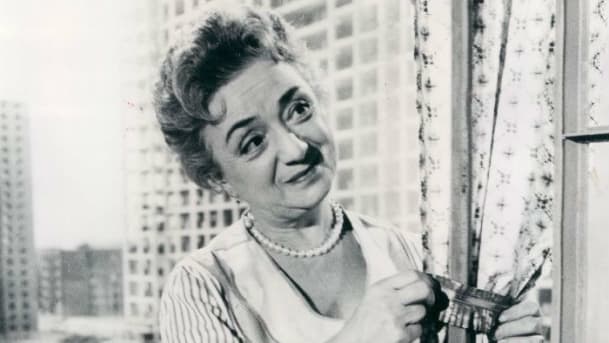 Could you say no to this woman?
 Above John at Glyndebourne, 2019:
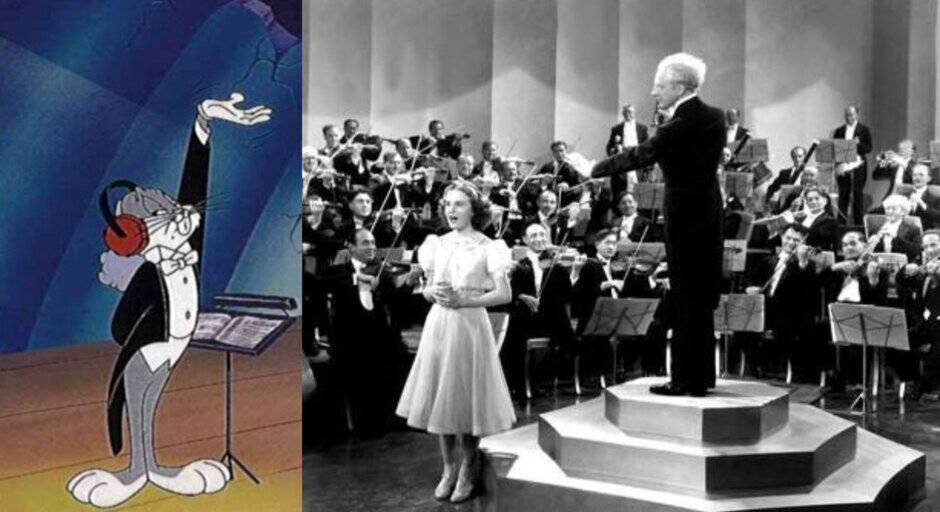
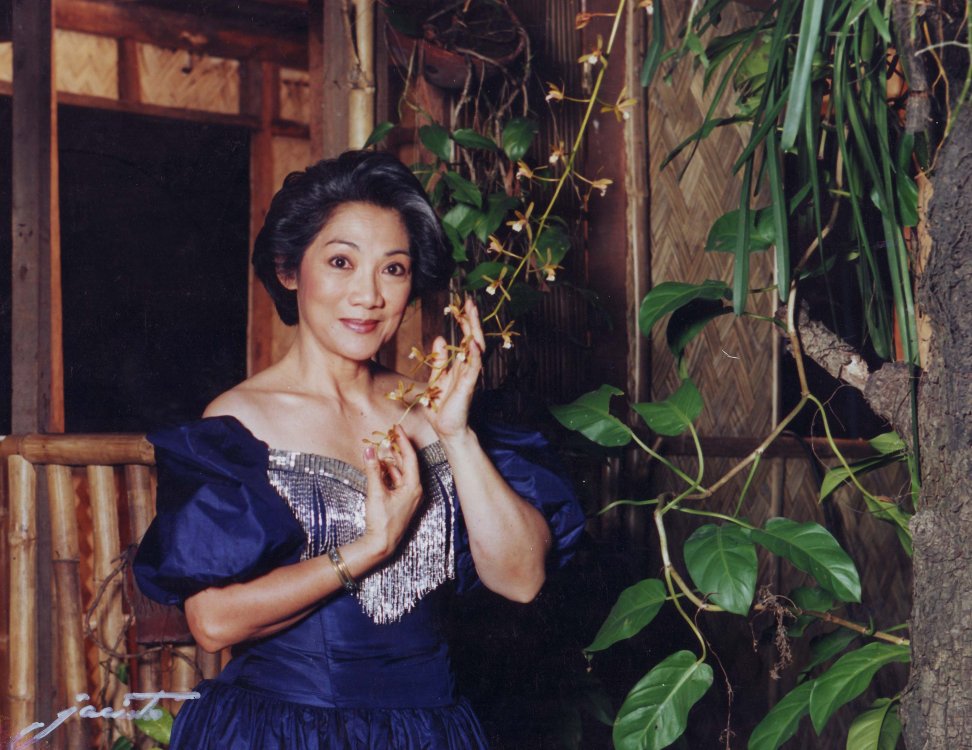 Above Cebuana New York-based soprano Evelyn Mandac (b 1945), who remains one of my role models (listen to her float over the fifth movement), the only Filipino singer ever to play the Met:
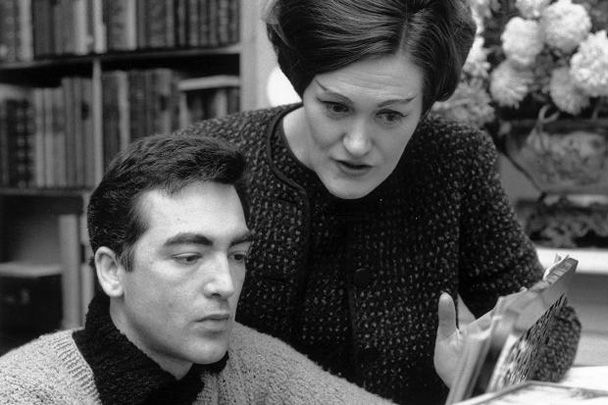 Australian-born conductor Richard Bonynge and soprano Joan Sutherland; they married in 1962.

 Above proudly nude Salome in the 1991 Covent Garden production of Richard Strauss’s 1905 opera directed by Ewing’s husband at the time, Sir Peter Hall:
 Above Dame Julie and her Prince Charming:
 Above my bonny John making nicey-nice with a soprano for once:
 "I'll Be Dead Before You Break My Heart"