From 1 June 2018: I dunno, watching 6 years of The Americans put me in an operational frame of mind…so I’ve been looking back at puzzling scenes and scenarios throughout my own life, trying to put the pieces together into recognizable shape…
Above: The Concertgebouw perform Dmitri Shostakovich’s fetching and popular Jazz Suite No 2 VI, Waltz IIcalled in our house “The Spies’ Waltz” because that’s what it sounds like
For example, that strange meeting in Loring Park under the statue of 19th century Norwegian violinist Ole Bull—was that really Mr Ray getting debriefed by a State Department/CIA guy? He always struck me as a little too European for our little Midwest hidey-hole (Minneapolis) anyway, not to mention his Russian was really, yummily good. Almost everything I know about Russia and the Russian language I first learned from Mr Ray and no one else, not even Mamoulian or Anthony Burgess.
I took Russian from Mr Ray for two years (1967-69), during which time: 1) I graduated from junior to senior high; 2) Mister Grumble was drafted, sent overseas and got shot at by the Ruskies; then halfway in 3) there were the assassinations of Martin and Bobby; and then to top it all off, 4) Richard Nixon finally gets elected president. Some ride, huh? I got in on some of the weirdness of that era, this is just one little piece.
NOTE: Yuri Nosenko was a false defector. The fact that he didn’t crack under three years of intense US interrogation satisfies me that he was a well-trained plant who was lying when he believed he was telling the truth / telling the truth when he believed his was lying. Thank you, KGB “doctors”. Why important? Philip and Elizabeth Jennings appeared on the scene the exact year he defected to America—1964. The year, too, my high school Russian teacher, Glen Herbertovich Ray (real name?) was debriefed after his own mysterious trip to the USSR.
This is still especially for John, my English darling, but also for anyone else who wants to read on and not give me flak for my conclusions. There is no more contentious, infighting body on the face of the earth than the Kennedy researchers, except for The Brontë Society.
Fortunately, I’m not a “Kennedy researcher”. But I remember the Friday lunchtime when President Kennedy was killed in Dallas, and initial memories turn out to be very important in reconstructing what really happened way back then. Even the memory of an eight year-old girl in 4th grade class 900 miles away counts.
So that Friday before Thanksgiving. Mrs Weisberg got a call and told us the President was dead and we went into the library to watch the TV coverage. Like a good police procedural, the suspect was apprehended almost right away, and after that all seemed to proceed as normally as a TV show: bad guy caught, law prevails, life back to normal, only normal+a little mourning (Oh, God! “Salute your father’s coffin, John-John”)+a new head of the country. Which was going to be the same country as always anyway, right?
What a different world that was then. What a bunch of saps those murdering thugs took us for.
But I want to talk about what I saw and heard in the first broadcasts, when the police and newspeople brought out Oswald and informed us that he was 24, an ex-Marine, from New Orleans, well-traveled, the father of two, with a foreign wife. (They got that info pretty fast, didn’t they. Within minutes. This before the internet. Talaga.) My kind of male? I was already interested in boys, I wanted to check him out.
He was strangely resolute in front of the camera. “Did you shoot the President and Officer Tippit?” demanded the newsman.
“No, I did not,” he replied firmly, and I was impressed by his looks, his composure, his educated, non-regionally-accented speech. The boys around me were gathering for a Hate Minute: Of course he did it! Otherwise he’d be jumping up and down hollering his innocence!
But at the age of eight-going-on-nine I had two weird revelations staring at that thin pale face.
One: He knows something.
Two: I’m probably going to marry a man like that.
So by golly, number two came true: A white southener, self-educated, self-composed, brilliant but secretive, an average-looking, average-sized man who could pass for thousands of other average men—
And—an operative of Army Intelligence. I’m looking at my blind bearded baby in front of me right now, grateful the Ruskies didn’t shoot him down on some wintry street in Prague in 1968.
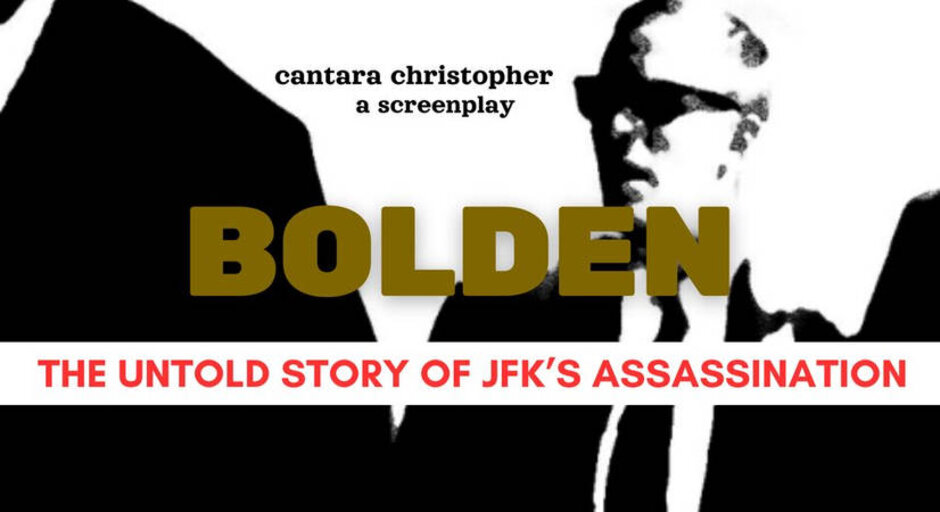
In Part Two I’ll talk about ex-friend Hollywood director Stephen Gyllenhaal, his shockingly idiotic, insulting, slightly treasonous project, and Abraham Bolden, for whom I wrote the screenplay, at his personal request, Bolden: The Untold Story of JFK’s Assassination.
There is a Meredith Willson-John Kennedy connection! It’s this peppy number, which was commissioned by President Kennedy for his Council on Physical Fitness for kids like us to do their daily school calisthenics to. Some people remember this number with affection, many don’t. Robert Preston sang it and the Warner Bros orchestra played it. It’s called “Chicken Fat”. Ten times!
With the coolest theme on American TV, The Equalizer introduced Copeland’s stunningly unique sound to the mainstream audience. In keeping with the series’ mash-up concept of “tradition merged with New Age high tech,” Copeland’s musical accompaniment would, one: with the exception of hero Robert McCall himself, forego the Wagnerian structure of identifiable leitmotifs, and instead choose to score the city of New York itself as a primary character; and, two: fuse classical structure with the combo of “percussion carrying melody and synthesized strings” attached to world rhythms. Copeland’s would be a coldly ethereal yet dense “urban ballet” sound inexorably linked to the modern cityscape. This sound would influence composers such as Hans Zimmer and Thomas Newman.
They shot several episodes in my old neighborhood, the East Village, at great risk to star Woodward (two heart attacks and once he fell through an apartment building roof–not ours thankfully). That’s 610 East 9th Street, where we lived 1981-86. Rent for our 4-room inc full kitchen and full bathroom, 2 bedrooms and 1 living room, facing street: $250/m. You read that right. $250 a month.
Copeland was born in 1952. The son of CIA officer Miles Copeland, Jr (who appears as a character in Norman Mailer’s epic spy novel Harlot’s Ghost), he took up the drums at 12, was raised internationally in Cairo, Beirut, the US and England; and throughout the 1970s alternately worked as road manager and backup drummer for various groups until founding in 1977, along with Sting and Henry Padovani (later replaced by Andy Summers), the English progressive rock band The Police. After The Police went on extended hiatus in 1986, the drummer with a composer’s sensibilities dove headlong into scoring—to this day, one of his most notable works is as musical voice of The Equalizer, on which he composed 51 of 88 total episodes of the series.
Most people* seem to discount the idea that Bernard Herrmann’s score for Psycho is actually a near-perfect work for strings (given that it was written exclusively for strings anyway) and that, given the right setting, is a very listenable chamber piece that doesn’t need to reference the film. Here’s the Tippett Quartet performing this arrangement by Richard Birchall at Kings Place, 2011.
John Mills, Jeremy Isaac, Lydia Lowndes-Northcott, and Bozidar Vukotic: the London-based Tippett Quartet.
* Like Mister Grumble. This is the second-most heated debate** between us: whether or not movie music (for narrative films not musicals) can be considered truly concert-worthy.
** (The most heated debate between us is whether Oswald did it or not. This one gets us both really het up, as one of us has a slight connection with the actual case.)
The leader of the Tippitt Quartet (circa 2011), John Mills, is also the leader of The John Wilson Orchestra to date.
I’m all right, Mister Grumble’s all right. We’ve lived through an East Village tenement fire, an armed coup d’etat attempt in South America and the San Francisco Earthquake of ‘89, so this [fill in current disaster] is nothing.
Ah, the coup. The coup—actually the attempted coup—was part of the CIA’s plan to oust popular Ecuadorian leftist president Rafael Correa by inciting the federal police in Quito to violently demonstrate for a pay raise. Normal TV broadcasts suspended, the government broke in on a rerun of Las Zuquillo, damn; on the phone the American Embassy told us not to worry, if the borders closed they’d send a car to fetch us; and we (the downstairs neighbors—Jewish Cuban refugees—and I, Mister Grumble having entirely lost his sight by then) spent the rest of the day watching for tanks to come rolling down the Autopista Rumiñahui, a major road into the city, which got Mister Grumble all reminiscent of the time in ’68 when Soviet tanks rolled down the streets of Prague, resulting in Army Intelligence sending him into Czechoslavakia. (His mission—which turned out fatal for everyone but my sweet baby—was declassified so I guess I can tell the story, but not now.)
But listen: Some weeks before the coup, while Mister Grumble was going blind, I was desperately looking for some entertainment we could both enjoy and found online BBC Radio on Demand—this was back in the days when there was Radio 4, Radio 4 Extra and Radio 7…now all gone. It was on, I think, 23 August 2010 they advertised on their news feed a live broadcast that evening of an all-Rodgers & Hammerstein concert at the Royal Albert Hall, to be headed by a “brilliant young conductor” named John Wilson. “The music of Rodgers & Hammerstein as you’ve never heard it before!” promised the Beeb. And oh, I was hungry for a little bit of America, of home.
“Do you want to hear it?” I called to Mister Grumble across our atypically vast living room.
“Where’s it coming from?”
“England,” I told him.
“Are you kidding!?” he answered with a derisive laugh. And that was that.

 They shot several episodes in my old neighborhood, the East Village, at great risk to star Woodward (two heart attacks and once he fell through an apartment building roof–not ours thankfully). That’s 610 East 9th Street, where we lived 1981-86. Rent for our 4-room inc full kitchen and full bathroom, 2 bedrooms and 1 living room, facing street: $250/m. You read that right. $250 a month.
 John Mills, Jeremy Isaac, Lydia Lowndes-Northcott, and Bozidar Vukotic: the London-based Tippett Quartet.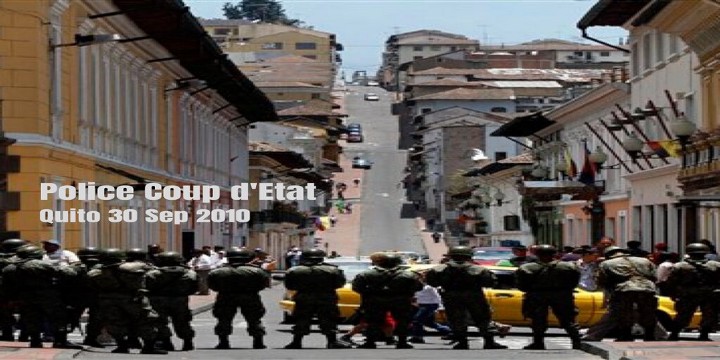
 "I'll Be Dead Before You Break My Heart"