From 2021: About 15 or so years ago, I was somebody’s plus-one on an industry pass to go to a preview of the showbiz biopic Beyond the Sea, which was being shown in a really good theater with an above-average sound system. I wasn’t a particular fan of Bobby Darin or even of Kevin Spacey (for all that he is the definitive Jamie Tyrone of our generation and frankly I don’t care about anything else); actually I just wanted to find out how cheesy the production could get. Well honestly, it did start off pretty cheesily, every element that should’ve contributed some genuine worth—like, you know, the lead acting, the directing, design, (makeup! prosthesis!) etc—was utter bad-phony, not good-phony, bullcrap…and then they struck up the soundtrack orchestra…
If I could’ve exclaimed “Holy mackerel!” out loud the moment that gorgeous snap hit my ears I would’ve exclaimed it out loud, but you don’t do that at an industry screening, so I exclaimed it in my mind. I hadn’t heard a commitment like that coming from a track orchestra in a very long time. This was no session, no pick-up crew, this was one tight unit, and they were hitting the musical values like nobody’s business. I vowed to remember the name of this bright new conductor-arranger—which of course I promptly forgot (There are a lot of John Wilsons in the world, as Anthony Burgess would be the first to tell you) and didn’t remember again until last May. Recorded by my darling and his O for the Warner Bros film at Pinewood Studios, 2003. A 2006 Grammy nominee in the Best Compilation Soundtrack Album for Motion Picture, Television or Other Visual Media category (composers Charles Trenet-Jack Lawrence, arranger Dick Behrke, producer Phil Ramone). Available on Rhino Records, that notorious niche label, and I really must find out who at Warners moved it to that catalog.
Since John’s management has long ago ditched his site johnwilsonconductor.com I went over to Bachtrack to find this info, and will probably end up going there and elsewhere evermore for more info on my bonny lad’s—w or w/o his Sinfonia of London—performances. (I also have John on Google Alert, plus I donate to the Royal College and the Royal Academy to get their email newsletters, plus I follow the Sinfonia and RTE on Facebook…plus if he’s scheduled to play movie music somewhere I can get that info from Juliet Rózsa…)
Know why I like this picture? ‘Cause there’s a devil face in the red vainly trying to get at my beloved through the impenetrable white light of my love. So there, John. I told you The Queen of Heaven had her eye on you
UPDATE! Some kind soul in the UK (probably my travelling writer friend Helen Ducal, and if it is you, Helen, thanks!) subscribed me a few days ago to the John Wilson & Sinfonia of London website, which promptly sent me the ballot ClassicFM put out for best classical recordings of 2023. So okay, I voted for his Vaughan Williams but NOT his compleat Oklahoma! out of respect for the memory of my old boss, Rouben Mamoulian, who John—prompted I’m sure by the BBC—saw fit to throw a little shade on when he conducted R&H back in 2010. (John’s still my guy, though. I’m sooo used to snarky artistic types.) So I’ll probably be getting the SoL schedule as they know it. But I still have to hunt up his other appearances.
The dates link to the ticket sites. The other highlights link to available recordings and YT appearances.
Sat 27 Jan 2024 19:30 Sheldonian Theatre Oxford, UK Oxford Philharmonic Orchestra Leonard Elschenbroich (cello)
Anthony Burgess, my Number One Language Guy, was on Dick Cavett’s talk show late one evening during my first year at music school. The host had brought up the oft-told story of how Burgess, when in his 40s, was diagnosed with a brain tumor and told he would be dead in a year; consequently he returned home to England (he’d been in the civil service in Brunei) and was seized by a mania of writing that resulted in his completing a half dozen intriguing novels, all of which are still in print. Oh, and he didn’t die in a year. Referring to his name at birth—he was christened John Wilson, Anthony being his Catholic confirmation name and Burgess being his mother’s maiden name—Burgess quipped, “We John Wilsons, we can be busy little beavers when we need to be.”
Dick Cavett and Anthony Burgess on my old B&W portable, a US knockoff made by the same company that cornered the 70s East Coast market in prepackaged noodle soup, Pho King. Above the interlocutors: A full audio recording of Burgess’s ’71 appearance on Cavett (the first half-hour) wherein he does an Ovaltine commercial as Shakespeare would have truly sounded. And here’s a downloadable copy of his most famous work, A Clockwork Orange.
Which is a remark that came to mind when I fell in love with John—my John, John Wilson the Conductor—and read how he spent 15 years transcribing the “lost” scores of MGM musicals, toting his Sibelius-programmed laptop around, listening to tracks in off moments, plugging in those thirds and fourths and damned glissandos as he heard them, passing on pub crawling or watching the telly to keep working on this gorgeous music…
Nobody learns Latin in school anymore, says Cleese. But God, this is a funny exchange and still resonates with anyone who ever studied with a maniacally strict grammarian.
I am sitting beside the shade of my favorite Brit and Number One Language Guy, fellow state-educated Catholic Anthony Burgess (a sourpuss in life, a bit of a giggle in death), and we’re both enjoying a hearty snort over this scene. But John Cleese is cutting it out of the musical!
Centurion: What’s this then? “Romanes eunt domus”? People called Romanes they go to the house? Brian: It says, “Romans go home!” Centurion: No it doesn’t. What’s Latin for Roman? Come on! Brian: Romanus? Centurion: Goes like? Brian: Annus? Centurion: Vocative plural of annus is— Brian: Anni? Centurion: Romani. (corrects graffito) “Eunt”? What is “eunt”? Brian: Go! Centurion: Conjugate the verb “to go”. Brian: Uh…”ire”, uh…”eo”…”it”…”imus”…”itis”…”eunt”… Centurion: So “eunt” is—? Brian: Ah, uh, third person plural…uh, present indicative. Uh, “they go”. Centurion: (pulling him up by his hair) But “Romans go home” is an order, so you must use the…? Brian: (howls in pain) The imperative! Centurion: Which is—? Brian: Um—”I”! “I”! Centurion: How many Romans? Brian: Aaah! “I”! Plural. Plural. “Ite”. “Ite”. Centurion: “Ite”. (correcting graffito) “Domus”? Nominative? (reads) “Go home”? This is motion towards. Isn’t it, boy? (pulls out sword and puts it to Brian’s throat) Brian: (shrieking) Aaah, dative, sir! No, not dative! Not the dative, sir! No! Ah! Aaah, the…accusative! Accusative!! Aah!!! “Domum”, sir! “Ad domum”! Centurion: Except that “domus” takes the…? Brian: The locative, sir! Centurion: Which is…? Brian: “Domum”. Centurion: “Domum”. (corrects graffito) “-um”. Understand? Brian: Yes, sir. Centurion: Now, write it out a hundred times. Brian: Yes, sir. Thank you, sir. Hail Caesar, sir. Centurion: Hail Caesar. If it’s not done by sunrise, I’ll cut your balls off.
Above: I’m afraid nothing on this list arouses my delight except the Martin-Blane standard, “Love”, here suavely sung by the co-composer himself, Ralph Blane; kickass arrangement by Ralph Burns, who 6 years later orchestrated Richard Rodgers’s No Strings.
The dates link to the ticket sites. The other highlights link to available recordings.
Wed 14 September 2022 19:30 Göteborgs Konserthus Gothenburg, Sweden Gothenburg Symphony Orchestra Leonard Elschenbroich (cello)
So speaks my beloved conductor John Wilson: ‘I am delighted beyond words to be taking Sinfonia of London on our first live tour, playing in some of the UK’s most exciting venues. All ninety of us are looking forward to welcoming audiences who know the orchestra through our recordings, our televised appearances at the BBC Proms, as well as anyone coming to hear us for the first time. We hope our programme will thrill and inspire you!’
Sat 26 November 2022 19:30 Symphony Hall Birmingham Birmingham, United Kingdom Sinfonia of London Martin James Bartlett (piano)
Conductor, composer and arranger John Wilson joins “Netty for Tea” in the latest episode. They delve into themes that are close to the heart of the OAE. John also recalls some interesting memories including his revelational trips to HMV, and his (nervous) first encounter with the OAE…
John Wilson, who joined us in the summer as conductor for our Princess Ida production, shares his journey into the world of music. There are compelling conversations about his skilful ability to piece back together scores that were destroyed, experiences of orchestrating a film and the intersection of discipline, expression and freedom in performance and composition.
Tea with Netty is our podcast hosted by viola player Annette Isserlis (Netty). Over a cuppa (or something a little stronger…), Netty chats with a variety of conductors, players and other guests as she ‘spills the tea’ on the side of classical music you don’t normally hear.
___
Wed 8 June 2023 19:00 Queen Elizabeth Hall London, United Kingdom Orchestra of the Age of Enlightenment
John: I think with Light Music generally one of its primary requirements is to ‘land in the listener’s lap’. It has to have a direct route to the listener’s emotions. You mention the Haydn Wood London Landmark Suite… In the 1930s from about 1933 onward, with Eric Coates’s London Suite, there was a sudden vogue for London—it was an illusory London, but it was very useful for these composers who wanted to express these sort of picture-postcard scenarios in music… Eric Coates did that very effectively with his London Suite in 1933. Now, why did people suddenly start copying Coates? It’s because it was enormously successful… It sold 400,000 copies of the 78 [record] and suddenly of course dollar signs started flashing in front of the publishers’ eyes.
And these three that we’re going to hear tonight are incredibly different individually. What should the listeners be expecting to hear?
John: The tunes are good. Particularly the last movement, “The Horse Guards—Whitehall” which was used as a signature tune for a long-running radio show [Down Your Way, 1946-92]… That’s obviously got a jaunty, horsey aspect to it… The first, “Nelson’s Column”, has a sort of quality nautical aspect to it… And the middle movement, “Tower Hill”, has a sort of thread of tragedy running through it. It’s never profoundly tragic, it’s all a kind of…as I keep saying earlier, a kind of picture postcard, a sort of 1930s-1940s sort of illusory version of what these places represent.
What are the sort of challenges you come across as a conductor when conducted and preparing music like this?
John: You know, there are a time when there was no division between light music and serious music. But with the advent of broadcasting and seaside orchestras there was a new market for composers who specialized in that field… And the challenge as a conductor is that you have to get off the page the immediacy of the music, the directness of the melodies and the rhythms, so I think on common levels of snap, articulation, fervor, all those things to bring these pieces to life… It’s, I think, from a player’s point of view, it’s often more than you might actually think. Part of the secret of this music’s success is that it never outstays its welcome. Which means as a player you have very little time to establish yourself. You’ve got to be in the zone and you’ve got to kind of deliver immediately. I mean, you know, I’ve been doing this stuff here with this orchestra for a lo’ of years, so they’re quite familiar with not only the style but what it is I like, so it’s all very happy music making.
Recorded at the Duke’s Hall, Royal Academy of Music, 2 July 2021. Found the donation window, incidentally. Back in January, 2020 after we heard John conducting them in Tchaikowsky I said to Mister Grumble, ‘That was as good as any small-city orchestra in the US. I’d’ve paid cash money for this,’ and darned if the RAM didn’t just make my life a little easier. Here it is.
To continue from my earlier posting, “My Beloved John Wilson Appointed to the Henry Wood Chair of Conducting at the Royal Academy of Music and Conducts the RAMSO in Arnold Schoenberg’s ‘Verklärte Nacht’ (1899) at Snape Maltings, 6 June 2021”: We talked over beers, Mister Grumble and I, about John’s energy, among other things, a couple of weeks ago. After we toasted Bloomsday, he gave me his take on John and John’s music. Mister G isn’t as enamored of John Wilson’s enormous and varied repertoire—from Broadway tunes to Rachmaninoff to Turnage—as I am, but he has many good things to say about my beloved conductor’s basic character. I described to him (my angel baby is blind) how differently John looks and acts when he’s with the RAM, or the Sinfonia of London or the Royal Northern Sinfonia. Less tense, more in control, more in his element—happier. Plus he doesn’t sweat as much as on the stage of the Royal Albert. ‘Then this is where he belongs,’ said Mister Grumble.
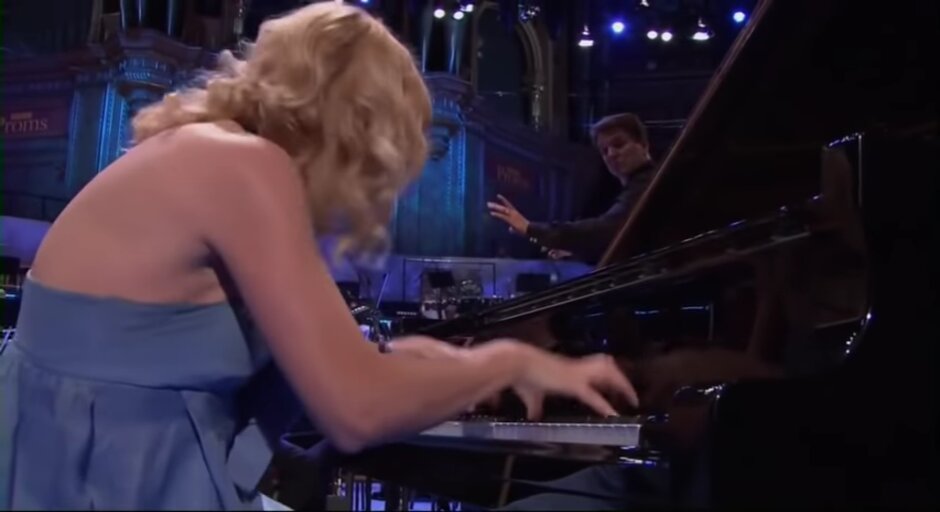
I love watching how Lockhart, official Guest Conductor of the BBC Concert Orchestra, scrupulously keeps in sync with not just his orchestra but with his soloist. It’s also a delight to watch at the beginning of the clip Lisitsa curtsying almost shyly to leader Cynthia Fleming.
Valentina Lisitsa, who started out as a YouTube sensation 12 years ago and is now counted as one of the foremost keyboard interpreters of the Eastern European Romantics, gives an intensely satisfying performance here of Addinsell’s “Warsaw Concerto“. The concerto was written for the movies—for, specifically, the 1941 movie Dangerous Moonlight, in which Polish concert pianist Anton Walbrook becomes a fighter pilot for the RAF, falls in love, gets amnesia, and composes some music. The movie, although a success from a propaganda viewpoint, was considered a potboiler by critics, and even the astute Anthony Burgess, who was an army sergeant and nascent composer himself at the time, looked down on the “Warsaw Concerto” as a cheap imitation of Rachmaninoff. Intellectual snobs have derided the piece, but it’s lingered in the memory for lo these many years, and is only now taking its permanent place in the Classic Repertoire.
For that we have to thank composer/film music restorer Philip Lane. It was to Lane that the musical estate of Richard Addinsell was entrusted and, like composer/orchestrator William David Brohn for Prokoviev’s Alexander Nevsky (Abbado with the LSO + full score here on YT) and my beloved John Wilson, Lane took on the task of reconstructing by ear written scores for film music whose manuscripts had been destroyed through carelessness or war. (Some suggest that the “Warsaw Concerto” was entirely the work of Addinsell’s orchestrator, Roy Douglas, who died in 2015 at the age of 107.) Addinsell’s—or Douglas’s—”Warsaw Concerto” was one of them. As Lane writes:
“The process of reconstruction does not get easier, but some films are more difficult than others. The biggest enemy is the combination of dialogue and sound effects over the music, and occasionally there are seconds of complete inaudibility when guesswork has to replace authenticity. The greater the composer, the more difficult the work, on the whole, since the melodic and harmonic language tends to be more adventurous. In the case of recent scores there are usually soundtrack CDs devoid of extraneous sounds to work from, but despite the change in status of film music, present day composers still mislay their scores. I have reconstructed music by Jerry Goldsmith, Randy Edelman and James Horner in the last year alone. If the composers are still alive I obviously encourage them to do the reconstruction themselves. So far, they have declined for various reasons.”
“The process of reconstruction does not get easier, but some films are more difficult than others. The biggest enemy is the combination of dialogue and sound effects over the music, and occasionally there are seconds of complete inaudibility when guesswork has to replace authenticity. The greater the composer, the more difficult the work, on the whole, since the melodic and harmonic language tends to be more adventurous. In the case of recent scores there are usually soundtrack CDs devoid of extraneous sounds to work from, but despite the change in status of film music, present day composers still mislay their scores. I have reconstructed music by Jerry Goldsmith, Randy Edelman and James Horner in the last year alone. If the composers are still alive I obviously encourage them to do the reconstruction themselves. So far, they have declined for various reasons.”
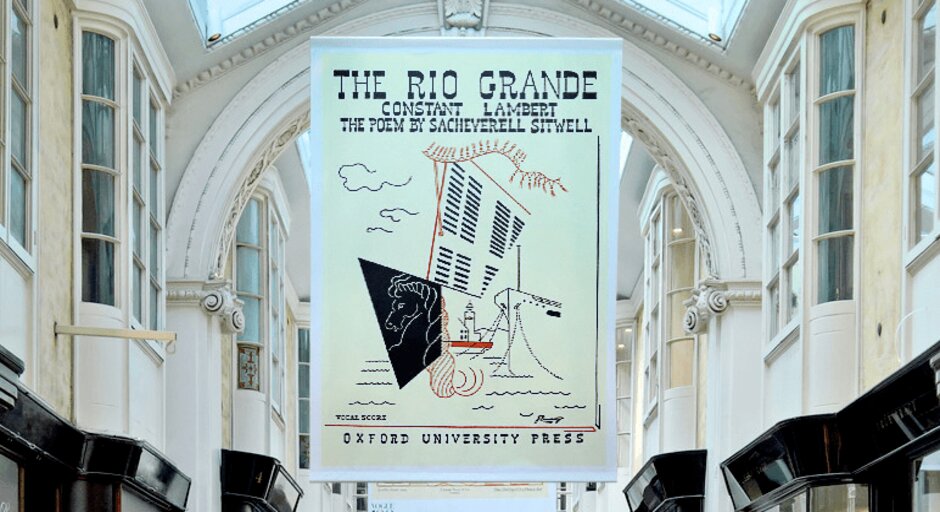
A very nifty, lively, jazzy modernist piece written by Constant Lambert (The Who manager Kit Lambert’s dad) in 1927. Australian virtuoso Eileen Joyce, who famously played the heart-wrenching Rachmaninoff in the film Brief Encounter (entire film here), is at the piano here. County Antrim-born Jean Allister, contralto soloist, joins her with the BBC Symphony Orchestra and the BBC Chorus. At the podium is Sir Malcolm Sargent.
Composer-novelist Anthony Burgess, in his autobiography Little Wilson and Big God (Burgess’s original name was John Wilson; his middle family name was Burgess and his confirmation name was Anthony) wrote,“Lambert, who admired Duke Ellington and proclaimed his harmonic roots in Frederick Delius (who in his turn had taken them from Debussy), was a fearless reconciler of what the academies and Tin Pan Alley alike presumed to be eternally opposed. I was present at that first performance, and so was my father. And, in 1972, on a plane from New York to Toronto, I found myself sitting next to Duke Ellington, who spoke almost with tears of the stature of Lambert, admitted that he had learned much from both Delius and Debussy, and expressed scorn for the old musical division, which had been almost as vicious as a colour bar. He had lived to see it dissolve and jazz become a legitimate item in the academic curricula.” [More Burgess on Lambert here.]
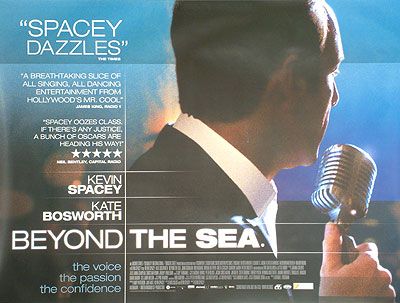 Above Spacey: “Beyond the Sea” as only my beloved John could do it.
 Dick Cavett and Anthony Burgess on my old B&W portable, a US knockoff made by the same company that cornered the 70s East Coast market in prepackaged noodle soup, Pho King. Above the interlocutors:

 Above: Eric Coates’s “Cinderella: A Phantasy” recorded by my darling John Wilson with the Royal Liverpool Philharmonic Orchestra, 2006.

 "I'll Be Dead Before You Break My Heart"