My First Music: Meredith Willson, and That Kennedy Thing, Part 1

This is still especially for John, my English darling, but also for anyone else who wants to read on and not give me flak for my conclusions. There is no more contentious, infighting body on the face of the earth than the Kennedy researchers, except for The Brontë Society.


Fortunately, I’m not a “Kennedy researcher”. But I remember the Friday lunchtime when President Kennedy was killed in Dallas, and initial memories turn out to be very important in reconstructing what really happened way back then. Even the memory of an eight year-old girl in 4th grade class 900 miles away counts.

So that Friday before Thanksgiving. Mrs Weisberg got a call and told us the President was dead and we went into the library to watch the TV coverage. Like a good police procedural, the suspect was apprehended almost right away, and after that all seemed to proceed as normally as a TV show: bad guy caught, law prevails, life back to normal, only normal+a little mourning (Oh, God! “Salute your father’s coffin, John-John”)+a new head of the country. Which was going to be the same country as always anyway, right?

What a different world that was then. What a bunch of saps those murdering thugs took us for.

But I want to talk about what I saw and heard in the first broadcasts, when the police and newspeople brought out Oswald and informed us that he was 24, an ex-Marine, from New Orleans, well-traveled, the father of two, with a foreign wife. (They got that info pretty fast, didn’t they. Within minutes. This before the internet. Talaga.) My kind of male? I was already interested in boys, I wanted to check him out.

He was strangely resolute in front of the camera. “Did you shoot the President and Officer Tippit?” demanded the newsman.

“No, I did not,” he replied firmly, and I was impressed by his looks, his composure, his educated, non-regionally-accented speech. The boys around me were gathering for a Hate Minute: Of course he did it! Otherwise he’d be jumping up and down hollering his innocence!

But at the age of eight-going-on-nine I had two weird revelations staring at that thin pale face.

  • One: He knows something.
  • Two: I’m probably going to marry a man like that.

So by golly, number two came true: A white southener, self-educated, self-composed, brilliant but secretive, an average-looking, average-sized man who could pass for thousands of other average men—

And—an operative of Army Intelligence. I’m looking at my blind bearded baby in front of me right now, grateful the Ruskies didn’t shoot him down on some wintry street in Prague in 1968.

In Part Two I’ll talk about ex-friend Hollywood director Stephen Gyllenhaal, his shockingly idiotic, insulting, slightly treasonous project, and Abraham Bolden, for whom I wrote the screenplay, at his personal request, Bolden: The Untold Story of JFK’s Assassination.


There is a Meredith Willson-John Kennedy connection! It’s this peppy number, which was commissioned by President Kennedy for his Council on Physical Fitness for kids like us to do their daily school calisthenics to. Some people remember this number with affection, many don’t. Robert Preston sang it and the Warner Bros orchestra played it. It’s called “Chicken Fat”. Ten times!

FULL DRESS // A gifted mesmerist—a sinister composer—a naive young conductor from the north…inspired by an episode from the life of Rachmaninoff // DOWNLOAD FREE BOOK POSTER

My First Music: “Dahil Sa Iyo” and My Sentimental Devotion to Bonny John Wilson, Conductor

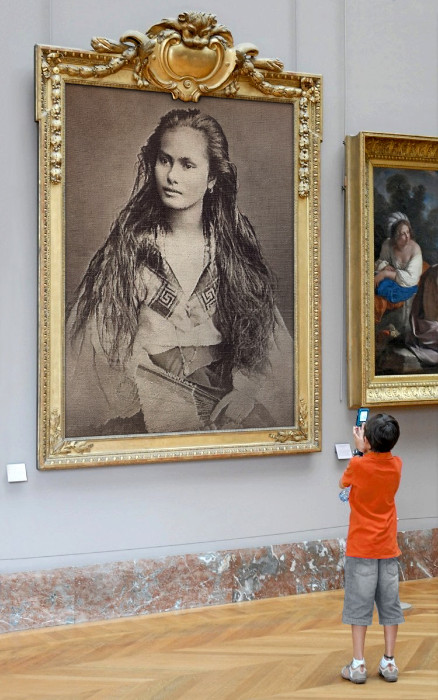
If you could, my bonny John Wilson, imagine me wearing a maria clara (like great-grandmother Aberin below) and you wearing a barong, I’d be singing you this song:

Sa buhay ko’y labis
Ang hirap at pasakit, ng pusong umiibig
Mandi’y wala ng langit
At ng lumigaya, hinango mo sa dusa
Tanging ikaw sinta, ang aking pag-asa.

Dahil sa iyo, nais kong mabuhay
Dahil sa iyo, hanggang mamatay
Dapat mong tantuin, wala ng ibang giliw
Puso ko’y tanungin, ikaw at ikaw rin

Dahil sa iyo, ako’y lumigaya
Pagmamahal, ay alayan ka
Kung tunay man ako, ay alipinin mo
Ang lahat sa buhay ko, dahil sa iyo

Dahil Sa Iyo”
Mike Velarde Jr music (1938), Tom Spinoza, lyrics
Cora and Santos Beloy, vocalists
Tri-World Records (1964)

Great-Grandmother Aberin 1.jpgMy mother’s lola, my great-grandmother, the spitting image of my mother the way Georgiana Drew is the spitting image of Drew Barrymore and I’m the spitting image of my dad. I have no documentation for my assertion—my gran’s house and possessions were completely destroyed during the Japanese Occupation. But whenever we came across this picture in the media—in an article in Time, for example—my mom would always point her out and tell me the story of how my great-grandfather came over from Ireland and, upon discovering he was meeting fellow Catholics in a sea of Asians, stayed, changed his name from O’Brien to Abérin, and married the local beauty. How Van Camp found her is anybody’s guess.


FULL DRESS // A gifted mesmerist—a sinister composer—a naive young conductor from the north…inspired by an episode from the life of Rachmaninoff // DOWNLOAD FREE BOOK POSTER

My First Music: “Jauchzet Gott in allen Landen” Cantata 51 by Johann Sebastian Bach

I was 17 and my voice was not going to get me to the Met, but I enjoyed singing to the tiny group that gathered on Friday afternoons in Room 204 of Northrup Auditorium at the U in Minneapolis. The month my draftee boyfriend Jesse got out of the army (May 1972, just before he joined the Black Panthers) my teacher lent me an album of Teresa Stich-Randall and I picked out this number to do. It’s not a hard piece to learn but whoa, that breath control… That I managed to make it to the very end with some grace is due to Bach’s blessing to singers—all that forward motion impels you. But the effort was worth it. What a high!

Johann Sebastian Bach


Bach composed BWV 51 during a period when he composed church cantatas only irregularly, some of them to complete his earlier cycles. Both the soprano part, which covers two octaves and requires a high C, and the solo trumpet part, which at times trades melodic lines with the soprano on an equal basis, are extremely virtuosic. The cantata is one of only four sacred cantatas that Bach wrote for a solo soprano. The first aria, “Jauchzet Gott in allen Landen” (“Exult in God in every land”), is in da capo form, with extended coloraturas. The theme, with a beginning in a triad fanfare, is well suited to the trumpet. It is first developed in a ritornello of the orchestra and then constantly worked in the soprano part. At least, that’s what I remember.


FULL DRESS // A gifted mesmerist—a sinister composer—a naive young conductor from the north…inspired by an episode from the life of Rachmaninoff // DOWNLOAD FREE BOOK POSTER

My First Music: Soames Rapes Irene in The Forsyte Saga (BBC, 1967); “Halcyon Days” from Eric Coates’s Three Elizabeths Suite Played by the BBCPO and Conducted By My Excellent John Wilson

I was twelve when The Forsyte Saga was first shown on American TV and I thought it was the coolest series ever.* It was about a large, rich and, though unconnected, influential family living in late-capitalist England circa 1879, who keep getting into pretty heated conflicts with each other—which at the bottom are really about, more or less, the value of art and the inner life vs commerce—all the while being beautifully attired and beautifully well-spoken. Hearing this royal fanfare “Halcyon Days” that opened the show was enough to get me all excited with anticipation on a Sunday night, but it wasn’t until last year around May when I finally discovered the composer of the piece, Eric Coates, plus the rest of this ravishing movement, when I fell in love with conductor John Wilson and developed a raging need to get close to the music he’s close to.

Screening Room, SF 1979Above: Above Soames played by Eric Porter—The Man of Property, Noted Art Collector, and about as Mr Wrong as you can get—who mistook his wife for a soulless mannequin and, in novelist John Galsworthy’s sardonic words, “asserted his marital rights and acted like a man” in this scene, in which the BBC made shocking good use of Nyree Dawn Porter’s lovely embonpoint: My gorgeous, wondrous John Wilson leads the BBC Philharmonic in Coates’s “Halcyon Days”.
My beloved John conducted this 29 March, 2022 in Salford, as part of a program devoted exclusively to the music of prolific BBC composer, Eric Coates. It was glorious.

Here’s a remembrance of Nyree Dawn Porter and The Forsyte Saga in The Guardian reprinted in FB, including my protestation over the use of the word “frigid”.

*In fact it got me to read the entire cycle of nine novels the series was based on; finished them when I was thirteen. Dinny Cherrell’s my favorite character.


FULL DRESS // A gifted mesmerist—a sinister composer—a naive young conductor from the north…inspired by an episode from the life of Rachmaninoff // DOWNLOAD FREE BOOK POSTER

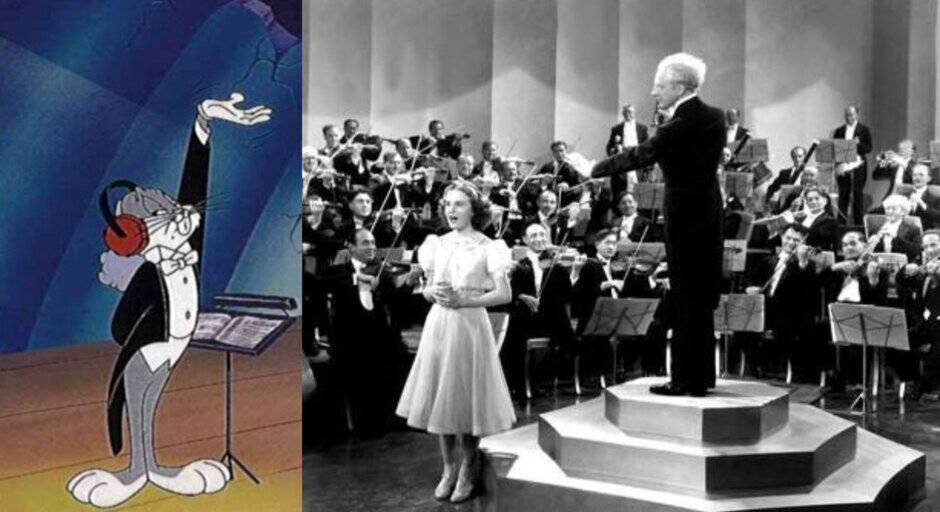
“Leopold! Leopold!”

Here’s Stokowski, international maestro (and, like my beloved John Wilson, a graduate of the Royal College of Music) in my second favorite Deanna Durbin movie: 100 Men and a Girl. Directed by Henry Koster. Universal, 1937. Andre Previn‘s great-uncle Charles Previn, musical director, arranger, composer and conductor at Universal, won an Oscar for his score for 100 Men and a Girl. While at Universal, Previn accumulated over 225 films to his credit, including most of Deanna Durbin’s films.

The bass-baritone in the Bugs Bunny classic “Long-Haired Hare” (Warner Bros 1949), where the title of this posting comes from, is voiced by bass-baritone SF native (and, like my son, a former pupil at Mission High School) Nicolai Shutorev.


FULL DRESS // A gifted mesmerist—a sinister composer—a naive young conductor from the north…inspired by an episode from the life of Rachmaninoff // DOWNLOAD FREE BOOK POSTER

My First Music: Friday Night Is Music Night with the BBC Concert Orchestra, Conducted by the Oh-So-Kissable John Wilson, August 2005

At around the same time of life the oh-so-kissable John Wilson was a wee bairn in Gateshead falling out of his high chair in excitement over the brand-new BBC news theme, I was in my playpen in the living room of the old one-bedroom apartment in South Minneapolis jumping up and down in excitement to the theme of Captain Kangaroo on TV.

Now here we are with my darling 33-year-old (in 2005) lad on the podium in the first televised broadcast of this longtime radio fixture, and I get to find out the titles of all those excerpts and show themes I’ve heard on the Beeb for years. The sign-in music, incidentally, is Charles Williams‘s “High Adventure.”

A Little Light MusicI will never understand the English tradition of drag. Now, the American tradition of drag, like future husband Mister Grumble doing his Twiggy impersonation at a gay revue in Dallas back in 1964—THAT’s hot. Above John and his admirer: Audio of the entire Friday Night Is Music Night program, “A Little Light Music”.

The program: “The Devil’s Galop” (Dick Barton Special Agent, Monty Python) / Charles Williams; “Portrait of a Flirt” / Robert Farnon; “The Lion and Albert” (comic verse) / Marriott Edgar; March from “Little Suite” (Dr Finlay’s Casebook) / Trevor Duncan; “Barwick Green” (The Archers) / Arthur Wood; “The Typewriter” (The News Quiz) / Leroy Anderson; “Roses of Picardy” / Haydn Wood; “Calling All Workers” (Music While You Work) / Eric Coates; “By the Sleepy Lagoon” (Desert Island Discs) / Eric Coates; “A Canadian in Mayfair” / Angela Morley; “In a Party Mood” / Jack Strachey; “Sailing By” (The Shipping Forecast) / Ronald Binge; “Charmaine” (Monty Python) / Erno Rapee; “Puffin’ Billy” (Captain Kangaroo!!!) at 47:00 / Edward White; “Birdsongs at Eventide” / Eric Coates; “The Dam Busters” March (from the 1954 film) / Eric Coates. Janis Kelly, soprano. Roy Hudd, host.


FULL DRESS // A gifted mesmerist—a sinister composer—a naive young conductor from the north…inspired by an episode from the life of Rachmaninoff // DOWNLOAD FREE BOOK POSTER

My First Music: Geraldo Among the Filipinos, 1963

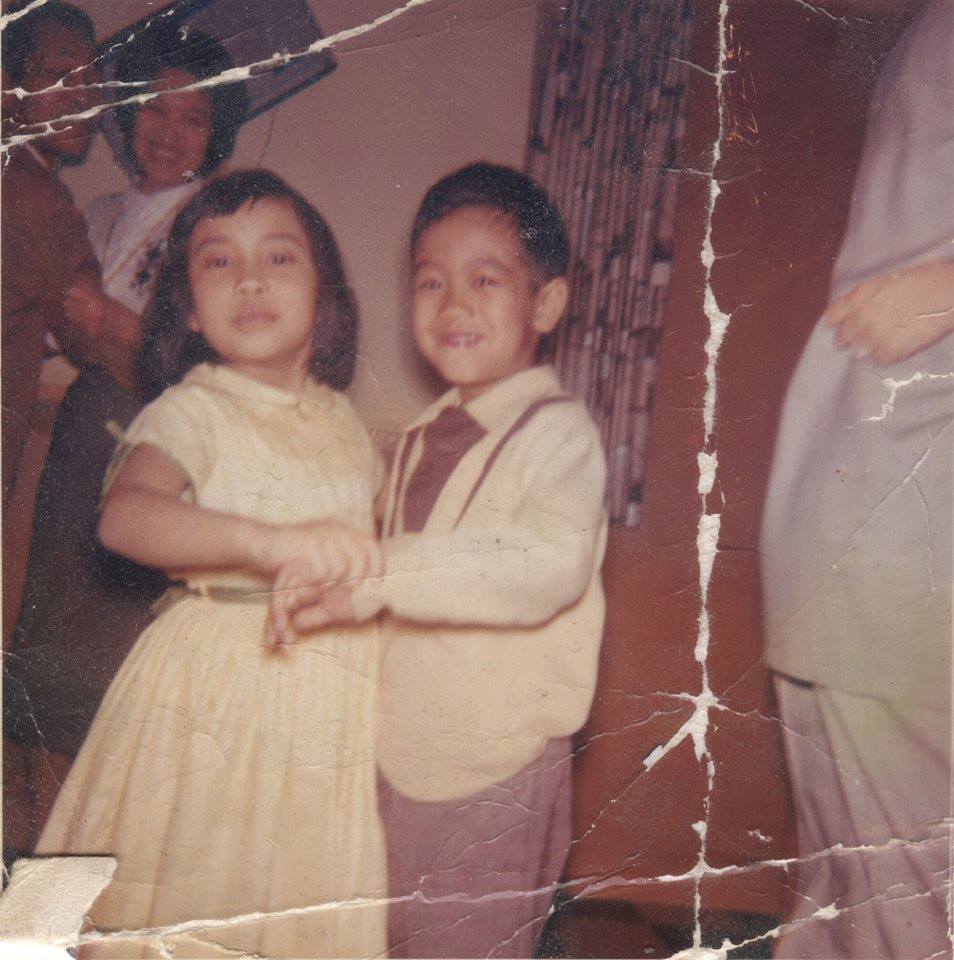
God, Danny Sibolboro was such a weenie. Taken December 1963 at one of the many, many dances of the Moveable Filipino Club, Minneapolis, Minnesota. Geraldo was playing. Filipinos love Geraldo.

Cantara Dancing with Danny Sibolboro

Hit the Road to Dreamland
Harold Arlen, Johnny Mercer (1943)
Shall We Dance?
Big Band Arrangements of Geraldo
John Wilson Orchestra
John Wilson, conductor
Vocalion, 2002


FULL DRESS // A gifted mesmerist—a sinister composer—a naive young conductor from the north…inspired by an episode from the life of Rachmaninoff // DOWNLOAD FREE BOOK POSTER

My First Music: “My Mother Bids Me Bind My Hair” by Joseph Haydn, Sung by Joan Sutherland with Richard Bonynge at the Piano, 1970

Smile as you will at this mincing little ditty but it got me a medal at the Tri-State Vocal Competition of 1969 when I was fourteen. Go Minnesota!

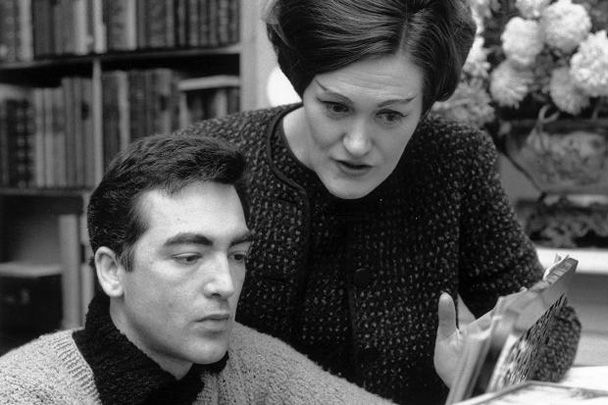
Joan Sutherland Richard Bonynge.jpgAustralian-born conductor Richard Bonynge and soprano Joan Sutherland; they married in 1962.

FULL DRESS // A gifted mesmerist—a sinister composer—a naive young conductor from the north…inspired by an episode from the life of Rachmaninoff // DOWNLOAD FREE BOOK POSTER

My First Music: The Pure Joy of St Trinian’s and The Inn of the Sixth Happiness by Malcolm Arnold

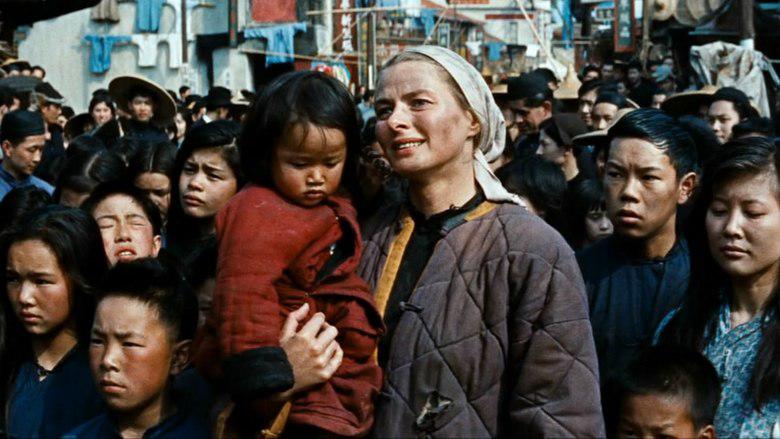
There must be something in the English character that enables the better artists among them to depict situations of unassuming, steady bravery with superior deftness, which is probably why their World War II pictures are better than ours. One of them, The Inn of the Sixth Happiness (20th Century Fox, 1958), doesn’t technically qualify either as a UK picture—Fox produced it; or as a WWII picture—it’s set during the Sino-Japanese War of 1938; but it does have unarmed peasantry scattering to the hills under Japanese gunfire, which is a theme that ran through my mother’s life starting with Pearl Harbor and ending in March, 1945 when American troops marched through the rubble-strewn streets of Manila, hunky victorious good guys. My mother’s first teenage romance was with a private in the 31st Infantry Regiment named Kelly, come to think of it.

Now, when I refer to better artists of English character I don’t mean the film’s producer, director, writer (American, American, American), or stars (Swedish, Austrian). But it’s because of: one, the true-life heroine the story was based on; two, the location shooting; three, the non-lead casting; and four and most importantly, the music, that I think of Sixth Happiness as an English film. The true-life heroine of the story was English-born, not to mention the film has Snowdonia standing in for the daunting terrain around Yangcheng and pretty near the entire Chinese heritage population of Liverpool standing in for Chinese nationals, with supporting roles portrayed by stalwarts of UK stage and screen. This is the first thing I ever saw Burt Kwouk in.

But to the music. This is not Malcolm Arnold’s finest score—Bridge On the River Kwai (Columbia, 1957) really is a superior composition—but it rates higher with me becauuuse, you guessed it, The Inn of the Sixth Happiness has a gorgeous Love Theme, which you can hear below as the Royal Academy of Music performed the suite back in 2014. You’ll also hear the bright, high fanfare brass that Arnold used in a few other of his movies, River Kwai and the one below, for examples. Also, I’m starting to develop a theory to satisfy myself that certain intervals, played with conviction, are the real sinews of English music: they make for that sound of “rightness”, which you can take one way or another, depending on the mood—or your mood, for that matter. Sixth Happiness has plenty of those.

Inn of the 6th Happiness.jpg

Besides the satisfying fanfare brass, Sixth Happiness shares with the satirical The Belles of St Trinian’s (British Lion, 1954) a bit in the score where there’s a song meant to be sung by children—in Sixth Happiness it’s “This Old Man”; in St Trinian’s it’s the school’s hilarious “Battle Cry”. I’m not posting the lyrics here, so click on the link in red to listen to those cheerfully bloodthirsty oaths. But can you imagine what a liberating tonic this ferocious roar from the depths of The Untamed Female Soul was to a little girl in the Catholic part of Minneapolis, watching this on Saturday matinee TV (a tonic, incidentally, I would not imbibe again till I heard Bernadine Dorhn mouth off a few years later)—?

Here’s the BBCCO doing the St Trinian’s suite at the Proms (Timothy West, narrator) bringing back almost all the familiar, funny-music leitmotifs to smile at, like George Cole’s character’s “Flash Harry”, a loping, rattling kind of tune (although lamentably there’s no sign of Joyce Grenfell’s scurrying “Ruby Gates”) before returning to that ghoulish school pageant march, lyrics I believe provided by Arnold himself.

In contrast, “This Old Man” is meant to be a “found” song, purportedly a children’s counting song, heard on the playground since the 19th century, and in a way that’s right, as the first time I heard “This Old Man” was on the playground—but only because it had become a hit on US radio first in 1959. It’s still impossible for me not to hear “This Old Man” and not think of the climactic scene in Sixth Happiness: the hundred children crossing the Yellow River into safe territory, ragged and exhausted but alive, marching into the unoccupied city to cheering crowds, loudly singing this song. Invariably it brings tears to my eyes, immigrants’ daughter that I am, and I remember the first time I watched—and heard—this film on TV with my mother, my mind nearly forming the question I never asked her, not then, not ever: “What happened to you in the war, mom?” Because the music was so ravishing, the love story was so satisfying, and my mother just wanted to enjoy an Ingrid Bergman film.


FULL DRESS // A gifted mesmerist—a sinister composer—a naive young conductor from the north…inspired by an episode from the life of Rachmaninoff // DOWNLOAD FREE BOOK POSTER

My First Music: John Wilson Conducts the National Youth Orchestra of Great Britain in 2015, the BBCSSO in 2018, and the Sinfonia of London in Ottorino Respighi’s “The Pines of Rome” (Chandos, 2020)

My beloved John conducted the National Youth Orchestra of Great Britain (who The Guardian described as “a fearless young army on the move”) in “The Pines of Rome” by Respighi in Leeds in 2015; and in Glasgow, where he’s been the Associate Guest Conductor for several years, with the BBC Scottish Symphony Orchestra in 2018. Now he’s rounding out his association with this perennial orchestra piece with a wonderfully crisp and sparkling new recording from Chandos with the new Sinfonia of London.

I classify this under My First Music because I first heard this symphonic poem in a broadcast of a Young People’s Concert. Leonard Bernstein conducted, the NY Philharmonic played. Listen for the feet of Roman soldiers along the Appian Road, my affectionately-remembered rabbi of music suggested. I think I was 11.

john-wilson-and-the-nyogb2NOTES for “Respighi: Rome” on Chandos available here. John rehearsing the NYOGB in The Appian Road, summer 2015. Above John: The Villa Borghese.

FULL DRESS // A gifted mesmerist—a sinister composer—a naive young conductor from the north…inspired by an episode from the life of Rachmaninoff // DOWNLOAD FREE BOOK POSTER

My First Music: On Conductor John Wilson and His Thing About Percussion, Plus Emmanuel Chabrier’s “España” (1883), John’s New Recording with the Sinfonia of London from Chandos

Self-taught French composer Emmanuel Chabrier wrote this enduringly scrumptious piece in the early 1880s, the orchestration sounding more like something post-WWI. Yet it was composed during the height of La Belle Epoque. This was the last piece (a reduction, of course) I ever played on the violin in my junior high school orchestra, before switching a couple years later, at 16, to Voice at the University of Minnesota.

As for my beloved Johns own especial sensitivity to percussion: Listening to and viewing John conduct the RAM student orchestra last Friday in Tchaikovsky’s 6th—in particular watching John’s very visible reaction to the cymbals in the third movement—gave me some insight into his musical values, which never fail to impress me. I understood the kind of sound he was trying to bring out from that young cymbalist and, had it worked, would indeed have sounded sooo nifty, it would have been John Wilson Orchestra nifty, but alas…

(The sound aspired to, incidentally, was that “snap” I heard the JWO achieve in Beyond the Sea about 16 years ago.)

Lastly, a word about the strings in the fourth movement. Yup, there was that “John Wilson Orchestra shimmer”, that famous wrist vibrato anyone who’s ever picked up a fiddle recognizes and has to have come to terms with fairly early in training. We used to wonder if it made our playing actually sound better, and it depends. The Russians and Mittel Europeans used it a lot a hundred years ago. Some call this type of playing now “period playing”. My old boss, Rouben Mamoulian, called this style of playing “crying violins”. He claimed it was his idea to use it in the musical Love Me Tonight, in the “Isn’t It Romantic” sequence.


John Chabrier EspanaNOTES for Escales (Chandos, 2020) can be found here.


FULL DRESS // A gifted mesmerist—a sinister composer—a naive young conductor from the north…inspired by an episode from the life of Rachmaninoff // DOWNLOAD FREE BOOK POSTER

My First Music: Al Bowlly Sings Ray Noble’s “Goodnight, Sweetheart” in “City on the Edge of Forever” on the Original TV Show Star Trek (NBC, 1967)

The traditional closing number for any formal dance (the orchestra played this at every Rizal Day dance I ever attended in Minneapolis as a girl), the tender song “Goodnight, Sweetheart” was written in 1931 by the English composing team of Ray Noble, Jimmy Campbell and Reg Connelly. In the recording used in Star Trek it was played by the Ray Noble Orchestra and sung by Al Bowlly, that darkly good-looking singer who, at the height of WWII, was found in the rubble of his London flat after a blitz attack, dead, but without a mark on his handsome face.

City on the Edge of Forever
Above Joan Collins and William Shatner in this memorable final episode of the first season, 1967: “Goodnight, Sweetheart” sung by Al Bowlly.


FULL DRESS // A gifted mesmerist—a sinister composer—a naive young conductor from the north…inspired by an episode from the life of Rachmaninoff // DOWNLOAD FREE BOOK POSTER

My First Music: Original Soundtrack for Picnic (Columbia, 1955) Composed by George Duning, Orchestrated by Arthur Morton, and Conducted by Morris Stoloff

According to composer Duning, Picnic director Joshua Logan insisted on using the old standard “Moonglow” (Hudson-Mills-DeLange, 1933) in a critical scene, as had been done in the Broadway play, but demanded that Duning’s love theme be added at a specific point. Columbia’s music director Stoloff and Duning complied, creating a unique arrangement of the song and the movie theme, and it became an iconic moment in 1950s cinema, a pairing of tunes that would thereafter seem inextricably intertwined. [Read more on George Duning from the Film Music Society here.]

Picnic 2William Holden and Kim Novak in the famous dance scene. Cinematography by James Wong Howe.

Here’s that “Moonglow-Picnic” number.

And for good measure, here’s popular 50s singer Dorothy Collins’s rendition from her album Dorothy Collins Sings Steve Allen (Allen wrote the lyrics).


PICNIC is available to watch in its entirety here


FULL DRESS // A gifted mesmerist—a sinister composer—a naive young conductor from the north…inspired by an episode from the life of Rachmaninoff // DOWNLOAD FREE BOOK POSTER

My First Music: “Padanggo Sa Ilaw”, Another Tricky Filipino Dance

I’m not going to talk about the Tinikling here as it brings back unpleasant memories of having my ankles banged with bamboo poles, but I will mention the Pandanggo (from the Spanish word “fandango”). This is very elegant dance where dancers wear not the formal Maria Clara, which is hard to get around in, but the patadyong, which is a simple cotton dress with butterfly sleeves. My aunt Wilhelmina looked very nice doing this dance, with the candles on the backs of her hands and the candle on her head. You try balancing that. I almost started a fire.

Pandanggo Sa Ilaw (Marty McCorkle, 2016)Above “Pandanggo Sa Ilaw” by Visayan resident Marty McCorkle (2016) the title dance to this posting, performed by Juan Silos Jr and his orchestra.

Pandanggo traditionally is danced to rondalla music, which is a sort of serenade played by an ensemble of guitars and mandolins and other stringed instruments. It originated in Spain during the Middle Ages. You can also hear the rondalla sound in Mexican and Central and South American music, which should show that Filipinos are more cultural kin to the Hispanic world than the mainland Asian. But we claim both.


FULL DRESS // A gifted mesmerist—a sinister composer—a naive young conductor from the north…inspired by an episode from the life of Rachmaninoff // DOWNLOAD FREE BOOK POSTER