Hot-weather days like this make me remember when we—The Kid, Mister Grumble and I—lived at one point of a triangle that made us not only two blocks away from the sunny Castro, but two more-or-less-equal blocks away from the first station of the cross of the obsessive lover’s screen via dolorosa, (fellow communicant) Alfred Hitchcock’s Vertigo—and by that I mean Mission Dolores, San Francisco. (After 248 years, it’s still beautiful.)
You look good, you delectable thing you. Been working out?
As for the other point, you can’t imagine what a randy yet romantic stretch of real estate that was before AIDS hit. I remember how colorful and musical it all was.
There has been much discussion here about the music that gets the show going, some of which has addressed the ‘Mont Blanc’ of Broadway overtures, that to The King and I.
Above Ken Watanabe and Kelli O’Hara in 2015 Broadway’s sexy production of The King and I, my beloved Brit John Wilson conducts his John Wilson Orchestra in the Albert Hall in the Overture.
Amusingly, orchestrator Robert Russell Bennett tagged it ‘Le roi et moi’. One can only imagine whom the ‘roi’ is meant to be. However, those of you who have come across the French will also be familiar perhaps with this expression, typically seen in a famous cartoon set in a restaurant where a waiter is dealing with a complaint from a diner: ‘Le client est roi: le patron est dieu’ [The customer is king; the boss is god].
Anyway, like Mont Blanc, there are different ways up it (and back down again), which vary according to how much snow and ice or wind or wet or hot weather have to be negotiated. A lot of versions of score, arrangement and style of performance can be heard, and they are all interesting. At this present moment, however, I am quite taken with Lesko’s 1977 recording, under Milt Rosenstock’s supervision, of a truly involving reading of the overture. Their approach is intensely ‘musical’ and it triumphs for that reason, whatever differences there may be in substance compared with other performances.
How do I judge this? I put myself in the shoes of someone who has turned up to the theatre and knows the name of the show (this is now frequently projected onto a drop curtain at the start, to help the slow-witted) and nothing else. The King and Iis a very sensible title, presenting two ideas: royalty and an anonymous first-person narrator. Royalty is far away from the experience of most people, but it is recognised as being an ‘absolute’ beyond which further progress cannot be expected: ergo, a ‘King’ doesn’t usually have much to strive for, no goal to reach, and thus tends to make for a bad protagonist (unless you’re watching them fall!). Therefore, subconsciously the audience is already rooting for the unidentified ‘I’. (Incidentally, the heroine narrator of Rebecca is only identified by that single letter, and there are other examples.)
What then follows is something that appears to be an ‘overture’ in the Broadway manner, comprising a list of big tunes from the upcoming entertainment. Subconsciously, though, it can also be read as a programmatic tone-poem offering a summary of the events leading up to the start of the drama proper. My hypothetical punter might understand it as follows:
1) The Hammer-Blows of Fate fall and send everything flying—these are the two musical ideas out of which the rest of the overture (and score) is constructed 2) Melancholic love arises, moving slowly, chordally, perhaps recalling a lost romance, maybe a death 3) Sudden change of mood interrupts this and jerks us into youthful, childlike chirpiness, which jars 4) An abrupt relapse follows into deeper desires, barely grasped, but insistent, driven by powerfully expressed longing, yearning 5) Gently undulating movements surge forward in the bass and high strings, with a long tune bobbing rhythmically through them, rather like a sea voyage 6) Triple-time acceleration of the ‘journey’ then propels us along faster, where the steady treading of chords and the opening scales have been brought much closer together, yet without quite actually joining, before the music culminates in— 7) Arrival at the destination, announced by a more emphatic restatement of the opening grand chords. Curtain up on ship arriving in Bangkok Harbour.
Or something like that.
To be perfectly honest, the Prelude to Tristan und Isolde does the same thing. The whole is held together by the orchestration, which is phenomenal. Furthermore, in the same way as one does not need to ‘know’ what Wagner’s four-note rising and falling and rising chromatic motifs ‘mean’ in order to ‘feel’ their tidal effect, nor to feel in one’s very marrow what those ‘tides’ relate to in oneself, it is immaterial what specific incidents have brought ‘I’ to this place. A closer musical theatre example might be for some the overture to The Mikado, perhaps; in terms of musical complexity it is less challenging although it certainly seems to begin similarly, but the emotional depth of R&H far exceeds that of the skilful D’Oyly Carte parodists. Crucially, Rodgers draws on the big guns of the past to learn from them; Sullivan plunders his predecessors in order to send them up.
Here, because of the terseness of the musical argument, the best performances are those which are most involved in the ‘music’ to the exclusion of any ‘intrusive phrasing’. I mean by this, musical phrasing which seems to articulate the sense of the ‘text’: Particularly when dealing with a very familiar score, any approach at conducting ‘the big tune’ runs the risk of simply luring the audience into ‘singing-along’: and how they do. In fact, once they feel they have ‘permission’ to do this, there is no knowing when the audience might feel moved to accompany ANY member of the cast in whatever they have to sing. I have lost count of the number of productions I’ve seen where this occurs. However, I have also paid careful attention to when it does NOT happen.
In this single example, then, an excellent rendition of the overture—or prelude—to The King and I. Some people may find this approach at analysis unnecessarily fussy if not a tad precious; on the other hand, there might be some mileage in it.
~Julian Eaves, Composer from Musical Theatre Orchestrations
EXTRA! Courtesy of YT an entire episode of Groucho’s classic TV “game” show, You Bet Your Life from 5 December 1957, featuring American concert baritone and outspoken rock’n’roll hater, John Charles Thomas, plus the heroine of the most scandalous book in my mother’s forbidden library, The Big Love—the fetchingest teenager (15!) in Hollywood, Beverly Aadland! Just months before Errol Flynn swept her away! At 11:50 Beverly sings “All Shook Up” and Groucho dances a few steps solo, then with her, in a really sweet passage a deux.
I will, however, obsess at this time over John’s manly jewelry, mostly his lucky watch (given him by Austin son-of-Eric Coates, author of Rizal: Philippine Nationalist and Martyr) and his lucky cufflinks which, thanks to John’s latest interview in The Stage, I now know to be a gift from the widow of music critic and Barbirolli chum, Michael Kennedy.
A while back I wrote a posting (“Marquess of the Gardens of Aranjuez, His Finest Work in the 1995 UK Film, Brassed Off”) where I played around with the possibility of exploring the differences between your early musical+general education and mine; and for that, I started gathering items from around the internet, which are still in my workbasket. Below are a few scraps:
But that’s not what I’m here to talk about. I also noted, in my travels around the internet, that your career website is now up on Squarespace, administered by some bloke named Simon Lunt-Grifter, but with NO concert information! I note as well, that someone (this selfsame Grifter?) updated your Wikipedia entry back in February, with a more complete listing of your recordings and some additional information about your past and projects that weren’t previously there—although nothing I hadn’t previously looked up, with some effort, and ALREADY knew and wrote about.
My blog regularly gets visitors from the US and the UK (as well the rest of the world). Frequently I get a singular visitor who lingers, reading dozens of my postings at a time, downloading dozens of my music files, and it makes me happy to imagine that somebody out there might have stumbled onto my blog and discovered it an open treasure trove they were welcome to take from. I’m in love with you and want to give you nice things(including good reviews when warranted, and the story of my life)—but because I’m in love I also want to give the world nice things too, and that turns out to be your music.
What I object to is laying out a banquet and having one of your grubby dogsbodies take my offerings with two hands and stuffing their pockets on the assumption that I was already on the same team, so why not?
Since John’s management has long ago ditched his site johnwilsonconductor.com I went over to Bachtrack to find this info, and will probably end up going there and elsewhere evermore for more info on my bonny lad’s—w or w/o his Sinfonia of London—performances. (I also have John on Google Alert, plus I donate to the Royal College and the Royal Academy to get their email newsletters, plus I follow the Sinfonia and RTE on Facebook…plus if he’s scheduled to play movie music somewhere I can get that info from Juliet Rózsa…)
Know why I like this picture? ‘Cause there’s a devil face in the red vainly trying to get at my beloved through the impenetrable white light of my love. So there, John. I told you The Queen of Heaven had her eye on you
UPDATE! Some kind soul in the UK (probably my travelling writer friend Helen Ducal, and if it is you, Helen, thanks!) subscribed me a few days ago to the John Wilson & Sinfonia of London website, which promptly sent me the ballot ClassicFM put out for best classical recordings of 2023. So okay, I voted for his Vaughan Williams but NOT his compleat Oklahoma! out of respect for the memory of my old boss, Rouben Mamoulian, who John—prompted I’m sure by the BBC—saw fit to throw a little shade on when he conducted R&H back in 2010. (John’s still my guy, though. I’m sooo used to snarky artistic types.) So I’ll probably be getting the SoL schedule as they know it. But I still have to hunt up his other appearances.
The dates link to the ticket sites. The other highlights link to available recordings and YT appearances.
Sat 27 Jan 2024 19:30 Sheldonian Theatre Oxford, UK Oxford Philharmonic Orchestra Leonard Elschenbroich (cello)
“I Shall Return.” The Invasion of Lingayen Gulf (Paglusob sa Golpo ng Lingayen), was an amphibious operation in World War Two led by General Douglas MacArthur, 6-9 January 1945
After looking at a Google map, I figured that if the Gulf were big enough to accommodate battleships in wartime, it would’ve been big enough to harbor smaller vessels in peacetime, like tramp steamers. Tramp steamers were easy to sign on to then, and even as late as the 1970s you could hop on, do a lot of dirty heavy work, then hop off at the first stop and hop on the next steamer going further. The trick back then was knowing the comings and goings of such short-run vessels which, as this was in the old days before comprehensive shipping news, you pretty much had to do by going in person right to the docks to find out.
There were two directions my dad could’ve taken, east or west. West would’ve meant hopping from steamer to steamer, wending his way through the islands and peninsulas of Indochina. East meant making his way down the coast of Luzon facing the China Sea, into Manila Bay, where if he lucked out he could sign on to one of the much larger, international, Pacific-crossing tramp steamers, like the Queenmoor out of Newcastle, UK. I’m inclined to think that’s the route he chose. Because, thanks to the Thomasite teachers sent by our American conquerors, Dad had one invaluable asset: He could speak the English language.
In either case, it still might’ve taken him as long as 6-8 months to reach San Francisco, which my mother told me was his first place of residence. So it happened that my father, Cenon Merto “Sam” Ramos, started his American life in the most evocative city in America—the home of fog, hills, sourdough, hashish, Dashiell Hammett, Harry Bridges, Gracie Allen, Mission Dolores, earthquakes, Chinatown, Manilatown, the DiMaggio boys, and the San Francisco Symphony Orchestra (period recording of Alfred Hertz conducting the SFSO in Wagner’s Parsifal here).
The picture below is of the fourth anniversary banquet of the local Asinganian Club, November 1941, just two weeks before Pearl Harbor. That’s my dad, extreme right under the picture, when he still had hair.
Asinganian, I have to explain, means “of Pangasinan”, which is the province my father comes from—but it can be extended to also mean “of La Union”, meaning from the province above Pangasinan, called La Union, which is where my mother was born. Think of these provinces as the Lancashire and Yorkshire of the Philippines, John.
Note the date: 27 November 1941, two weeks before Pearl Harbor. Also note the flags: The Philippines was a US Commonwealth (which made us technically US nationals) and didn’t achieve independence until 4 July, 1946
There were about 100 Filipino-American clubs in the US around this time; this is the way Filipino immigrants socialized, and it was pretty successful. Even years later my mom could tell you the names and phone numbers of Filipinos in Calgary, Denver, Manila etc, just because they were Filipino and exchanged visiting cards with her at some party thrown at one of the many, many dances of the Moveable Filipino Club for manongs+manangs and their white/pinoy spouses/children in Minneapolis. It was quite a network while it lasted.
But don’t get the idea that my father and my mother met through some stateside Filipino club, because at the time she was still in the Philippines, getting occupied and bombed on. (See “The Pure Joy of St Trinian’s and The Inn of the Sixth Happiness by Malcolm Arnold“.) We never talked about that part of her life at home, but after my father died I eventually managed to get some extremely unsettling details from my various cousins.
But aside from that, as it turned out, after the war Mom and Dad had met through the penpal ads that were in the back of the regular issues of the Asinganian Club newsletter, which circulated not only in the States but the Philippines. After my dad’s first marriage in the mid-1940s to a white, probably Irish, woman named Margaret—I’m going to imagine her name was Margaret—failed to work out (see “25 May—Two Birthdays: My Dad’s and My Beloved English Conductor John Wilson’s”) my dad, like so many other young guys working far from home in a strange new place, was counseled to take “a wife from the old country”. But where to find one? The immigration quotas of the 1920s-1940s were not favorable to single, marriageable Filipino men: the percentage during that time was never more than 2 marriageable females for every 98 marriageable males. But if you were a citizen (by then, my dad was already a total US citizen and the Philippines was a separate sovereign nation), you could travel to the islands, choose a wife, and bring her back as your dependent. A lot of American soldiers did this after the war.
What I didn’t learn until the second wave of cousins passed through our house in the period after my father’s death, was that my mom wasn’t the only by-mail bride he was courting.
EXTRA! As a San Francisco treat, here’s Dennis Hagerty between showings at the Castro Theatre playing our city theme, “San Francisco, Open Your Golden Gate” from the 1936 MGM classic movie with Jeannette MacDonald and Clark Gable, San Francisco.
How Mr Stevens and my father initially met I’m not quite sure, although I think at this time my dad had gotten into domestic service, maybe even through his white wife (and possibly career housekeeper) Margaret… Because from the first Mr Stevens, liking the cut of his jib so to speak, employed my dad as an all-around house servant—major domo, valet, cook, chauffeur. In those days it was a prestige thing for a successful American (i.e. white) businessman to have an Oriental houseboy, like Sammee Tong in Bachelor Father. This is real Scott Fitzgerald country.
Then when the old man died his son and heir, Winfield Stevens Jr, took over the railroad business and added to that his own Buick dealership. Mr Stevens Jr, being more of a family man, didn’t need a valet, so he got a job for dad with the MN&S in the yard so Dad could join the railroad union and start racking up benefits. He also paid Dad off the books to cook for his family on Sundays (which is when I would see my father dress for work in his crisp, clean white short-sleeved shirt and black bow tie); and during the hunting season he would cook for Mr Stevens and his railroad cronies wherever they were shooting. These two, three times a year Dad would come home with a side of venison or a brace of pheasants which, I don’t know how he did it, he managed to cook pretty tastily. Probably it was the soy sauce, garlic and vinegar.
I went on one of these trips with my dad a couple times in ’63 when I was eight. It was fun, sleeping in the top bunk of a compartment all alone (dad slept with the men on the other side) in a railroad-car-turned-hunting-cabin, being so deep in the woods. And you can’t beat the Minnesota woodland, old and mysterious and full of Chippewa lore.
So it’s 1951. There’s my dad in a clean prosperous city, Minneapolis, with a good job and good prospects, without a wife, not getting any younger, and going through a sort of anxious “last chance to have a family” phase.
His only hope for matrimony lay in the three—count ’em—three penpal relationships he started after he and Margaret the Irish-American housekeeper called it quits in St Louis and he followed his new boss, starting out in Mpls in a one-bedroom in a big old building near 38th & Chicago where the George Floyd memorial is now, and where my mother, then I four years later, were brought home to.
The Jai Alai Building in Manila—home of young marrieds, Filipino swells, and the WWII Japanese secret police.
Now, as I recall it, there were a couple of cousins on my dad’s side from Manila, spinster sisters, who came around to the house after dad died to: one, pay their respects; and two, make sure they were still getting their remittances. (Dad supported a lot of cousins in his lifetime.) Relieved at mother’s assurances that the checks would keep on coming, the two sisters—let’s call them Patti and Laverne—sat me down privately one evening during…I guess it was Dad’s wake, more or less…to tell me the saga of the Three Penpals and My Father’s Quest for Ms Right.
My dad had her letters and her picture—like I said, she was as pretty as a movie star. And as Patti and Laverne reported back to my father, she was educated and from a good family in the professional class (her father, my lolo, my grandfather, José de la Peña a municipal judge; her mother, my lola, my grandmother, Cristina Abérin a schoolteacher). Domestic talents—nil, but look at that punim! They couldn’t have done a better job if they’d been selling Edward Rochester on Bertha Mason.
But more on that later. Let’s just say it worked like the plot of a Mamoulian musical, a fairy tale where all the women are either witches or princesses and there’s always that Magick Choice of Three…
So, according to Patti and Laverne’s scorecard, candidates one and two struck out but candidate three, my mother, was the bride for my dad. He wrote and proposed to her, she answered yes, except he’d have to meet her family first. Cut to scene of my dad landing in Manila where he hasn’t set foot in 24 years. Dad spends the rest of the dry season making the rounds of the de la Peñas, being inspected and generally approved of; my dad was always a simple, up-front guy and people got to like him very easily.
O, let us be married, too long we have tarried! But what shall we do for a church? was the question, as my father, a divorcé (remember Margaret?) didn’t qualify for a church wedding. Before too long someone in the family suggested the Jai Alai Building in Manila, the Art Deco showcase where the local smart set had their do’s and where the Japanese in World War Two had their secret police headquarters.
But the inside is nice and my parents’ wedding even made the society page. They described my dad as an “American businessman”.
EXTRA! For those of you who’ve read this to the end, here’s the danceable jukebox version of “Dahil Sa Iyo” I grew up listening to.
From August, 2020: Like his coeval Pete Townshend, Paul McCartney never learned to read/write music, but like Townshend, that certainly didn’t stop him. Composer-arranger David Bennett talks about this in his latest YT podcast, “How Much Music Theory Did The Beatles Know?”
“‘The Beatles didn’t read or write sheet music, so surely they didn’t understand music theory…?’ Well, no. Reading sheet music is only part of what it means to understand music theory,” says Bennett. Which gets me fascinated enough to want to ask my beloved John Wilson how he and McCartney were able to musically communicate when they did Ocean’s Kingdom together…
And just so you don’t think I’m always down on bonny John, who was himself brilliantly educated at the Royal College of Music, here’s his orchestration, written in 2002 when he was 30, of Howard Goodall’s score for the TV movie The Gathering Storm, a bit Elgarish. And here’s the orchestration he wrote when he was 28, of Richard Rodney Bennett’s music for the TV mini-series fantasy Gormenghast, which won the Ivor Novello Award for Best Film Score in 2000.
Anthony Burgess, my Number One Language Guy, was on Dick Cavett’s talk show late one evening during my first year at music school. The host had brought up the oft-told story of how Burgess, when in his 40s, was diagnosed with a brain tumor and told he would be dead in a year; consequently he returned home to England (he’d been in the civil service in Brunei) and was seized by a mania of writing that resulted in his completing a half dozen intriguing novels, all of which are still in print. Oh, and he didn’t die in a year. Referring to his name at birth—he was christened John Wilson, Anthony being his Catholic confirmation name and Burgess being his mother’s maiden name—Burgess quipped, “We John Wilsons, we can be busy little beavers when we need to be.”
Dick Cavett and Anthony Burgess on my old B&W portable, a US knockoff made by the same company that cornered the 70s East Coast market in prepackaged noodle soup, Pho King. Above the interlocutors: A full audio recording of Burgess’s ’71 appearance on Cavett (the first half-hour) wherein he does an Ovaltine commercial as Shakespeare would have truly sounded. And here’s a downloadable copy of his most famous work, A Clockwork Orange.
Which is a remark that came to mind when I fell in love with John—my John, John Wilson the Conductor—and read how he spent 15 years transcribing the “lost” scores of MGM musicals, toting his Sibelius-programmed laptop around, listening to tracks in off moments, plugging in those thirds and fourths and damned glissandos as he heard them, passing on pub crawling or watching the telly to keep working on this gorgeous music…
I, however, have fallen hopelessly in love with an English, middle-ranking orchestra conductor, and this book was on his Facebook Likes List, and since nowadays I will follow (almost) anywhere my beloved John Wilson leads me, here we are. Why else would I not only purchase, but listen to, 58 Fanfares Played by the Onyx Brass and Geraldo’s Greatest Dance Hits—which nonetheless I have come to adore?
What the argument of the esteemed late fictional dirigent, “Barrington Orwell” speaking through his still-living amanuensis, Lev Parikian—son of the noted violinist Manoung Parikian—seems to be is that the career of an orchestral conductor is not a happy one. It is of course a hazardous profession, notorious for causing insanity, emotional instability, ruined health and, in at least one case I read about in Slipped Disc—when a woman in Brighton rushed the stage during a performance of Rodgers & Hammerstein and stabbed the conductor with a no. 2 Dixon-Ticonderoga shrieking, “You have desecrated the music of my people!”—homicide. But Orwell, or Sir Barry if you prefer, so reverences the lofty position he himself holds that he places the blame for dirigental woes everywhere but on the dirigent himself: on the uncooperative/disrespectful weather; or concertmaster; or soloist; or composer; or entire orchestra—choose one. Or all. I’m surprised he didn’t bring up Bernstein vs the BBCSO, but maybe the English were right on that one.
Unfortunately, in no way has this slight volume helped me better grasp the mind of my beloved, although it managed to identify his type. When not on the podium he wears neither Armani nor Hugo Boss but rather attires himself in jeans, trainers, horn-rimmed glasses and, because of his preternaturally long arms, blue bespoke shirts. I think he’s about 11 stone. Apparently off the podium he’s a combination of The Scholar and Mister Shouty-Scary. On the podium, in full formal dress, he is a god.
Which brings me to the theory of which I am the author: The conductor exists not for the orchestra, not for the composer living or dead (Good grief! Whoever had that idea?), but for the audience. Whether from a box at the opera or from the floor at the Royal Albert, the conductor is the friend, philosopher and guide we require and as such (except for that dishy second-desk violinist with the golden locks) ought to be our sole focus. Yes, it is a weighty role that demands an enormous amount of conviction and honest purpose in those foolhardy enough to accept it. But remember that it is We, the People, aka The Audience, who ultimately hold a conductor’s success or failure in our own sweaty hands.
From June 2023. Sorry for my shaky handwriting but while listening to this I had a fantasy that gave me the giggles: John being interviewed by my favorite ohne palones—prime purveyors of the gay-gypsy-theatrical patois called polari—Julian and Sandy. Played of course by the inimitable Hugh Paddick and Kenneth Williams on Round the Horne. (This more-than-usual musical episode of Kenneth Horne’s 1967 radio show also includes Rambling Syd Rumpo, the Fraser Hayes 4 singing off-key not on purpose, and the screamingly funny takeoff sketch, “Young Horne with a Man”.)
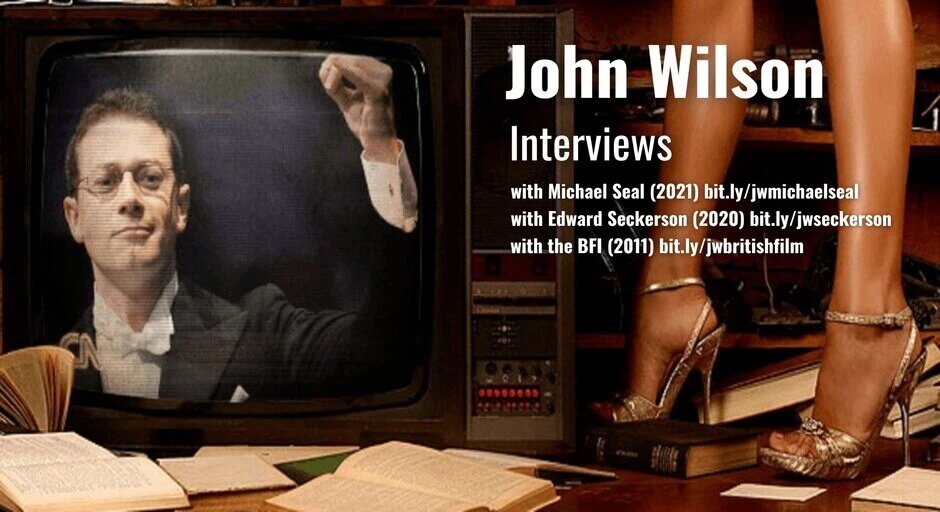
Now John, John / Glorious John, I know that you know, and I know that you know that I know, that my long-distance lovemaking to you is being observed by a few; not many, just a few. So this rundown is for them, love:
Here are the main points I took away from this podcast: “What I do try to do as a conductor is carry my sound around with me… It’s almost—I don’t really feel comfortable talking about because you know music is basically a doing thing and not a talking thing… My deepest musical creed is wrapped up with how an orchestra sounds…” Which pretty much confirms what I’ve suspected all this time about him.
John, fire of my loins, I respect your process.
Now, as heard on Monty Python:
Fantasia on “Greensleeves” Ralph Vaughan Williams, composer Barbirolli Conducts English String Music RCA, 1963 first issue The Sinfonia of London John Barbirolli, conductor
EXTRA! Here are 2 interviews with John from BBC 2 Radio: one (8 min long) from 24 April 2016 with Michael Ball, and one (4 min long) from 4 November 2013 with Steve Wright.

 Above Ken Watanabe and Kelli O’Hara in 2015 Broadway’s sexy production of The King and I, my beloved Brit John Wilson conducts his John Wilson Orchestra in the Albert Hall in the





 Dick Cavett and Anthony Burgess on my old B&W portable, a US knockoff made by the same company that cornered the 70s East Coast market in prepackaged noodle soup, Pho King. Above the interlocutors:
 "I'll Be Dead Before You Break My Heart"