My First Music: Soames Rapes Irene in The Forsyte Saga (BBC, 1967); “Halcyon Days” from Eric Coates’s Three Elizabeths Suite Played by the BBCPO and Conducted By My Excellent John Wilson

I was twelve when The Forsyte Saga was first shown on American TV and I thought it was the coolest series ever.* It was about a large, rich and, though unconnected, influential family living in late-capitalist England circa 1879, who keep getting into pretty heated conflicts with each other—which at the bottom are really about, more or less, the value of art and the inner life vs commerce—all the while being beautifully attired and beautifully well-spoken. Hearing this royal fanfare “Halcyon Days” that opened the show was enough to get me all excited with anticipation on a Sunday night, but it wasn’t until last year around May when I finally discovered the composer of the piece, Eric Coates, plus the rest of this ravishing movement, when I fell in love with conductor John Wilson and developed a raging need to get close to the music he’s close to.

Screening Room, SF 1979Above: Above Soames played by Eric Porter—The Man of Property, Noted Art Collector, and about as Mr Wrong as you can get—who mistook his wife for a soulless mannequin and, in novelist John Galsworthy’s sardonic words, “asserted his marital rights and acted like a man” in this scene, in which the BBC made shocking good use of Nyree Dawn Porter’s lovely embonpoint: My gorgeous, wondrous John Wilson leads the BBC Philharmonic in Coates’s “Halcyon Days”.

My beloved John conducted this 29 March, 2022 in Salford, as part of a program devoted exclusively to the music of prolific BBC composer, Eric Coates. It was glorious.

Here’s a remembrance of Nyree Dawn Porter and The Forsyte Saga in The Guardian reprinted in FB, including my protestation over the use of the word “frigid”.

*In fact it got me to read the entire cycle of nine novels the series was based on; finished them when I was thirteen. Dinny Cherrell’s my favorite character.


FULL DRESS // A gifted mesmerist—a sinister composer—a naive young conductor from the north…inspired by an episode from the life of Rachmaninoff // DOWNLOAD FREE BOOK POSTER

“Changing My Tune” from The Shocking Miss Pilgrim by The Gershwins and Rescued by Composer Kay Swift, George Gershwin’s Married Secret Lover

We can thank composer-arranger Kay Swift, composer of “Fine and Dandy” and George Gershwin’s married secret lover, for making sure this song found its perfect setting in this 1947 20th Century Fox musical after his untimely death ten years earlier.

Castles were crumbling
And daydreams were tumbling
December was battling with June
But on this bright afternoon
Guess I'll be changing my tune

swift-gershwinAbove Kay Swift and her secret love: Barbara Cook and Tony Perkins sing “Changing My Tune” in Ben Bagley’s legendary recording series of deep Broadway cuts.

“When someone in the story is famous, every moment of his existence has, for people who care, an aura of significance, and there will always be people with a quasi-authority who think they know things they could not possibly know, simply because they have a lot of information and curiosity and a sense of entitlement to “the truth” about George Gershwin, as if sufficient obsession and possession of a lot of verifiable facts can earn both entitlement to and knowledge of the unknowable.”

from The Memory of All That (Broadway Books, 2012)
by Katharine Weber, Kay Swift’s granddaughter


FULL DRESS // A gifted mesmerist—a sinister composer—a naive young conductor from the north…inspired by an episode from the life of Rachmaninoff // DOWNLOAD FREE BOOK POSTER

A Reading Note Just for My Beloved John Wilson, Conductor: The Truest Rendering of My Feelings for You in The Black Prince by Iris Murdoch

From 2022: Hope you’re feeing better, mi vida, and that you’re up and getting ready for Sheffield. Given that my feelings for you lie somewhere between a Larry Hart lyric and an Iris Murdoch story, I want to share with you 1) one of most beautiful Rodgers+Hart songs; and 2) an early passage from my second favorite comic novelist’s 15th novel, The Black Prince* (Viking, 1973) before everybody goes to hell and—well, I won’t give it away:

…[I]t is one of the peculiarities, perhaps one of the blessings, of this planet that anyone can experience this transformation of the world. Also, anyone can be its object. … The foreverness of real love is one of the reasons why even unrequited love is a source of joy. The human soul craves for the eternal of which, apart from rare mysteries of religion, only love and art can give a glimpse. … Love brings with it also a vision of selflessness. How right Plato was to think that, embracing a lovely boy, he was on the road to the Good. I say a vision of selflessness, because our mixed nature readily degrades the purity of any aspiration. But such insight, even intermittent, even momentary, is a privilege and can be of permanent value because of the intensity with which it visits us. Ah, even once, to will another rather than oneself! Why could we not make of this revelation a lever by which to lift the world? Why cannot this release from self provide a foothold in a new place which we can then colonize and enlarge until at last we will all that is not ourselves? That was Plato’s dream. It is not impossible.

*The Black Prince is lust. Figured that out myself.

Above John’s adorable face: Jane Frohman sings the song I’d make a fool of myself singing on the streets of Southwark below his window, “With a Song in My Heart”.


FULL DRESS // A gifted mesmerist—a sinister composer—a naive young conductor from the north…inspired by an episode from the life of Rachmaninoff // DOWNLOAD FREE BOOK POSTER

Wide Sargasso Sea by Jean Rhys; Soundtrack Score for the 1993 Film by Stewart Copeland

When I was a teenager I read all of the Brontë novels, including The Professor, Shirley, Villette, Agnes Grey, and The Tenant of Wildfell Hall. When I was 19 I read all of Jean Rhys‘s novels, including this one. Whyd’you think Charlotte Brontë mutilated and blinded that racist bastard Mr Rochester anyway?

Above: Stewart Copeland’s weird, haunting music for the 1993 film


FULL DRESS // A gifted mesmerist—a sinister composer—a naive young conductor from the north…inspired by an episode from the life of Rachmaninoff // DOWNLOAD FREE BOOK POSTER

Letter to Leonard Bernstein from Felicia Montealegre, Late 1951

An extremely private but deeply moving letter, published in a collection by Yale U Press in 2013. This was written around the time she had just married Bernstein and was still acting in television (watch Felicia as Mildred in Of Human Bondage on Studio One on my YT channel here):

Lenny and FeliciaAbove the newlyweds: Bernstein’s early piano composition, “Four Anniversaries: 1. For Felicia”

Darling,

If I seemed sad as you drove away today it was not because I felt in any way deserted but because I was left alone to face myself and this whole bloody mess which is our “connubial” life. I’ve done a lot of thinking and have decided that it’s not such a mess after all.

First: we are not committed to a life sentence—nothing is really irrevocable, not even marriage (though I used to think so).

Second: you are a homosexual and may never change—you don’t admit to the possibility of a double life, but if your peace of mind, your health, your whole nervous system depend on a certain sexual pattern what can you do?

Third: I am willing to accept you as you are, without being a martyr or sacrificing myself on the L.B. altar. (I happen to love you very much—this may be a disease and if it is what better cure?) It may be difficult but no more so than the “status quo” which exists now—at the moment you are not yourself and this produces painful barriers and tensions for both of us—let’s try and see what happens if you are free to do as you like, but without guilt and confession, please!

As for me—once you are rid of tensions I’m sure my own will disappear. A companionship will grow which probably no one else may be able to offer you. The feelings you have for me will be clearer and easier to express—our marriage is not based on passion but on tenderness and mutual respect. Why not have them?

I know now too that I need to work. It is a very important part of me and I feel incomplete without it. I may want to do something about it soon. I am used to an active life, and then there is that old ego problem.

We may have gotten married too soon and yet we needed to get married and we’ve not made a mistake. It is good for us even if we suffer now and make each other miserable—we will both grow up some day and be strong and unafraid either together or apart—after all we are both more important as individuals than a “marriage” is.

In any case my dearest darling ape, let’s give it a whirl. There’ll be crisis (?) from time to time but that doesn’t scare me any more. And let’s relax in the knowledge that neither of us is perfect and forget about being HUSBAND AND WIFE in such strained capital letters, it’s not that awful!

There’s a lot else I’ve got to say but the pill has overpowered me. I’ll write again soon. My wish for the week is that you come back guiltless and happy.

~F

from The Leonard Bernstein Letters
edited by Nigel Simeone
Yale University Press, 2013


FULL DRESS // A gifted mesmerist—a sinister composer—a naive young conductor from the north…inspired by an episode from the life of Rachmaninoff // DOWNLOAD FREE BOOK POSTER

Richard Rodney Bennett’s Concerto for Stan Getz Played by the BBC Scottish Symphony Orchestra and Conducted by Bonny John Wilson (Chandos, 2017)

A few insights on the orchestral pieces of the lively and prolific Richard Rodney Bennett (“A Collage Artist” will be the post’s title) to be finished as soon as I, one, do a little necessary sex writing, and, two, actually buy the complete Chandos 4-volume set of the work of John’s distinguished mentor, conducted by John. For now, here’s a recording from a BBC broadcast (yes, bonny John is conductor) that starts off with a few words from the composer himself:

John AlbumAbove my beloved John at 28 and his major musical influence, Richard Rodney Bennett (1936-2012) [download PDF of Feb 2020 issue of Gramophone with John’s interview here]: Concerto for Stan Getz (I know I knocked their album Orchestral Jazz and rightly so, but this is a swell picture)


By the way John, with your brimming schedule I can imagine you’re not much of a reader, but I’m sure like many you like having useful books at hand, so here are three in pdf:


NOTE: “[The English temperament] is disciplinable, and steadily obedient to certain limits, but retaining an inalienable part of freedom and self-dependence, [with a propensity for] spending its exertions within a bounded field, the field of plain sense, of practical utility.” ~ Matthew Arnold The Study of Celtic Literature (1867)


FULL DRESS // A gifted mesmerist—a sinister composer—a naive young conductor from the north…inspired by an episode from the life of Rachmaninoff // DOWNLOAD FREE BOOK POSTER

25 May—Two Birthdays: My Dad’s and My Beloved English Conductor John Wilson’s

My father, who was born on the 25th of May 1905, went to the movies with me only a couple of times. The first was for Taras Bulba (United Artists, 1962). I remember him getting a particular kick out of the ride of the Cossacks scene, thrilling Franz Waxman music and all.

The second time was for Tora! Tora! Tora! (20th Century Fox, 1970). The movie house in Columbia Heights, just over the city line from Northeast Minneapolis, was within walking distance, I walked it all the time, and could still get in for 50 cents because at 15 I still looked 12. For some reason my father ended up not only driving me the few blocks, but after I’d found my seat and the lights went down I was astonished to notice him come in and sit down beside me.

“Dad, what are you doing here?” I whispered loudly. “You know, the Japs win in this.”

“Not for long,” he answered cheerfully, which is about as close as anyone in our family got to talking about the 7 December 1941 attacks and the general brutality my mother, then a teenager in Bangar in the province of La Union, had to face in an occupied country.

Bangar in those days was rather like Nouvion in ‘Allo ‘Allo—a little town situated a ways from the capital but near the sea, a hotbed of resistance. When you read about Bangar here, just remember: that kid who escaped, which resulted in occupying troops burning down the place, was one of my cousins. When the guards marched him to town to be executed, his family, through looks and gestures from a distance, pretty much gave him the word that they expected him to “take one for the team” i.e. let himself be shot; but at the last moment, as family legend goes, he grabbed the officer’s sword and in the confusion was able to get away into the forest. And so as feared came the reprisals.

A shadow still hangs over the de la Peña family.
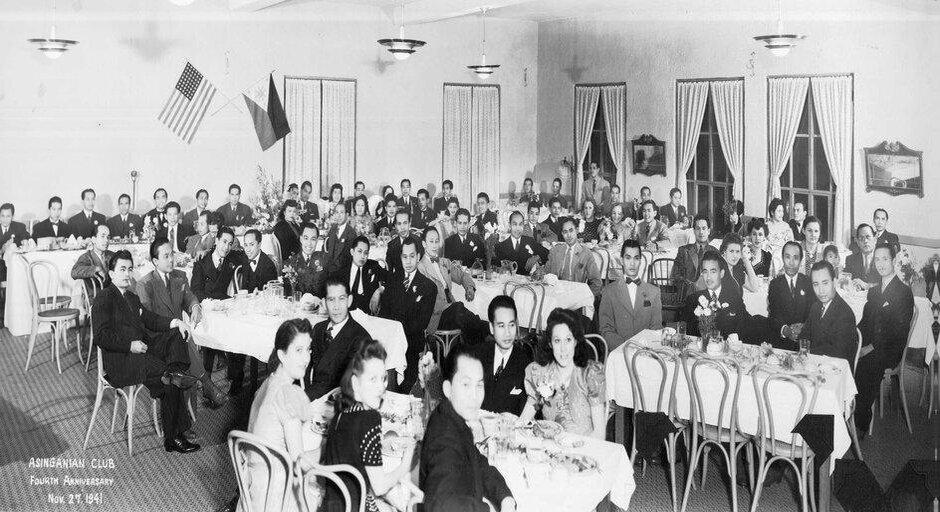
Fil-Am 1941Taken at a banquet of an old Filipino-American association my dad was part of (that’s him under the picture on the right; keep forgetting he still had hair before I was born), one of about a hundred around at the time. Note the date: only a couple of weeks before Pearl Harbor. Note also the Philippine flag on the wall. The Philippines wasn’t yet a sovereign nation but a Commonwealth and didn’t achieve independence till 1946. More at “To My Beloved John Wilson, Who Shares His May 25th Birthday with My Dad; Or, Don’t Call Me a Person Of Color, I’m a Product Of Empire, 2”


Meanwhile in California my dad, who had come to the States a young man in 1927, was engaged to a woman from St Louis he eventually COULD NOT MARRY because—are you ahead of me on this?—HE WASN’T WHITE!!! Yes! The MISCENEGATION LAW of the State of California—which by the way was NOT REPEALED UNTIL 1948—prohibited them and God knows how many other California couples from legally joining, forcing them to travel to other states where they could. Recently read this happened to, among others, that fine actor Dean Jagger (here seen with Danny Kaye and Bing Crosby in White Christmas, 1954 Paramount) and his Chinese-American fiancee; and the Oscar-winning cinematographer-director James Wong Howe (Picnic, 1955) and his white fiancee, author Sanora Babb. I‘d be curious to hear other people’s stories.

How my dad, residing at last in Minneapolis, eventually found and married my mother in Manila is another story, and it’s a doozy. I’ll tell it one of these days. Here it is:


“To My Beloved English Conductor John Wilson, Who Shares a Birthday With My Dad; Or, Don’t Call Me a Person of Color, I’m a Product of Empire”

Part 1 here | Part 2 here | Part 3 here | Part 4 here


Now for John, who was born the day of my father’s final birthday, in 1972. John, I’m not saying we’re psychically linked, but about a month ago in the middle of defrosting the refrigerator I think I got a weird emotional flash from you where you were being right annoyed over some flap over a booking… I got the impression it might’ve been for The John Wilson Orchestra. [UPDATE: It wasn’t, it was the Sinfonia of London. 4 September 2021.] You were waiting for some kind of answer re your orchestra, whichever one it was, and not getting it, and I actually felt your annoyance… As I say, it was weird, like listening in on a party line…

That’s all I could make of it. But it’s enough to make me want to give you something special for your birthday. So…I’ve tried this only once, with an old boyfriend, and I think because I was really, really into him it worked. On the actual day of your birthday, John, I’m going to try to send you an energy shot. [UPDATE: Just did it. Think I got through. 25 May 2020 2AM UK time.] Until then, Happy Birthday, light of my life, fire of my loins. And if you and I ever meet up, tell me if it worked.

[More About My Dad]


FULL DRESS // A gifted mesmerist—a sinister composer—a naive young conductor from the north…inspired by an episode from the life of Rachmaninoff // DOWNLOAD FREE BOOK POSTER

Patrick Hamilton’s Hangover Square; Laird Cregar; Plus Bernard Herrmann’s Concerto Macabre in BBCSSO’s Music to Be Murdered By (2011) Conducted by John Wilson, My Beloved Enfant Terrible

Hangover Square is a 1945 American film noir directed by John Brahm, based on the 1941 novel of the same name by English author Patrick Hamilton. The screenplay was written by Barré Lyndon (pseudonym of Alfred Edgar), who made a number of typical Hollywood changes to Hamilton’s pre-WWII black comedy novel, which sympathetically portrayed the denizens of London’s seedier bedsitters and pubs—the most notorious changes being 1) turning alcoholic protagonist George Harvey Bone into a classical composer-pianist; 2) turning down-and-out Hangover Square into a fakey-English-fakey-genteel neighborhood; and 2) setting the story in the early 20th-century, complete with tailcoats, corsets, chandeliers, the works.

The film was released in New York City on February 7, 1945, two months after its star Laird Cregar suffered a fatal heart attack at the age of 31. His idiosyncratic career lives on in his films—The Lodger, most notably, and this one.


The complete film HANGOVER SQUARE is available here


Screening Room, SF 1979

Above Cregar’s mad composer: Bernard Herrmann’s composition by a mad composer, played by Ben Dawson and backed by the BBC Scottish Symphony Orchestra under the firm virile baton of my beloved John


From FilmScore.com, 2011: John Wilson, the current enfant terrible of British conductors, was in Glasgow yesterday, Sunday 18th September, to conduct Music To Be Murdered By: a varied selection of Bernard Herrmann, Alfred Newman, Miklós Rózsa, David Raksin, Richard Rodney Bennett and Constant Lambert film music with the Scottish Symphony Orchestra.

The rousing Overture from North By Northwest started off this marvellous concert and showed what both the orchestra and conductor were capable of. Then a short suite from David Raksin’s Laura (John) gave us another side of film music: soft, sweet and completely entrancing. More Herrmann next with the Prelude-Nightmare-Love Scene from Vertigo, superbly played with just the right amount of tension and tempo.

The Overture to All About Eve, Alfred Newman’s 1950 20th Century Fox classic film score followed and then pianist Ben Dawson joined Wilson and the BBCSSO to perform brilliantly the Concerto Macabre (John), the climax to Herrmann’s spine-tingling score from Hangover Square. The first act finale was Parade of the Charioteers from Ben Hur (John), Miklos Rozsa’s masterpiece—the orchestra and Wilson brought the house down with this rousing and spectacular performance.

More Herrmann started Part Two: Prelude-Murder-Finale from Psycho (John) . Just the right amount of brio and flair showed the appreciative audience just what a great conductor John Wilson is—he nailed this suite with consummate ease. He might have been channelling Bernard Herrmann here—one of the best performances of this music I have heard.

A suite from Anna Karenina, Constant Lambert’s (John) underrated score from the 1948 British film came next and Wilson told the audience that Bernard Herrmann had originally recorded this for a Decca Album, Great British Film Music. Then the thrilling Main Title from Marnie gave us more classic Herrmann and the concert concluded with the Christopher Palmer adapted Herrmann Suite from Taxi Driver and Richard Rodney Bennett’s Overture and Waltz from Murder On the Orient Express for orchestra, piano and…fire extinguisher! (simulated steam noise for the engine in this well-played piece).

The afternoon was a great addition to Bernard Herrmann’s centennial—and the almost-full auditorium at Glasgow’s City Hall proved that the audience certainly appreciated Herrmann, the Scottish Symphony Orchestra and conductor John Wilson, whose love of film and film music gave us a performance to treasure—and remember. ~Alistair Kerr

EXTRA! Because this is as good a place as any to put it, here’s Laird Cregar playing a surprisingly comic role in my old boss Mamoulian’s sweet 1942 romance, Rings On Her Fingers


FULL DRESS // A gifted mesmerist—a sinister composer—a naive young conductor from the north…inspired by an episode from the life of Rachmaninoff // DOWNLOAD FREE BOOK POSTER

Claptrap, a volume of poetry by Stephen Gyllenhaal (Cantarabooks, 2006)

Lest we forget the source of our lately grief, this is Steve’s one and only book, which my small press published in 2006. The poems were good. The poet was a schmuck. And I say that in deference to his lovely (ex-)wife, Naomi, to whom he dedicated this slim volume of confessional free verse. I wrote about this in my nutty memoir A Poet from Hollywood, available for free in pdf download here.

Claptrap by Stephen Gyllenhaal

Naomi, why do you purposely fail to believe me??? I turned the meathead down! Twice!! Above Stephen and Peter Sarsgaard (yes, that’s the back of Peter‘s head): Hugo Alfven’s “Swedish Rhapsody” arranged-conducted by Michel Legrand and played by his orchestra.


The dedication by Jamie Lee Curtis (she’s Jake‘s godmother so she did Naomi a favor by writing this for Steve, who was in a jam—well, just read about it here) is pretty adorable and for that sake I might try to hunt up the pdf galley and upload it here.

EXTRA! Not that he deserves the attention, but here are three of Stephen’s poems, recited by the idiot himself:

EXTRA EXTRA!


FULL DRESS // A gifted mesmerist—a sinister composer—a naive young conductor from the north…inspired by an episode from the life of Rachmaninoff // DOWNLOAD FREE BOOK POSTER

A Great American Songbook Song for My Beloved John Wilson, Conductor: Rodgers+Hammerstein’s “Some Enchanted Evening” from South Pacific, Sung by Jane Olivor

I like to post short little items like this when I’m in the middle of big writing, which is where you find me now. This tune was tremendously popular in the jukeboxes of the Castro, circa late 1970s, before and after AIDS first hit. So ubiquitous was Jane Olivor’s rendition novelist Armistead Maupin couldn’t ignore it—this was the song that brought Michael “The Mouse” Tolliver to tears in the first volume of Tales of the City. Put this on and there isn’t a dry eye in the room, whether you’re thinking of a dead lover or a living one. I think of both.

Jane Olivor First Night

Above: “Some Enchanted Evening” written for the 1947 stage musical South Pacific, music by Richard Rodgers, lyrics by Oscar Hammerstein II. A song has lyrics, John my love. This is how I speak to you.


FULL DRESS // A gifted mesmerist—a sinister composer—a naive young conductor from the north…inspired by an episode from the life of Rachmaninoff // DOWNLOAD FREE BOOK POSTER

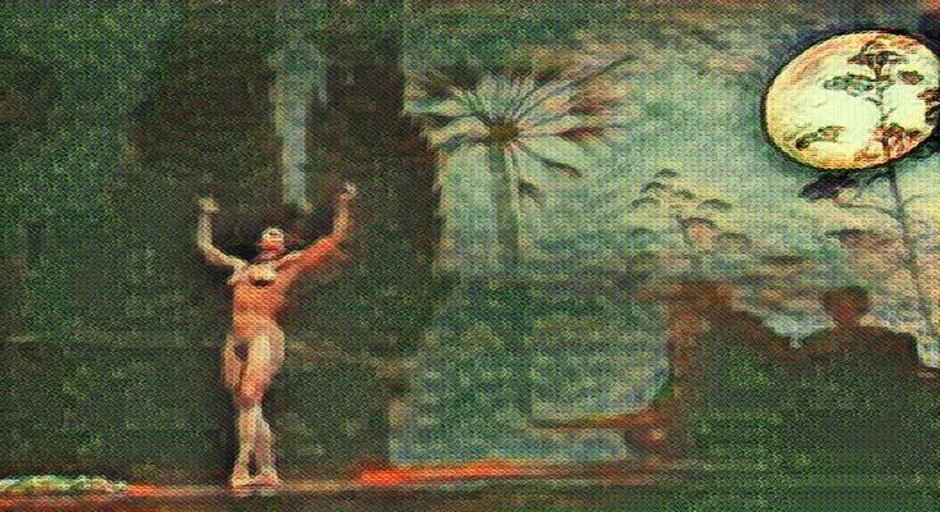
Maria Ewing (1950-2022) Gives Richard Strauss’s Salome the Full Monty and Sings “Bali Ha’i” Exotically with The JWO, Just for My Beloved English Conductor, John Wilson

There are 3 naked ladies in this blog. This is one of them.

“I’m not given to displays of emotion, but when Maria and I met up again [to record the R&H album] we had tears in our eyes. She’s so exotic!” enthused my bonny conductor about this Detroit-born soprano. “I love her—as a person!” Yes, John. I’d love to hear more.

Maria Ewing in SalomeAbove proudly nude Salome in the 1991 Covent Garden production of Richard Strauss’s 1905 opera directed by Ewing’s husband at the time, Sir Peter Hall: “Bali Ha’i” sung by soprano Maria Ewing in the compilation Rodgers & Hammerstein At the Movies, with The John Wilson Orchestra, conducted by John Wilson (Warners, 2011).

About the DVD recording of Salome, says Toronto blogger John Gilks in Opera Ramblings: “The production is really pretty conventional… Almost all the visual interest revolves around Ewing’s Salome though Michael Devlin’s scantily clad and palely made up Jochanaan is quite arresting too. Narraboth (Robin Legate) is an unremarkable actor and Herod (Kenneth Riegel) and Herodias (Gillian Knight) look uncomfortably like a couple of drag queens… The recording, directed by Derek Bailey, is about what one would expect from a 1992 BBC TV broadcast… This is probably worth having a look at as a record of an iconic performance by Ewing but I can’t imagine anyone would choose it as the definitive Salome.”

Here’s another exotic nude, just for my beloved John Wilson.

And the third and best, which you can find in the posting, “Cantara Christopher in Sadie (Bob Chinn director, Mitam Productions, 1980) as Indexed in the Database of the British Film Institute; and ‘Pictures of Lily’ by Pete Townshend”.


FULL DRESS // A gifted mesmerist—a sinister composer—a naive young conductor from the north…inspired by an episode from the life of Rachmaninoff // DOWNLOAD FREE BOOK POSTER

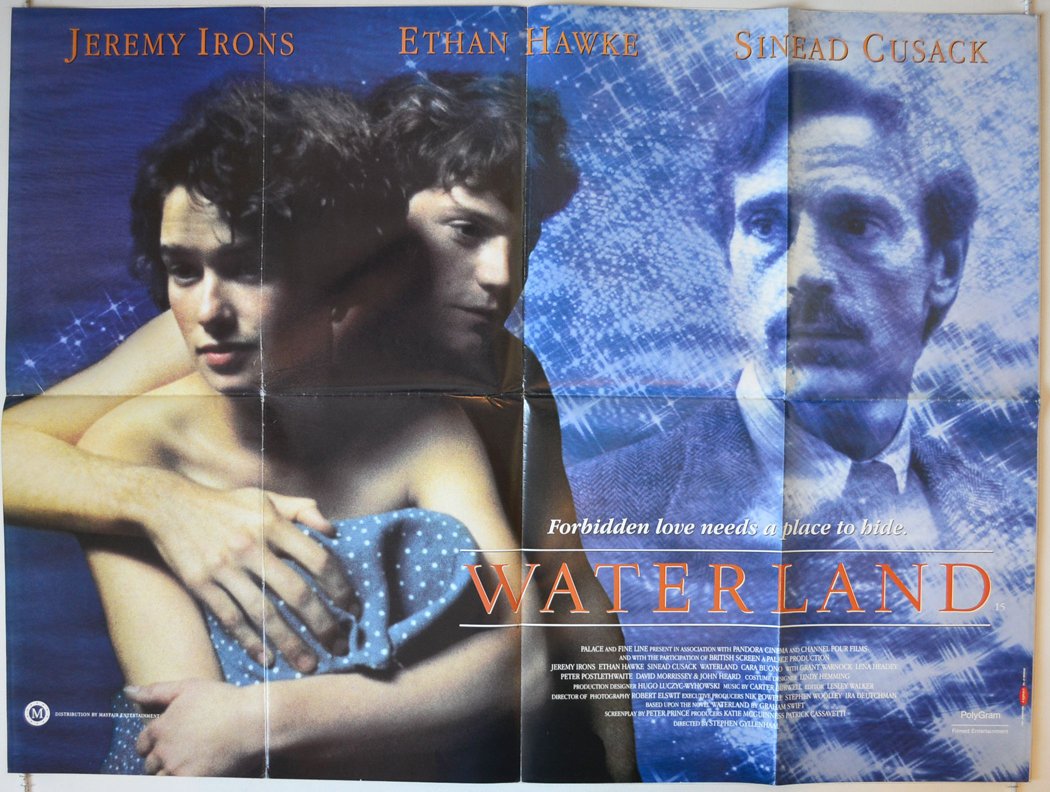
Waterland from the Graham Swift Novel Starring Jeremy Irons, Sinead Cusack, Ethan Hawke, Grant Warnock, Lena Headey; Music by Carter Burwell; Directed by Stephen Gyllenhaal, 1992

This is Stephen’s best movie, hands down. Whenever I think of Stephen and thinking of him raises my blood pressure remembering all the shenanigans he pulled on me, I also think of Waterland and (almost) all is forgiven between us, as far as I’m concerned.

Waterland.jpgThat’s Lena Headey in her first screen role. Above Lena, Grant Warnock and Jeremy Irons: Carter Burwell’s gorgeous, haunting music from Waterland.


I’m not a huge fan of Graham Swift‘s books, but I read his Waterland and Last Orders, and much prefer Last Orders as a novel but Waterland as a film, no matter how many trivial changes the screenwriter made. In Swift’s memoir there’s the amusing revelation that Steve got this assignment because although he was last on the list he was the only one available…yeah, that’s the Gyllenhaal Luck. Fortunately—really fortunately—Steve had with him a very good Director of Photography, Robert Elswit, and score composer Carter Burwell, whose music you can hear above.

I mentioned in another posting about his film work that “there’s a creepy, dreamy, nasty edge in almost all the sex scenes in Steve’s movies…” which certainly figures here. Not in the actual sex scenes between the teenage lovers, which are all lyrically rendered, but in that damn ABORTION SCENE in the woods, which never fails to get gasps from us females in the audience. Check it out. There’s a weird fairy-tale quality to this scene which is beautiful, but sooo the wrong tone.


FULL DRESS // A gifted mesmerist—a sinister composer—a naive young conductor from the north…inspired by an episode from the life of Rachmaninoff // DOWNLOAD FREE BOOK POSTER

Update On Conductor John Wilson’s 2020 Gigs: Britten’s The Turn of the Screw (March); Tchaikovsky’s Symphony No 4 in Santiago (April); and Massenet’s “Meditation” (Chandos, February)

CANCELLED: Opera GlassWorks’s fully-staged production of Benjamin Britten’s chamber opera The Turn of the Screw scheduled to open 11 March 2020. More information on my later posting, “Benjamin Britten’s The Turn of the Screw with Peter Pears and the EOG, 1954; and Wilton’s Music Hall, 2020, Filmed by Opera GlassWorks and Conducted by My Beloved John Wilson”.


EXTRA! My beloved John speaks in this half-hour BBC4 radio show about the re-staging of Turn of the Screw at Wilton’s Music Hall, 2020


AVAILABLE 30 JAN 21: Opera Glassworks’s TURN OF THE SCREW streamcast at Marquee.tv


CANCELLED: During Easter Week, the holiest week of the year for observing Catholics, John in Santiago, Chile conducting a me-tic-ulously chosen student orchestra, culminating in a concert on Easter Sunday consisting of the always-favorite Tchaikovsky’s Symphony No 4 and Rachmaninoff’s Piano Concerto No 3.

John Wilson with Onyx Brass, 2021NOTES for John’s new CD Escales (Chandos, Feb 2020) can be found here.


RECORDED: Lastly, re “Meditation” above, that short symphonic intermezzo between the scenes in Act 2 in the opera Thaïs (1893) by Jules Massenet, which my beloved John conducts on his February 2020 album from Chandos (10th cut) and in which Andrew Haveron performs his violin solo like an angel…

Gazing now at John with love and longing and taking this to a private place. Everybody, go away.


FULL DRESS // A gifted mesmerist—a sinister composer—a naive young conductor from the north…inspired by an episode from the life of Rachmaninoff // DOWNLOAD FREE BOOK POSTER

On Conductor John Wilson’s Orchestral Arrangement of “Now, Voyager” at the BBC Proms 2019 and The First Porn Movie I Ever Did, 3

Dearest John Wilson, Conductor, it makes me happy to be in your audience and I don’t require you at all to be in mine—mostly because, as Mister Grumble just pointed out, my flicks would probably give you a heart attack. It also makes me happy that you’re going to be concentrating more on the Classic Repertoire this season, although it means leaving your faithful John Wilson Orchestra fans for a timeand only because when you’re not playing American film music, you’re not on the podium making the kind of quasi-witty comments that would make even me wince, and I used to be Arthur Godfrey’s gag man back in the fifties.


Now VoyagerNow, Voyager (1942): Bette Davis as brave Charlotte Vale and Paul Henreid as her handsome weenie of a lover in this BBC2 Saturday Afternoon Movie I’ll bet John saw once upon a rainy day when he was a kid and couldn’t make head nor tail of, except for the music. Above: That’s my beloved John conducting the Sinfonia of London in this Max Steiner score, including the Warners Bros studio theme, which Steiner also wrote. Orchestration by Hugo Wilhelm Friedhofer.


By the way John my sweet Geordie lad, I’m getting a kick out of imagining you form the word “porn”. Pohhhrnnn.

On that note, I just want to let all of you know that I realize it’s not hard to find me. Really. I’m in the IMDb. I don’t even have to fill you in on what my screen name is because IMDb seems to have switched pretty much every one of my credits back to my legal name anyway, so it would be kind of pointless… All right. It’s Simona Wing. My castmates in my first movie, Dork & Sindy aka Playthings, gave it to me, and I consider it quite a lagniappe. Mister Grumble used it for my character’s name in his first novel (Tales from the Last Resort, Brave New Books, 2002) and no one has been able to get better use out of it since.

I have pleasant memories of that shoot. For one thing, it was shot in Marin County. In Sausalito! In a house overlooking the Bay. Do you see in that pic those houses up in the hills? The white house above the red roof, that’s where we shot.

For another thing, Craft Services was fantastic. You could graze all day.

And it was a friendly, clean shoot. Does anyone here who saw the flick remember what I was wearing before the guy in sunglasses stripped me naked, threw me into the hot tub and started chewing on my behind? That white blouse, that long black skirt, those pumps? That was my secretarial outfit, the one I wore a few months earlier in Beverly Hills when I worked for Rouben Mamoulian. Practically every day, I was that poor (took Sunset bus to foot of Schuyler Road, got off, wearing sneakers climbed hill, at Mamoulian’s door removed sneakers, put on pumps which I carried in my handbag). I remember I had one line which has since been coming back to me regularly, because whenever I run into an occasional fan, he (and it’s always a he) tends to quote it to me:

“Marin County been bery, bery good to me.”

Now, you have to be a real Saturday Night Live geek to recognize that line, and I’m not going to decipher it for you. But I suppose this showed people I could do voices, because I got a lot of work from this film, almost all of it involving fakey foreign-sounding accents. Like Fatima, woman of Borneo, in the softcore version of Sadie Thompson aka Rain by Somerset Maugham. I’m not kidding.


The entire film RAIN with Joan Crawford is available on my YT channel here


FULL DRESS // A gifted mesmerist—a sinister composer—a naive young conductor from the north…inspired by an episode from the life of Rachmaninoff // DOWNLOAD FREE BOOK POSTER