The Silent Musician by Mark Wigglesworth, Richard Wagner, Cosmic Sex, and My Beloved Conductor John Wilson

From 2021: In an earlier post I mentioned that, since May a couple years ago, I’ve been reading books by orchestra conductors on conducting, in order to better glimpse into the unfamiliar heart and mind of my beloved John Wilson. That classic tome written by Richard Wagner was far out, of course, and going back to some of Leonard Bernstein‘s early writings was deeply nostalgic.

But it was my treatment of a book my bonny conductor had on his public Facebook Likes list that done me in—a thin, and thinly humorous, volume written by a coeval of John’s who let out his dirigental insecurities in a tirade of snark that I answered in kind in a long, 4-star Amazon review that I thought was hilarious, which it was, although apparently only to me. I did this to get John’s attention. I got it. John did not like what I wrote. Hence, he learned how to spell my name ab-so-lute-ly correctly.

Now, Mark Wigglesworth has a 30-year career conducting a number of the great operas and a number of the great symphony cycles, to much acclaim. If there is one thing that John’s friend’s book made evident, in its perverted way, it’s the importance of a conductor being holistically grounded, and Wigglesworth is, as we used to say in the 70s, a grounded guy. Not surprising for someone who has Alan Watts on his bookshelf; and since the English-born psychedelic Zen guru of San Francisco is one of my guiding lights too, it was a deep pleasure to read The Silent Musician, Wigglesworth’s musings on his inner/outer artistic journey as a conductor. Wigglesworth, from Sussex, is an acclaimed interpreter of Gustav Mahler as well as Wagner, two creative heavyweights who positively require those who would approach their work to have had a fair look first into their own personal psychological-spiritual makeup. Consider Daniel Barenboim—one artist on the world stage I respect the hell out of—and his own moral / philosophical / logistical grapplings with the Architect of Bayreuth (download his “Wagner and Ideology” here) and let me just say, if Barenboim figured it out I’m satisfied).

Speaking of Wagner, a few years ago Wigglesworth conducted the overture to a Wagner opera I’ll bet you’ve never heard of: Das Liebesverbot, or, The Ban on Love. I only know about this one because I took the mandatory survey course at music school at the university and never ran into it again till now. So this is the first and only thing I’ve ever heard from this opera:

Overture to Das Liebesverbot (1836)
Richard Wagner
Mark Wigglesworth, conductor
BBC Orchestra Wales

Or will ever hear, ever again. Just a bit…Mediterranean, wouldn’t you say?

But what amazes me more is the libretto, because Wagner—get this—chose for his source material the scuzziest, meanest sex comedy ever written, which is, of course, Measure by Measure by William Shakespeare. Yes, at the end hypocrisy is vanquished and everyone gets laid, but eeeeuuwww…

Now, think on the twenty-three year psychological-spiritual journey from Das Liebesverbot to this:

“Mild und leise” from Tristan and Isolde (1859)
Richard Wagner
Daniel Barenboim, conductor
Waltraud Meier, soprano
Beyreuth, 1995

I’m sorry, but when I hear that tune I want to see John’s dear face.

The rest of you, behold Hedy Lamarr and Aribert Mog in Ecstasy (Elektafilm, 1933).


FULL DRESS // A gifted mesmerist—a sinister composer—a naive young conductor from the north…inspired by an episode from the life of Rachmaninoff // DOWNLOAD FREE BOOK POSTER

Two Amanuenses: Frederick Delius’s Eric Fenby and Mister Grumble’s Cantara; Plus John Wilson Conducts the Sinfonia of London in Delius’s “Late Swallows”

It’s a funny coincidence, but the first—the very first—music article I wrote was for the University Chorus’s newsletter, a review of Ken Russell’s 1968 film, A Song of Summer. It just happened to have been on TV that month, May 1972, the month we were performing Frederick Delius’s 1916 Sea-Drift (available here on YouTube with accompanying score) and seemed like a natural to talk about…

frederick_delius_and_eric_fenby_by_simonawing_dgxg0vx-350tAbove: “Late Swallows” , the 3rd movement from Frederick Delius’s String Quartet in E minor, originally published in 1916 and re-arranged by Eric Fenby. My beloved John Wilson conducts his Sinfonia of London (Chandos)

[more later—my blind baby angel Mister Grumble‘s dictating his latest work to me, tentatively called The Last Bohemia; meanwhile amuse yourselves with his first here available in pdf, a comic novel of aliens, hippies, FBI agents, and cheap beer, Tales From the Last Resort…or this novella, Quality Time, about a day in the life of a young San Francisco heartbreaker…as for me, right now I’m re-reading Delius, As I Knew Him by Eric Fenby (G Bell & Sons, 1936)]


FULL DRESS // A gifted mesmerist—a sinister composer—a naive young conductor from the north…inspired by an episode from the life of Rachmaninoff // DOWNLOAD FREE BOOK POSTER

Iris and Groucho

I became a fan of the slyly comic novels of Iris Murdoch because of Groucho Marx, who made it known on The Dick Cavett Show that he was a fan… This was around the time Murdoch, prolific novelist, was coming out with her 15th book, The Black Prince (I dedicated a quote from it to the fire of my loins: “A Reading Note Just for My Beloved John Wilson, Conductor: The Truest Rendering of My Feelings for You in The Black Prince by Iris Murdoch”).


EXTRA! Courtesy of YT an entire episode of Groucho’s classic TV “game” show, You Bet Your Life from 5 December 1957, featuring American concert baritone and outspoken rock’n’roll hater, John Charles Thomas, plus the heroine of the most scandalous book in my mother’s forbidden library, The Big Love—the fetchingest teenager (15!) in Hollywood, Beverly Aadland! Just months before Errol Flynn swept her away! At 11:50 Beverly sings “All Shook Up” and Groucho dances a few steps solo, then with her, in a really sweet passage a deux.


FULL DRESS // A gifted mesmerist—a sinister composer—a naive young conductor from the north…inspired by an episode from the life of Rachmaninoff // DOWNLOAD FREE BOOK POSTER

“We John Wilsons, we can be busy little beavers when we need to be” ~ Novelist-Composer Anthony Burgess (Dick Cavett, ABC-TV 1971)

Anthony Burgess, my Number One Language Guy, was on Dick Cavett’s talk show late one evening during my first year at music school. The host had brought up the oft-told story of how Burgess, when in his 40s, was diagnosed with a brain tumor and told he would be dead in a year; consequently he returned home to England (he’d been in the civil service in Brunei) and was seized by a mania of writing that resulted in his completing a half dozen intriguing novels, all of which are still in print. Oh, and he didn’t die in a year. Referring to his name at birth—he was christened John Wilson, Anthony being his Catholic confirmation name and Burgess being his mother’s maiden name—Burgess quipped, “We John Wilsons, we can be busy little beavers when we need to be.”

Burgess and Cavett 940x512Dick Cavett and Anthony Burgess on my old B&W portable, a US knockoff made by the same company that cornered the 70s East Coast market in prepackaged noodle soup, Pho King. Above the interlocutors: A full audio recording of Burgess’s ’71 appearance on Cavett (the first half-hour) wherein he does an Ovaltine commercial as Shakespeare would have truly sounded. And here’s a downloadable copy of his most famous work, A Clockwork Orange.


Which is a remark that came to mind when I fell in love with John—my John, John Wilson the Conductorand read how he spent 15 years transcribing the “lost” scores of MGM musicals, toting his Sibelius-programmed laptop around, listening to tracks in off moments, plugging in those thirds and fourths and damned glissandos as he heard them, passing on pub crawling or watching the telly to keep working on this gorgeous music…

First fruit of my beloved’s efforts: The MGM Jubilee Overture, which was performed for its 50th anniversary by The John Wilson Orchestra at the Royal Festival Hall in 2004. (More information on the Overture plus tune credits here.)

FULL DRESS // A gifted mesmerist—a sinister composer—a naive young conductor from the north…inspired by an episode from the life of Rachmaninoff // DOWNLOAD FREE BOOK POSTER

My 2019 Amazon Review of Waving, Not Drowning by Lev Parikian; Plus My Beloved John Wilson and His Sinfonia of London Play Kenneth Fuchs’s Yummy Cloud Slant

There must be 17 people in the entire world for whom this book has any relevance. I am not one of them.*

John Mills, John Wilson, Kenneth Fuchs rehearsing the Sinfonia of London in Fuchs’s Cloud Slant. And if you think I’m hanging around enjoying too much of a good thing, read the first three words of Chapter 1 of Lenny Bruce’s How to Talk Dirty and Influence People.

I, however, have fallen hopelessly in love with an English, middle-ranking orchestra conductor, and this book was on his Facebook Likes List, and since nowadays I will follow (almost) anywhere my beloved John Wilson leads me, here we are. Why else would I not only purchase, but listen to, 58 Fanfares Played by the Onyx Brass and Geraldo’s Greatest Dance Hits—which nonetheless I have come to adore?

What the argument of the esteemed late fictional dirigent, “Barrington Orwell” speaking through his still-living amanuensis, Lev Parikian—son of the noted violinist Manoung Parikian—seems to be is that the career of an orchestral conductor is not a happy one. It is of course a hazardous profession, notorious for causing insanity, emotional instability, ruined health and, in at least one case I read about in Slipped Discwhen a woman in Brighton rushed the stage during a performance of Rodgers & Hammerstein and stabbed the conductor with a no. 2 Dixon-Ticonderoga shrieking, “You have desecrated the music of my people!”—homicide. But Orwell, or Sir Barry if you prefer, so reverences the lofty position he himself holds that he places the blame for dirigental woes everywhere but on the dirigent himself: on the uncooperative/disrespectful weather; or concertmaster; or soloist; or composer; or entire orchestra—choose one. Or all. I’m surprised he didn’t bring up Bernstein vs the BBCSO, but maybe the English were right on that one.

Unfortunately, in no way has this slight volume helped me better grasp the mind of my beloved, although it managed to identify his type. When not on the podium he wears neither Armani nor Hugo Boss but rather attires himself in jeans, trainers, horn-rimmed glasses and, because of his preternaturally long arms, blue bespoke shirts. I think he’s about 11 stone. Apparently off the podium he’s a combination of The Scholar and Mister Shouty-Scary. On the podium, in full formal dress, he is a god.

Which brings me to the theory of which I am the author: The conductor exists not for the orchestra, not for the composer living or dead (Good grief! Whoever had that idea?), but for the audience. Whether from a box at the opera or from the floor at the Royal Albert, the conductor is the friend, philosopher and guide we require and as such (except for that dishy second-desk violinist with the golden locks) ought to be our sole focus. Yes, it is a weighty role that demands an enormous amount of conviction and honest purpose in those foolhardy enough to accept it. But remember that it is We, the People, aka The Audience, who ultimately hold a conductor’s success or failure in our own sweaty hands.

*And by the way, I got that Stevie Smith reference. I have my own Stevie reference in my memoir, Mamoulian In Mind

FULL DRESS // A gifted mesmerist—a sinister composer—a naive young conductor from the north…inspired by an episode from the life of Rachmaninoff // DOWNLOAD FREE BOOK POSTER

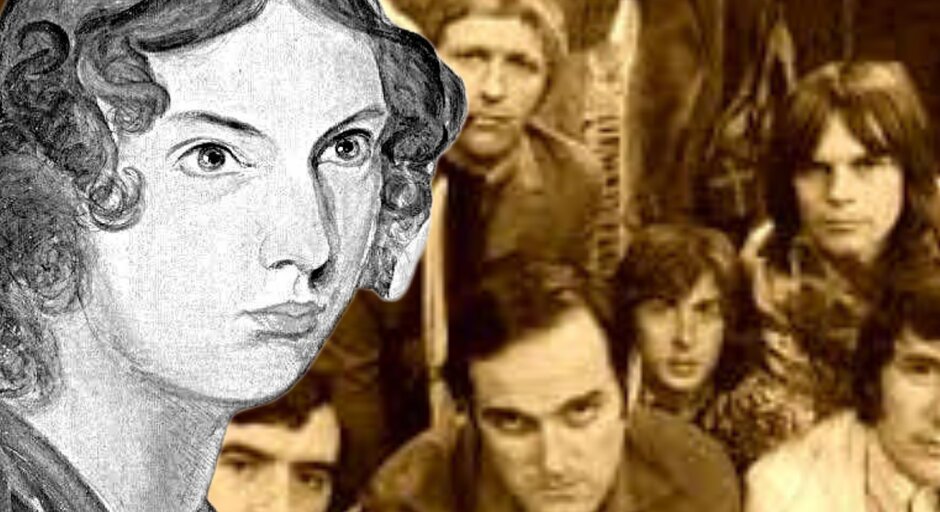
Anne Brontë and Monty Python

What shocking secret did teenage Jane learn on her wedding day! cried out the back of the Scholastic paperback on sale at school when I was 11, which got me to pony up the ninety-five cents to buy Charlotte’s Jane Eyre and find out. What merciless revenge did Heathcliff wreak on his in-laws! got another ninety-five cents out of me to buy Emily’s Wuthering Heights when I was 15. But it wasn’t until I was 19 when a sketch on Monty Python proclaimed Arthur Huntingdon’s shameless conduct against his wife that I was stoked to read Anne’s The Tenant of Wildfell Hall. It was worth the wait, I was finally old enough to appreciate it. The guy was scum.


From season 3, episode 9 (starting at 2:38) of Monty Python’s Flying Circus, the Housing Development Sketch*:

A modern construction site where various fictional characters from 19th century English literature are at work: a saucy dairymaid from Thackeray’s Barry Lyndon mixes cement; a crinolined lady from Trollope’s Barchester Towers carries a shovel; the beadle from Dickens’s Oliver Twist pushes a wheelbarrow; farmers from Hardy’s Tess of the d’Urbervilles lay bricks.

Voice Over (Michael Palin): This new housing development in Bristol is one of the most interesting in the country. It’s using a variety of new techniques: shockproof curtain walling, a central high voltage, self-generated electricity source, and extruded acrylic fiberglass fitments. It’s also the first major housing project in Britain to be built entirely by characters from 19th century English literature!

In a half-finished concrete shell, a little girl in a shabby dress is working on top of a ladder.

VO: Here, Little Nell from The Old Curiosity Shop fits new nylon syphons into the asbestos-lined ceilings— (shot of electrical wiring) But here’s the electrical system which has attracted the most attention! (cut to Arthur Huntingdon in blue safety helmet studying blueprint) Arthur Huntingdon, who Helen Graham married as a young girl, and whose shameless conduct eventually drove her back to her brother Lawrence in Anne Brontë’s The Tenant of Wildfell Hall, describes why it’s unique.

Huntingdon (Eric Idle): Because sir, it is self-generating. Because we have harnessed here in this box the very forces of life itself. The very forces that will send Helen running back to beg forgiveness!

*Postwar council-housing building scandals were a major issue in England in the 60s-70s. Check out the seminal BBC series, Our Friends In the North.


FULL DRESS // A gifted mesmerist—a sinister composer—a naive young conductor from the north…inspired by an episode from the life of Rachmaninoff // DOWNLOAD FREE BOOK POSTER

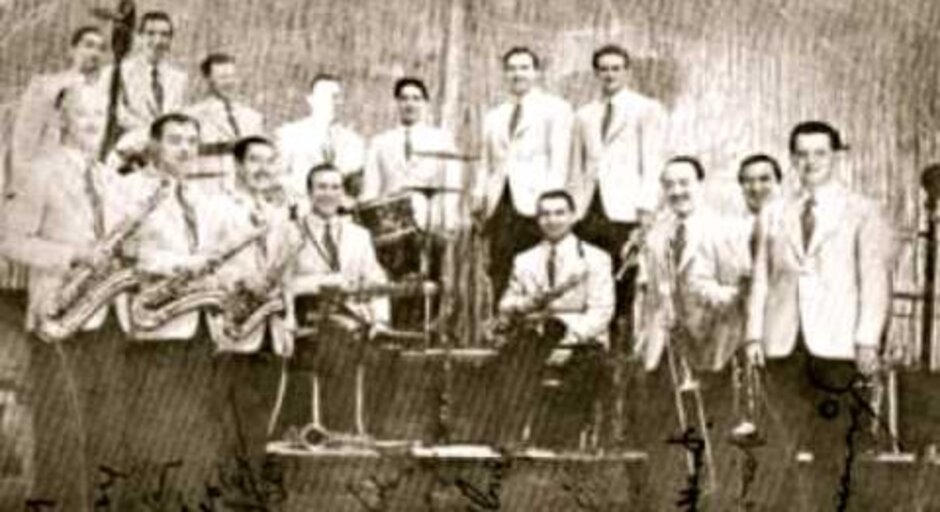
Pete Townshend’s Dad Cliff and The Squadronaires Perform “Rock’n’Roll Boogie”, 1956

From November 2018: Who I Am: A Memoir by English progressive rock composer Pete Townshend of the Who (Harper, 2012).

The Squadronaires.jpgThe Squadronaires, “Rock’n’Roll Boogie”, 1956.

“In 1945 popular music had a serious purpose: to defy postwar depression and revitalize the romantic and hopeful aspirations of an exhausted people. My infancy was steeped in awareness of the mystery and romance of my father’s music, which was so important to him and Mum that it seemed the centre of the universe. There was laughter and optimism: the war was over. The music Dad played was called Swing. It was what people wanted to hear. I was there. …”

“As the son of a clarinettist and saxophonist in the Squadronaires, the prototypical British Swing band, I had been nourished by my love for that music, a love I would betray for a new passion: rock‘n’roll, the music that came to destroy it.”


FULL DRESS // A gifted mesmerist—a sinister composer—a naive young conductor from the north…inspired by an episode from the life of Rachmaninoff // DOWNLOAD FREE BOOK POSTER

On Conductor John Wilson’s Full Dress and The First Porn Movie I Ever Did, 1

From 2019: For those of you who know that, as well as being a retired porn actress, I also write porn for pleasure (actually genteel erotica but you know and I know it’s porn, lady porn, but PORN), Full Dress being a riff on my old boss Rouben Mamoulian’s classic The Song of Songs—you know, the one where Marlene Dietrich has a rich would-be composer for a husband and a young, sensitive, bespectacled conductor for a lover, inspiring them both to artistic heights through her Mighty Marlene Power. Oh, baby. This is the movie that inspired me to emulate you in my youth.

But just so you don’t go on thinking this is some kind of fanblog (really, I’m not a fan*, just crazy in love with the bloke below) I thought I’d spend a posting to tell you all how I got my first gig in pictures.

John ExposedAbove John’s arousingly exposed suspender: Nina Simone sings Cole Porter’s “All of You” just for my wild Geordie lad.

This happened in San Francisco—in the 70s a paradise for the sexually adventurous—and coming after the time I worked as classic film director Rouben Mamoulian‘s amanuensis, which was after the time I posed nude for a blind sculptor in St-Paul-de-Vence, which was after the time I danced topless in a mob-run bar in Red Hook, which was after the time I was the night solfeggist at ASCAP

So anyway. One lovely summer evening about six weeks after I hit the city I went with a (legit) actress friend to a house party up on Potrero Hill, mostly because she enticed me with the information that the party would be featuring a hot tub. (Am such a pushover for hot tubs.) Well, at the party there was this cute but obvious older guy from London (trimmed ginger beard, open shirt, bead bracelet—no one goes California like the English) named Paul, who owned the house and who invited me seulement for a session of coke+quaaludes and a nice soak later, after all the other guests have left. Then he gave me his card. (This was only the second time a man ever gave me his business card before we had sex, and it wouldn’t be the last)…

Part 2 “Zombie Love Slave” here.
Part 3 “Sausalito Hot Tub” here.
Part 4 “Lovelace” here.

*No, really, I’m in love with John but he plows through Gershwin like a bull moose and treats Bernstein like Bernstein’s Saruman and he’s Frodo. How could any red-blooded American woman countenance such effrontery to our national treasures?**

**He does, however, conduct Elgar and Vaughan Williams like an angel.


FULL DRESS // A gifted mesmerist—a sinister composer—a naive young conductor from the north…inspired by an episode from the life of Rachmaninoff // DOWNLOAD FREE BOOK POSTER

My First Music: Meredith Willson, and That Kennedy Thing, Part 1

This is still especially for John, my English darling, but also for anyone else who wants to read on and not give me flak for my conclusions. There is no more contentious, infighting body on the face of the earth than the Kennedy researchers, except for The Brontë Society.


Fortunately, I’m not a “Kennedy researcher”. But I remember the Friday lunchtime when President Kennedy was killed in Dallas, and initial memories turn out to be very important in reconstructing what really happened way back then. Even the memory of an eight year-old girl in 4th grade class 900 miles away counts.

So that Friday before Thanksgiving. Mrs Weisberg got a call and told us the President was dead and we went into the library to watch the TV coverage. Like a good police procedural, the suspect was apprehended almost right away, and after that all seemed to proceed as normally as a TV show: bad guy caught, law prevails, life back to normal, only normal+a little mourning (Oh, God! “Salute your father’s coffin, John-John”)+a new head of the country. Which was going to be the same country as always anyway, right?

What a different world that was then. What a bunch of saps those murdering thugs took us for.

But I want to talk about what I saw and heard in the first broadcasts, when the police and newspeople brought out Oswald and informed us that he was 24, an ex-Marine, from New Orleans, well-traveled, the father of two, with a foreign wife. (They got that info pretty fast, didn’t they. Within minutes. This before the internet. Talaga.) My kind of male? I was already interested in boys, I wanted to check him out.

He was strangely resolute in front of the camera. “Did you shoot the President and Officer Tippit?” demanded the newsman.

“No, I did not,” he replied firmly, and I was impressed by his looks, his composure, his educated, non-regionally-accented speech. The boys around me were gathering for a Hate Minute: Of course he did it! Otherwise he’d be jumping up and down hollering his innocence!

But at the age of eight-going-on-nine I had two weird revelations staring at that thin pale face.

  • One: He knows something.
  • Two: I’m probably going to marry a man like that.

So by golly, number two came true: A white southener, self-educated, self-composed, brilliant but secretive, an average-looking, average-sized man who could pass for thousands of other average men—

And—an operative of Army Intelligence. I’m looking at my blind bearded baby in front of me right now, grateful the Ruskies didn’t shoot him down on some wintry street in Prague in 1968.

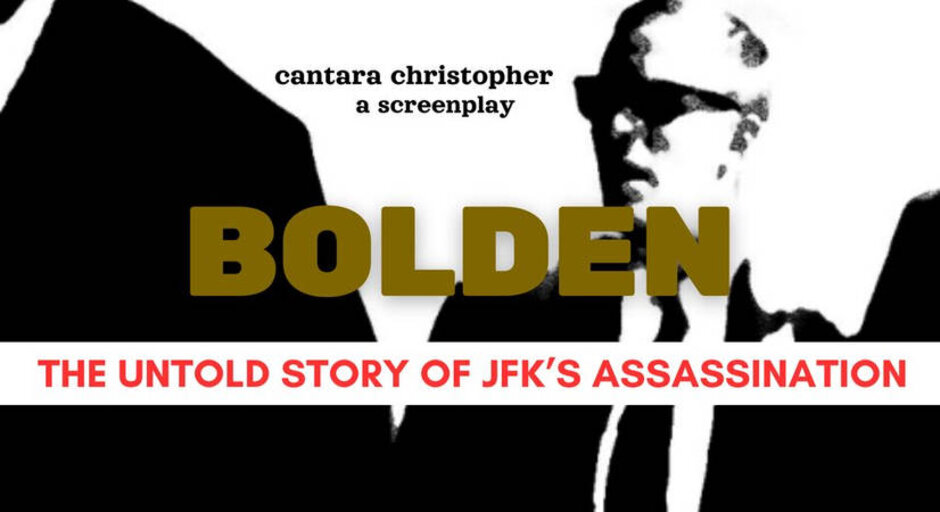
In Part Two I’ll talk about ex-friend Hollywood director Stephen Gyllenhaal, his shockingly idiotic, insulting, slightly treasonous project, and Abraham Bolden, for whom I wrote the screenplay, at his personal request, Bolden: The Untold Story of JFK’s Assassination.


There is a Meredith Willson-John Kennedy connection! It’s this peppy number, which was commissioned by President Kennedy for his Council on Physical Fitness for kids like us to do their daily school calisthenics to. Some people remember this number with affection, many don’t. Robert Preston sang it and the Warner Bros orchestra played it. It’s called “Chicken Fat”. Ten times!


FULL DRESS // A gifted mesmerist—a sinister composer—a naive young conductor from the north…inspired by an episode from the life of Rachmaninoff // DOWNLOAD FREE BOOK POSTER

The Bernstein Film That SHOULD Have Been: Leonard Bernstein’s True Love

My former nemesis, Hollywood producer-writer Naomi Foner Gyllenhaal (see Stephen Gyllenhaal), for years tried to get her project for son Jake Gyllenhaal off the ground: a film based on Bernstein’s decades-long love affair with an Israeli journalist-soldier-actor named Azaria Rapoport—the drama culminating in the 1981 premiere in Jerusalem of the conductor’s 16-minute piece for flute and orchestra, Halil (meaning flute), dedicated to young Israeli flutist-soldier (every Israeli is considered a front-line soldier) Yadin Tanenbaum, killed in the Yom Kippur war. The film was to be called Nocturne, which is how Bernstein himself described this work.

Above: Halil by Leonard Bernstein (Moscow, Maria Fedotova soloist)

But now I understand there’s a new movie out about my beloved rabbi of music that turns him into nothing more than half of some concocted New York glamour couple. Kind of like that smart-alecky piece by journalist Tom Wolfe, Radical Chic and Mau-Mauing the Flak Catchers, which was required reading in high school in Minneapolis, circa 1970; we were not-so-subtly encouraged to side with the Black Panthers (which was okay, my first boyfriend was a Black Panther) while snickering at Lenny and Felicia. This did not sit well with me at 15, a faithful viewer of Bernstein’s monthly Young People’s Concerts (all episodes here) on CBS Sunday afternoons (1958-1972). Call me a Lenny groupie, more or less. Just like Lydia Tár.


FULL DRESS // A gifted mesmerist—a sinister composer—a naive young conductor from the north…inspired by an episode from the life of Rachmaninoff // DOWNLOAD FREE BOOK POSTER

A Special Letter Featuring Scott Fitzgerald to My Beloved John Wilson, After His Appearance with the Sinfonia of London at The Glasshouse, Gateshead UK, 11 November 2023


See the name up in the title of this posting, The Glasshouse? Got it right this time. The only reason I kept the out-of-date jpg up on your schedule, John, is because I love this picture of Gateshead so much and got too lazy to change to the new name. Expect that pic to crop up again in some other impersonation in the future.

Number two. This picture. Okay, I will admit to a sudden unexpected and totally unfamiliar onrush of an irrational emotion. But if you don’t understand how you get to me there’s no hope for you or your generation.

Number three. This picture. An honest artistic statement. Yeah I stole your selfie. Come and get me, coppers.

Number four. The matter at hand. I got the strong impression last night, John, that you were still in Gateshead (you’ve probably finished your Liverpool gig by now) and needed some sort of psychic “Daphne Moon” boost from me. Glad to oblige. I’ll tell you the story, long overdue, of how my dad and mom met and got married. It has to do with two of my aunties not-really-aunties-but-older-cousins—years of letter writing—and the Jai-Alai Building in Manila…

Shoot, time passes…now I’ve got to go be with Mister Grumble for a while. Tonight we’re listening to (my baby angel’s blind, remember?) the near-beginning of The United States of Socialism by Dinesh D’Souza; the middle of The Con Man by Ed McBain (“Mendo-zaaaaaaaah!”); and the last chapter of The Simulacra by Philip K Dick. Oh! And streaming the fifth season of Star Trek: Deep Space Nine.

I’ll return on my next writing day, which fortunately is tomorrow.

I see they’re making you travel from Gateshead down west to Liverpool and then back up north to Glasgow and then back down to Nottingham and finally over to Manchester. Jeez, what a schedule for you and your people.

So you want to hear more about my dad. Okay! I’ve owed you this for a while, sorry for the lateness, juggling a lot of balls, including a heart episode, not to winge. Continuing what I wrote in “25 May—Two Birthdays: My Dad’s and My Beloved English Conductor John Wilson’s“…

Well, after that whole thing about not being able to marry the woman he wanted to because of the miscegenation laws of the state of California, my dad and his white fiancee (never found out her name but it was the late 1940s so I bet it was something pretty like Helen or Margaret) went back to her home in Missouri where, like in most of the interior states, there were no legal barriers.

[4:30pm 13 Nov 2023 Pacific Time. Have to go now, Mister Grumble’s dictating his new novel to me, his sixth…be back as soon as I can…]

Mister Grumble is calling his latest novel The Last Bohemia. It’s about our old neighborhood, New York’s East Village, during the cheap-rent artsy 1980s. I’m really looking forward to it.

Back to my dad. So John, the marriage didn’t work out, of course, name me another interracial couple who made it work in the midwest in the 1940s-50s. So when they broke up in St Louis, my dad I guess was at a crossroads. There were two things he knew how to do, box (he was a small-time prizefighter in California in the 20s, a flyweight like his hero, Filipino 1923 champion-over-Welshman-Jimmy-Wilde, Pancho Villa)—and cook.

This is where that Minneapolis railroad tycoon comes in and where the story enters Scott Fitzgerald country in more ways than one.

[2:20pm 14 Nov 2023 Pacific Time. If it doesn’t rain I promised to take Mister Grumble out for a beer, he can’t go out anymore by himself. (He has a red-tipped cane, but sighted people just don’t pay attention and the sidewalks are too littered anyway.) Still, the IPAs here are pretty good, so… ]

[WHOEVER’S READING THIS WHO ISN’T JOHN: If you’re around him during this tour and you can pass him a couple words when he won’t bite your head off, just let him know CANTARA GOT HIS DAPHNE and will try to write more soon. Right now I’ve got to talk about Kennedy]


FULL DRESS // A gifted mesmerist—a sinister composer—a naive young conductor from the north…inspired by an episode from the life of Rachmaninoff // DOWNLOAD FREE BOOK POSTER

The Equalizer Comes to New York’s East Village, Plus Stewart Copeland’s Theme Music

With the coolest theme on American TV, The Equalizer introduced Copeland’s stunningly unique sound to the mainstream audience. In keeping with the series’ mash-up concept of “tradition merged with New Age high tech,” Copeland’s musical accompaniment would, one: with the exception of hero Robert McCall himself, forego the Wagnerian structure of identifiable leitmotifs, and instead choose to score the city of New York itself as a primary character; and, two: fuse classical structure with the combo of  “percussion carrying melody and synthesized strings” attached to world rhythms. Copeland’s would be a coldly ethereal yet dense “urban ballet” sound inexorably linked to the modern cityscape. This sound would influence composers such as Hans Zimmer and Thomas Newman.

610 East 9th Street NYCThey shot several episodes in my old neighborhood, the East Village, at great risk to star Woodward (two heart attacks and once he fell through an apartment building roof–not ours thankfully). That’s 610 East 9th Street, where we lived 1981-86. Rent for our 4-room inc full kitchen and full bathroom, 2 bedrooms and 1 living room, facing street: $250/m. You read that right. $250 a month.

Copeland was born in 1952. The son of CIA officer Miles Copeland, Jr (who appears as a character in Norman Mailer’s epic spy novel Harlot’s Ghost), he took up the drums at 12, was raised internationally in Cairo, Beirut, the US and England; and throughout the 1970s alternately worked as road manager and backup drummer for various groups until founding in 1977, along with Sting and Henry Padovani (later replaced by Andy Summers), the English progressive rock band The Police. After The Police went on extended hiatus in 1986, the drummer with a composer’s sensibilities dove headlong into scoring—to this day, one of his most notable works is as musical voice of The Equalizer, on which he composed 51 of 88 total episodes of the series.


FULL DRESS // A gifted mesmerist—a sinister composer—a naive young conductor from the north…inspired by an episode from the life of Rachmaninoff // DOWNLOAD FREE BOOK POSTER

Things I Did for Love of Geordie John Wilson, 1: Watched Get Carter (British MGM 1971, Mike Hodges Director) and Sarah Millican; and Listened to, But Didn’t Watch, The Orville

This is all to do with my beloved John Wilson, Conductor being from Gateshead. Except for that Seth MacFarlane show.

Sarah Millican first. Tried listening to this fast-talking comedienne from nearby South Shields the middle of 2019 but could not keep up with her pace or her accent. Later I started watching old episodes of Auf Wiedersehn Pet, The Likely Lads, Byker Grove (which starred BGT presenters Ant & Dec when they were kids), and now one of my favorite shows ever on television, Our Friends In the North (all episodes here) etc etc but they’re just so…masculine, you know? Which I suspect probably pretty much characterizes Geordie culture anyway… So I started alternating watching that show with When the Boat Comes In, which was more successful for me, as the estimable Northumbria-born actress Jean Heywood provided a good model of what a feminine northeast accent sounds like. After her it was a snap to follow Millican.

Second, The Orville, Seth MacFarlane’s Star Trek-like TV series. Like the 70s folksinger says, “I’m a stoner, I’m a trekker, I’m a young sky walker…” So yeh, I’d be interested in watching this show just to see if it measures up to the standards of my youth. Unfortunately, none of MacFarlane’s (post-Family Guy) projects ever sound interesting enough for me to overcome my intense personal dislike for him. So…maybe later. I did, however, listen to the show’s theme music, which was written by Andrew Cottee, the same young man who wrote some arrangements for The John Wilson Orchestra over in England. The theme does everything expected of it.

Third, Get Carter, starring Michael Caine and the City of Newcastle. Made this movie last on my list because it deserves two paragraphs, being the British noir classic that it is…

Sidebar: As we all now know from film school, existentialism is the engine of noir, which means that petty details like Michael Caine speaking in a thick Cockney accent* when his character’s supposed to be from Newcastle-upon-Tyne oughtn’t to matter to the sophisticated auditor. But I had a problem. I’m sorry. Three years ago I wouldn’t have cared, one Brit being the same as any other. Then I fell in love with John Wilson, a Low Fell lad, and individuality suddenly became a very important thing to me.

The Movie Overall: Not quite sure why the filmmakers transplanted novelist Ted Lewis’s story from his original setting in Lincolnshire (Lewis’s birthplace), to Tyneside, but since it’s the classic story of the Anti-Hero’s Revenge, which works anytime, anyplace, it does fine here. Michael Caine’s a little podgy but quick with his reflexes and still a treat for the ladies. Lots of sex and violence, lots of local atmosphere, local faces, and landmarks like Tyne Bridge, the Newcastle Racecourse and, of course, the carpark across the Tyne River.

The Carpark in Gateshead Scene: By a stroke of luck Get Carter was just streamed on Criterion so I watched the entire movie, then to make sure, watched the carpark scene twice more in order to understand why it so sticks in the mind. Because it does, you know, even though I’m not a fan of movies like this. I guess it’s because there’s rather a high elegance to this scene that contrasts with all the mundaneness and phony poshness around it… Very arty, but a genuine statement. Or maybe it’s just because I like watching Michael Caine get all riled up.

EXTRA! Mark Steel’s in Gateshead. Say no more.


The now torn-down carpark at Trinity Square in Gateshead in this famous scene was a dreary piece of English Brutalist architecture that, according to its creator, was never meant to stand the test of time anyway. That’s the theme to The Orville above.

*I understand that a stage version of Get Carter was recently performed in Newcastle, with Carter’s accent vocalized accurately.


FULL DRESS // A gifted mesmerist—a sinister composer—a naive young conductor from the north…inspired by an episode from the life of Rachmaninoff // DOWNLOAD FREE BOOK POSTER

Gordon Cole: The Link Between Twin Peaks and Billy Wilder; Plus “The Emperor Waltz” by Johann Strauss II, Conducted by Daniel Barenboim with the Berliner Philharmoniker, 2013

What is the connection between David Lynch and Billy Wilder?

Goddammit, I’ve posed this question to all my Twin Peaks groups on Facebook, and nobody got it. Now I’m going to give it to you.

“The Emperor Waltz”: the music and the film.

Assistant Deputy Director Gordon Cole of the FBI is a character on Twin Peaks.

Assistant Producer Gordon Cole of Paramount Pictures is an unseen character in Sunset Boulevard. Gordon Cole wanted to borrow Norma’s classic car for a “Crosby picture”—Billy Wilder’s 1949 film The Emperor Waltz, starring Bing Crosby and Joan Fontaine.


The entire film THE EMPEROR WALTZ directed by Billy Wilder is available to watch here


But that’s not all. There’s an artistic, almost metaphysical link, to the David Lynch work and the Billy Wilder work. For all its color and seeming frothiness, The Emperor Waltz the film barely conceals the same awful truth Lynch made clear in episode 8 of the third season of Twin Peaks: that at a particular point during the middle of the 20th century, Evil partnered with the willing Spirit of Man to try to annihilate the human race. Joe McBride you big fat blowhard, I got that drowning mongrel puppies thing too. I was just a little girl when I first saw this movie and the drowning puppies bit shocked me at once—because, you know, puppies. But also because of what Mrs Weisberg taught us in 4th grade class. And, you know, Anne Frank.

David Lynch and Billy WilderAbove David Lynch and Billy Wilder: Daniel Barenboim conducts the Berliner Philharmoniker in Strauss’s grandest waltz.


In the Revolution of 1848, Johann Strauss II (or Jr) had sided with the dissidents—the anti-Habsburg faction—while Strauss Sr his father had been an avowed royalist, composing the Radetsky March in honor of the great general who played a large part in suppressing the Revolution. For some time the court looked with misgivings and suspicion at Strauss Jr, however important he proved to the Austrian image.

There’s a file of a police interrogation where the younger Strauss was asked why he had dared to play the Marseillaise. In an Austria of strict censorship, that was a loaded question. Strauss answered, “Because it is good music and good music is what concerns me.”

But the wounds of the revolution gradually healed. Soon Austria had a new emperor. When the emperor celebrated the 40th anniversary of his accession in 1888, Strauss composed a waltz in honor of Franz Josef.

My signal, my flame, my beloved John Wilson conducted this piece in Stockholm 29 March 2019.


FULL DRESS // A gifted mesmerist—a sinister composer—a naive young conductor from the north…inspired by an episode from the life of Rachmaninoff // DOWNLOAD FREE BOOK POSTER