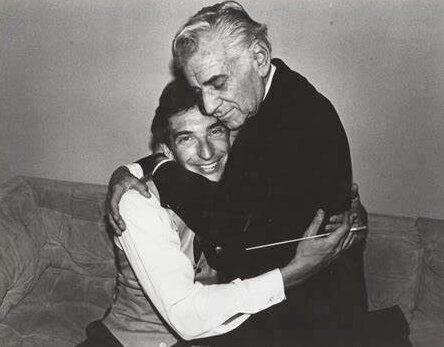
My former nemesis, Hollywood producer-writer Naomi Foner Gyllenhaal (see Stephen Gyllenhaal), for years tried to get her project for son Jake Gyllenhaal off the ground: a film based on Bernstein’s decades-long love affair with an Israeli journalist-soldier-actor named Azaria Rapoport—the drama culminating in the 1981 premiere in Jerusalem of the conductor’s 16-minute piece for flute and orchestra, Halil (meaning flute), dedicated to young Israeli flutist-soldier (every Israeli is considered a front-line soldier) Yadin Tanenbaum, killed in the Yom Kippur war. The film was to be called Nocturne, which is how Bernstein himself described this work.
Above: Halil by Leonard Bernstein (Moscow, Maria Fedotova soloist)
But now I understand there’s a new movie out about my beloved rabbi of music that turns him into nothing more than half of some concocted New York glamour couple. Kind of like that smart-alecky piece by journalist Tom Wolfe, Radical Chic and Mau-Mauing the Flak Catchers, which was required reading in high school in Minneapolis, circa 1970; we were not-so-subtly encouraged to side with the Black Panthers (which was okay, my first boyfriend was a Black Panther) while snickering at Lenny and Felicia. This did not sit well with me at 15, a faithful viewer of Bernstein’s monthly Young People’s Concerts (all episodes here) on CBS Sunday afternoons (1958-1972). Call me a Lenny groupie, more or less. Just like Lydia Tár.
Performed at the 1800-seat Fairfield Halls in Croydon. If you look fast you’ll notice 2nd violins leader Sir Neville Marriner (at the time former professor at the Royal College of Music, recent founder of the chamber orchestra St Martin in the Fields, and to-be music director of the Minnesota Orchestra). Note that touching moment at the end when the members of the LSO refuse to rise, at Bernstein’s insistence, for the applause of the audience, instead remaining seated and applauding Bernstein themselves. Now that’s respect.
A few postings ago (“On Conductor John Wilson’s Full Dress and The First Porn Movie I Ever Did, 1”) I said, “I’m in love with John but he plows through Gershwin like a bull moose and treats Bernstein like Bernstein’s Saruman and he’s Frodo.” Well…he was pretty respectful in his “Highlights from Candide” Proms show in 2015, and I have faith that somehow, somewhere during The Bernstein Year (2018) my bonny got through “The Age of Anxiety” with a clear conscience. But the crowning glory of my beloved John Wilson, Conductor’s relationship with composer Leonard Bernstein is supposed to be, by his own estimation, West Side Story, which he claims he’s conducted “a lo’, I’ve done a few complete productions of it”—so he should know what it’s all about, at least musically, right?
But first, let’s get that other business out of the way concerning John’s WSS attempt of 2018. I HATE HATE HATE to see The Race Card being played. Usually I try to avoid having to address the issue but sometimes it’s right in your face. If you don’t know what I’m talking about you can read about it here. Then read about the outcome here.
Know what I think? In the past few years I’ve begun to believe, and I’m probably coming late to this, that when Orwell was writing about Big Brother, he was really talking about the BBC. This is probably sooo evident to a lot of people, but I’ve been paying steady attention to the BBC for only about the last ten years and I’ve watched it devolve in ways previously unimaginable to me, so highly did I once esteem this radio/TV/internet broadcaster. So when I tell you I suspect that it was the Beeb behind that inane shuffling of sopranos and no one else, I do have a basis. (But not to go into that now. I’ll get to it when I talk in detail about Oklahoma!—and The Race Card—again.)
To get back to John, The John Wilson Orchestra, and West Side Story at the Royal Albert Hall, BBC Proms, 2018. Why the story above tells another possible story: One – soprano announces her withdrawal from the BBC Proms (that is, her reneging on her contract with the BBC) in April; two – five months later in August the new soprano is announced, a blatantly bogus attempt at more politically-correct casting, but anyway; three – at the same time, and only then, the show’s musical format is, for the first time in wide advertising, properly described as the official concert version. Which, let’s face it, makes the racial makeup of any of the singers totally irrelevant. Do you hear me squawking over Kim Criswell doing “Bali Ha’i”?
So in all this hoo-ha there’s John, who has absolutely nothing to do with the matter but nonetheless possibly, probably feels just a bit tainted by it, and who goes to his beloved orchestra with a “Gentlemen, ladies, let’s rise above this, shall we?” attitude, and a “Let’s give it all we’ve got!” kind of gungho-ness I last saw in Back to Bataan.
Because that’s how it came out in the music. Listening to the concert online, I got that same unsettling feeling you get some nights when you suspect your boyfriend’s unusually poundy lovemaking isn’t actually directed at you. It was almost unbearable to take. Mister Grumble even left the room. Before leaving he pointed an accusing finger at me. “This is your John Wilson,” he intoned darkly. “He’s not mine,” I declared. “He belongs to England!” But I couldn’t quite get the Vivien Leigh delivery so that bit just died.
But you know, I think that’s the crux of the matter, my beloved John being English and a Geordie and therefore too pigheaded to truly understand the American idiom. That, and Big Brother Beeb breathing down your neck, can cramp anyone’s sense of freedom, freedom of course being the American idiom.
I’m assuming, of course, that John, vaunted musicologist that he is, truly wants to understand the American idiom.
Of the 2013 concert, said Joshua Kosman in the SF Chronicle: “One of the great revelations of Thursday’s dynamic concert performance by Michael Tilson Thomas and the San Francisco Symphony was just how remarkable the score sounds in isolation… Bernstein’s creation stood more or less alone as a compendium of all the musical references swirling around in that great musical clearinghouse that was his mind.”
In an episode of this television series (available on my YT channel here), originally broadcast exclusively in New York City, Sondheim speaks before a workshop of NYC high school students, discussing the genesis of such songs as “Small World”, “I Feel Pretty”, and “One Hand, One Heart,” which are performed by Martha Wright and Ralph Curtis.
This show also includes question and answer period with Irwin Kostal, arranger and conductor for West Side Story. Hosted by Earl Wrightson. Produced by Ned Cramer. Directed by Neal Finn.
Everything’s Coming Up Roses – The CBS Orchestra
Small World – Martha Wright
Maria – Ralph Curtis
I Feel Pretty – Martha Wright
Tonight (Balcony Scene) – Ralph Curtis and Martha Wright
One Hand, One Heart – Ralph Curtis and Martha Wright
Mambo – The CBS Orchestra
Cool (Fugue) – The CBS Orchestra
Everything’s Coming Up Roses (reprise) – The CBS Orchestra
Mr Kostal, what is the difference between an orchestrator and an arranger?
It refers specifically to what you find on the music. When a composer composes a piece of music, we hope that it’s a complete piece of music, and when a man like Mr Bernstein composes the music (short laugh) it is. So all you do, you just discuss with him what he’d like to hear, flutes, violins…and you follow exactly what is written on the paper. This is what I call orchestration. Now, I get to do very little of that kind of work…because nowadays composers don’t bother with too much detail…
Steve [Sondheim] here is the kind of man we need because he’s studying music, and believe me that is a rarity on Broadway, because most composers don’t… At one time in history, composers actually did their own orchestration. They had the time in those days…but also, they could do it. For instance, Victor Herbert was a tremendous orchestrator. On one television show I did recently I actually used Mr Herbert’s scores as he wrote them in 1916—I couldn’t do ‘em any better. He knew what he was doing. Kurt Weill was the last one to do this. George Gershwin never did it on Broadway, but he—after he became a successful songwriter—studied music and learned how to orchestrate so that by the time he did Porgy and Bess he was able to do a very good job on the orchestrations.
Now, in arranging—if the composer does not do his job properly, the orchestrator has to come in and finish the job for him. Now, you’d be surprised how many times I do Broadway shows where I get roughly a one-line melody, a lead sheet, and I have to add the bass line, the harmony, the chords, and if it goes on for four minutes or a routine I have to think of things for the flutes to play and the violins to play etcetera, and it becomes a hefty job and I really feel like I am a composer’s partner when I do this*… You know, the more you do of this sort of work, the less the composer likes it. Because he’s kind of mad at you because he didn’t do it himself, I think anyway. And it serves him right. He should do it himself. I think he should go to school himself and learn. We have too many lead sheets—sure, the melody is the most important thing in music, but too many of our composers have decided to write only the melody. They have separated melody from music. Now, the art of melody writing is not a separate art from music, it’s a part of music. And when they have written this top line and leave the rest to me, they’ve got to be dissatisfied because they didn’t do it themselves. Let them get down to their business and go to school and learn to write!
[*I wonder who’s he’s talking about. Shinbone Alley’s George Kleinsinger? Fiorello’s Jerry Bock? Surely not The Music Man’s Meredith Willson—Willson went to Juilliard.]
If I seemed sad as you drove away today it was not because I felt in any way deserted but because I was left alone to face myself and this whole bloody mess which is our “connubial” life. I’ve done a lot of thinking and have decided that it’s not such a mess after all.
First: we are not committed to a life sentence—nothing is really irrevocable, not even marriage (though I used to think so).
Second: you are a homosexual and may never change—you don’t admit to the possibility of a double life, but if your peace of mind, your health, your whole nervous system depend on a certain sexual pattern what can you do?
Third: I am willing to accept you as you are, without being a martyr or sacrificing myself on the L.B. altar. (I happen to love you very much—this may be a disease and if it is what better cure?) It may be difficult but no more so than the “status quo” which exists now—at the moment you are not yourself and this produces painful barriers and tensions for both of us—let’s try and see what happens if you are free to do as you like, but without guilt and confession, please!
As for me—once you are rid of tensions I’m sure my own will disappear. A companionship will grow which probably no one else may be able to offer you. The feelings you have for me will be clearer and easier to express—our marriage is not based on passion but on tenderness and mutual respect. Why not have them?
I know now too that I need to work. It is a very important part of me and I feel incomplete without it. I may want to do something about it soon. I am used to an active life, and then there is that old ego problem.
We may have gotten married too soon and yet we needed to get married and we’ve not made a mistake. It is good for us even if we suffer now and make each other miserable—we will both grow up some day and be strong and unafraid either together or apart—after all we are both more important as individuals than a “marriage” is.
In any case my dearest darling ape, let’s give it a whirl. There’ll be crisis (?) from time to time but that doesn’t scare me any more. And let’s relax in the knowledge that neither of us is perfect and forget about being HUSBAND AND WIFE in such strained capital letters, it’s not that awful!
There’s a lot else I’ve got to say but the pill has overpowered me. I’ll write again soon. My wish for the week is that you come back guiltless and happy.
~F
from The Leonard Bernstein Letters edited by Nigel Simeone Yale University Press, 2013
My bonny John at 7:55: “The music is of such importance it actually unlocks some of the questions as to what people are meant to be doing and thinking on stage. I’ve done West Side Story a lo’, I’ve done a few complete productions of it and whenever you are unsure of how to turn something dramatically you look in the score and the subito or the hairpin will actually give you the direction of what’s happening on the stage in every bar.”
John honey, I know you were trying in your stumbling way to tie in the Wagnerian theory of stage action indicated by the music, but here in America our musicals have called these things called books…
And at 5:45: “He was writing these musicals to make some money… Because, you know, he had a wife and she wanted to live in a certain amount of style and he wanted, uh, some kind of security and…between 1943 with Oklahoma and 1965, 68, you have a fifteen-year period [sic] when there was greaaat money to be made on the Broadway stage, and he made no secret about it, you know… He wrote Wonderful Town in three weeks because he wanted to cash in…”
John, I know it was just a businessmen’s matinee, but couldn’t you have put some of your own genuine ideas into your talk?
Encouraged by Maestro Mauceri, I now look for the musical influences on games composers, hence my “Coplandesque” remark on FB about Michael Giacchino’s Medal of Honor theme below. Listen to my beloved and desired English conductor John Wilson helm the BBC Philharmonic in Copland works every American knows: “Fanfare for the Common Man” (commission, 1942) and the “Simple Gifts” part of the ballet Appalachian Spring. And just for good measure! “Hoedown” from the ballet Billy the Kid ’cause I enjoy a good steak.
Somewhere in my blog (“My First Music: The Pure Joy of St Trinian’s and The Inn of the Sixth Happiness by Malcolm Arnold“) I wrote about particular chords and intervals that, to me, give music a particularly “English” sound—well, I’m coming around to understand that Copland, far from being a lazy minimalist, was actually one of the founders of the “American” sound (along with Joplin, Dvorak, Gershwin, Schoenberg and, of course, Copland’s pupil Bernstein). I’m so glad my bonny John “gets” it. His Copland almost makes up for his 2017 butchery of Oklahoma! at the Royal Albert. As for Copland’s influence, listen for it in certain tunes of Jerry Goldsmith and, as I said above, games composer Michael Giacchino.
My beloved John conducted the National Youth Orchestra of Great Britain (who The Guardian described as “a fearless young army on the move”) in “The Pines of Rome” by Respighi in Leeds in 2015; and in Glasgow, where he’s been the Associate Guest Conductor for several years, with the BBC Scottish Symphony Orchestra in 2018. Now he’s rounding out his association with this perennial orchestra piece with a wonderfully crisp and sparkling new recording from Chandos with the new Sinfonia of London.
I classify this under My First Music because I first heard this symphonic poem in a broadcast of a Young People’s Concert. Leonard Bernstein conducted, the NY Philharmonic played. Listen for the feet of Roman soldiers along the Appian Road, my affectionately-remembered rabbi of music suggested. I think I was 11.
Serge Koussevitsky, Leonard Bernstein’s mentor, was on the podium conducting the first symphony by the “new young Soviet composer” Dmitri Shostakovich in the CBS radio Sunday afternoon broadcast of the New York Philharmonic when, in the middle of the first movement, none other than famed NY correspondent John Charles Daly broke in with the news of Pearl Harbor. The Japs bombed the naval base at Pearl twice that morning, first at 8am Hawaii time, then again at 9:30am…then went on that same day to bomb the fuck out of Singapore, Hong Kong, Burma, Guam…
I created this posting just for John Wilson, Conductor fans (and as a lagniappe for the lad himself). By the way, the third movement is the one you want if you want to hear violinist Andrew Haveron shine:
In 1988, I brought a recording of Erich Wolfgang Korngold’s Symphony in F-sharp to Leonard Bernstein’s country home in Fairfield, Connecticut. It was a rare event to have dinner with him and no one else. After dinner, I asked if he would be willing to hear something I had discovered and found particularly interesting.
I played the first movement of the symphony. Bernstein only knew that it was a symphony and therefore might have expected it to be in four movements. After intently listening to the twelve-minute movement, he had no idea who the composer was, but he liked the music enough to ask to hear the second movement. And so it went, after each movement I gave him a chance to beg off. The symphony’s third movement—its emotional climax—inspired him to jump to the piano and repeat its opening motif and the devastating substitution in its harmonic structure that happens twenty seconds into it. After the last movement, I told him who had composed it. I also told him that though the piece was completed in 1952, its concert premiere did not take place until 1972, fifteen years after the composer’s death.
On first hearing, Bernstein thought the symphony should have ended with the third movement, which would have made it a very tragic symphony indeed. I suspect he heard it in terms of Mahler, which is appropriate enough. He had not predicted—or perhaps wanted—its upbeat finale that takes the gentle second theme of the first movement and transforms it into a positive march, albeit with a dark warning before its conclusion.
Be that as it may…I am sure that he would have turned his attention to Korngold had he not passed away in 1990. Ironically, one of his mentors, Dimitri Mitroupoulos, had stated in 1959 that he had finally found “the perfect modern work” and planned to perform the Korngold the next season with the New York Philharmonic, but his death intervened.
from For the Love of Music: A Conductor’s Guide to the Art of Listening by John Mauceri (Knopf, 2019)
Behold the worst reviewmy bonny conductor John Wilson ever got and I cherish it because it’s so on the money. But first things first. Samuel Barber completed this Violin Concerto in 1939; a work in three movements, it lasts about 22 minutes. I’ve got this classic 1964 recording and it’s one of my yummier ones.
From Bachtrack: Exaggeration and Disinterest Mar John Wilson’s CBSO Programme
Simon Cummings, 08 April 2019. Great composers—or, rather, their greatest compositions—have a tendency to be able to shine through less than ideal performances. This was the situation that faced us in Symphony Hall last Saturday, though it’s important to stress that the root cause lay not with the City of Birmingham Symphony Orchestra, or their Chorus, or with either of the evening’s two soloists, but with conductor John Wilson.
Wilson’s approach to all three works on the programme could be summarised as ‘filmic’. It was as if each piece wasn’t quite adequate on its own terms but needed to be given the kind of superficial gloss that might make it suitable for Hollywood. The resulting effect of this was two-fold: exaggeration of the works’ more obviously lyrical or bombastic high points, and a kind of disinterested flattening of their less show-stopping sequences.
Thus, the contrasting episodes of Copland’s Appalachian Spring felt less like components of a single, overarching continuity than the vagaries of a narrative that kept changing its mind. At its most relaxed, as in the deliciously sleepy, dawn- and dusk-like music with which the works begins and ends, Wilson seemed to have little idea what to do, allowing its inherent prettiness to sound with indifference to pacing, shape and nuance. Only when the material became conspicuously excited did Wilson do the same, leading to a more appealing rendition of the assorted Allegro sections, which were lively and fun. (It’s interesting to note that Symphony Hall’s renowned acoustics, supposedly good for everything, audibly struggle when presented with small orchestras performing tight, crisp rhythms such as those in the Copland, on this occasion making the CBSO sound more than a little swamped.) But in hindsight these only made it more apparent how flat was the rest of the work, with clunky gear changes and a weak sense of connection.
The nature of the material in Samuel Barber’s Violin Concerto played much more into Wilson’s wheelhouse. The lyrical first two movements contain much that is redolent of silent film scores, which therefore suited the cinematic treatment they received. The sweetness in the music often felt rather cloying and over-earnest—where Copland had been likeable, Barber seemed to be spending all his time desperately trying to get us to like him–but the sense of dialogue between soloist James Ehnes and the orchestra, clearly heard here as equals, was highly engaging.
The Violin Concerto is a problematic work at the best of times, due to its weird structural combination of two emotionally-charged movements followed by an evidently bolted-on presto finale that appears to stem more from a desire to satisfy the demands of the original violinist than from the same creative impulse as the rest of the work. Yet on this occasion, Ehnes’ enthusiasm in the finale was a huge relief, his breakneck fingerwork rising above the robotic pulse laid down by Wilson. Best of all, though, was Ehnes’ even more unstoppable encore, a performance of Eugène Ysaÿe’s Violin Sonata no 3 that took real risks, resulting in such nail-biting excitement that the concerto was almost immediately forgotten.
For all the issues that had manifested in the Copland and Barber, nothing and no-one can stand in the way of the juggernaut that is Walton’s Belshazzar’s Feast. Wilson’s tendency to exaggeration was matched by Walton’s own overblown response to Osbert Sitwell’s libretto. To stunning effect, particularly in the first half of the work: testifying again that the devil has the best tunes, the combination of orchestra and chorus (who, on this occasion, augmented by the University of Birmingham Voices, were simply enormous) during Belshazzar’s unbound, sacrilegious revelries was an absolute riot and hugely involving. Considering the downfall that we all knew was coming next, one almost felt guilty for enjoying it so much.
Bass-baritone Božidar Smiljanić was by turns mesmerising, moving and borderline prophetic as soloist. His take on the introduction to Babylon was masterful, moving abruptly from proudly rattling off a list of valuable commodities to a stern, almost witheringly prolonged articulation of the word “slaves”, concluding with a tender lament for the “souls of men”. Likewise, the almost laughably undramatic moment when the libretto sums up almighty judgement in the wake of all the ungodly merriment in just a single sentence, Smiljanić made profound, as if he were heralding not merely the end of Belshazzar’s days but everyone’s.
Again, though, the music’s more inverted, painful episodes lacked weight, Wilson making them brisk and functional, mere lulls before the storms. When these came, they were overwhelming—how could they not be? But it was just such a shame that the most powerful moments of the concert, such as these, were for the most part in spite of John Wilson’s best efforts, rather than because of them.
The on-demand streamcast on BBC3 was actually pretty good—straightforwardly sung, acted and played; no John going meshugena with the tempi like he did two weeks ago with his own orchestra’s “concert” version of West Side Story. (In contrast, you do not mess around with the London Symphony Orchestra.) And is that the venerable UK-based American actor Kerry Shale doing the narrating?
As it was in West Side Story two weeks ago, I am theorizing that the terrifying foot-stomping in the audience that occurred when my lovely John stepped forward to take his bow at the end was started by fellow classmates of the youth chorus onstage, and not a biker gang.
This nine-minute medley sung by Julie Andrews and Carol Burnett, called “History of Musical Comedy”, is a variety-show tour de force enough for the first six minutes; then at 6:00 it rises to high art in the most affecting soprano duet in the repertoire of American lyric theater.


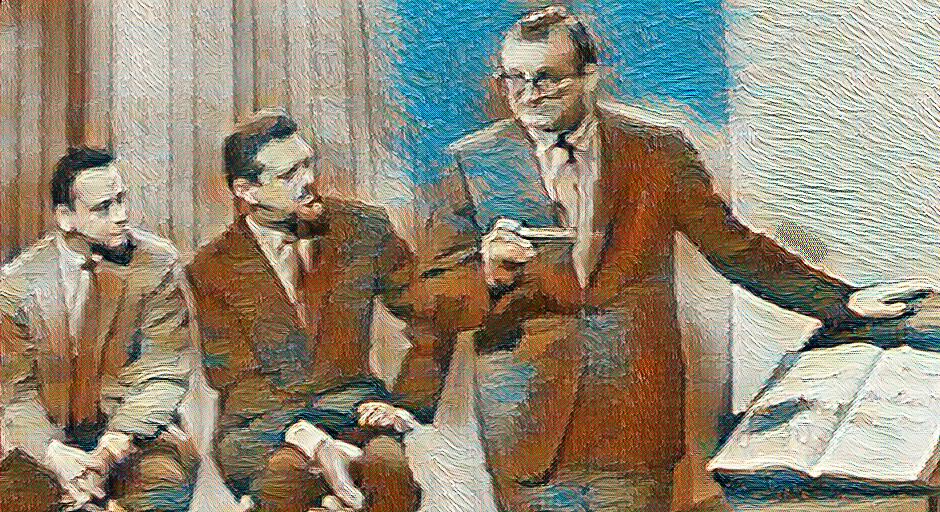 Above: Lyricist-Composer Stephen Sondheim, Baritone/Host Earl Wrightson, Orchestrator-Conductor Irwin Kostal. Again,
  Above the newlyweds: Bernstein’s early piano composition,
  Stephen Maddock, CEO of the City of Birmingham Symphony Orchestra, who manages to insert the word


 Above: “
 "I'll Be Dead Before You Break My Heart"