Apo Whang-Od, Kalinga Tattooist and Now Vogue’s Oldest Cover Model

Apo Whang-Od, a 106-year-old tattoo artist from the Philippines, is now the oldest Vogue cover model. Whang-Od is considered her country’s oldest mambabatok — or traditional Kalinga tattooist. (Kalinga being one of the tribes in the middle of the big island, Luzon.) Her tattoos use an age-old hand-tapping technique, which she perfected as a teenager using just a bamboo stick, a thorn from a pomelo tree, water and coal. Her work is now internationally known, and she told Vogue Philippines she’s training her granddaughters in this stunning and meaningful art form.


FULL DRESS // A gifted mesmerist—a sinister composer—a naive young conductor from the north…inspired by an episode from the life of Rachmaninoff // DOWNLOAD FREE BOOK POSTER

The MGM Jubilee Overture Arranged by Johnny Green, Reconstructed and Conducted by John Wilson, and Played by The John Wilson Orchestra

From November, 2018: MGM’s best-known music director arranged this piece in 1954 in commemoration of the studio’s 30th birthday. And since 2004, when my beloved John Wilson and his eponymous orchestra first played this reconstituted medley at the 2,900-seat Royal Festival Hall, it has gone on to become sort of their signature piece, which they’ve played all over the world from Sydney to Berlin. I can’t imagine how John was able to reconstruct the score directly from hearing this lusterless film short, but my darling has the gift of patience and commitment.

The John Wilson Orchestra 1The MGM Jubilee Overture above John Wilson, the Francois Villon of the podium. Added attraction: Here’s one of those rare moments when John conducted without his baton, which fell out of his grasp but was retrieved seconds later by an alert string player. Berlin, 2016.


Now….right. Because this is turning out to be the second most clicked-on post on my blog (the first most clicked-on being the one about Noli Me Tangere, the Filipino opera based on Jose Rizal’s classic novel) I’ve decided finally to take a few minutes to come back to this posting and add the names of the composers and lyricists as I promised—and bear in mind, I’m doing this pretty much from memory. (I was the night solfeggist at ASCAP, remember?): “Singin’ In the Rain” / Nacio Herb Brown; “I’ve Got You Under My Skin” / Cole Porter; “Broadway Rhythm” / Nacio Herb Brown; “The Last Time I Saw Paris” / Jerome Kern, Oscar Hammerstein II; “Temptation” (shades of Tony Martin!) / Nacio Herb Brown, Arthur Freed; “Be My Love” (shades of Mario Lanza!) Nicholas Brodzsky / Sammy Cahn; “The Trolley Song” (with the Judy sound) / Hugh Martin, Ralph Blane; “On the Atchison, Topeka and the Santa Fe” (more Judy sound) / Harry Warren, Johnny Mercer; “Donkey Serenade” / Herbert Stothart, based on Rudolph Friml; and “Over the Rainbow” (the Judy sound of all Judy sounds) / Harold Arlen, EY Harburg.

The last two numbers “Donkey” and “Rainbow” were obvious tributes to Green’s late predecessor as music director, Oscar winner (for The Wizard of Oz score, which John reconstructed by ear), Herbert Stothart.

Deleted: 2 bars plus “Baby, It’s Cold Outside” / Frank Loesser and John, I’d really enjoy a little chat with you regarding, among other things, your fellow musical reconstructor Philip Lane’s comments one of these days…


FULL DRESS // A gifted mesmerist—a sinister composer—a naive young conductor from the north…inspired by an episode from the life of Rachmaninoff // DOWNLOAD FREE BOOK POSTER

25 May—Two Birthdays: My Dad’s and My Beloved English Conductor John Wilson’s

My father, who was born on the 25th of May 1905, went to the movies with me only a couple of times. The first was for Taras Bulba (United Artists, 1962). I remember him getting a particular kick out of the ride of the Cossacks scene, thrilling Franz Waxman music and all.

The second time was for Tora! Tora! Tora! (20th Century Fox, 1970). The movie house in Columbia Heights, just over the city line from Northeast Minneapolis, was within walking distance, I walked it all the time, and could still get in for 50 cents because at 15 I still looked 12. For some reason my father ended up not only driving me the few blocks, but after I’d found my seat and the lights went down I was astonished to notice him come in and sit down beside me.

“Dad, what are you doing here?” I whispered loudly. “You know, the Japs win in this.”

“Not for long,” he answered cheerfully, which is about as close as anyone in our family got to talking about the 7 December 1941 attacks and the general brutality my mother, then a teenager in Bangar in the province of La Union, had to face in an occupied country.

Bangar in those days was rather like Nouvion in ‘Allo ‘Allo—a little town situated a ways from the capital but near the sea, a hotbed of resistance. When you read about Bangar here, just remember: that kid who escaped, which resulted in occupying troops burning down the place, was one of my cousins. When the guards marched him to town to be executed, his family, through looks and gestures from a distance, pretty much gave him the word that they expected him to “take one for the team” i.e. let himself be shot; but at the last moment, as family legend goes, he grabbed the officer’s sword and in the confusion was able to get away into the forest. And so as feared came the reprisals.

A shadow still hangs over the de la Peña family.
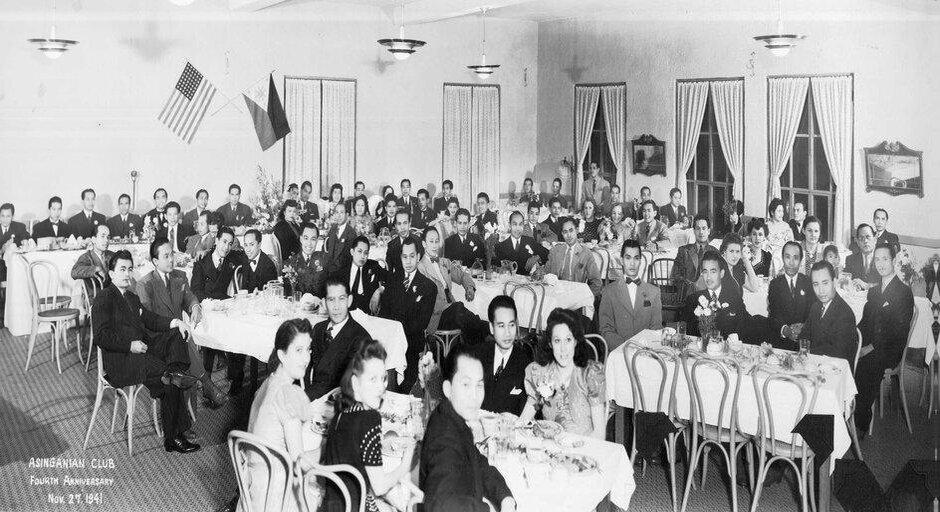
Fil-Am 1941Taken at a banquet of an old Filipino-American association my dad was part of (that’s him under the picture on the right; keep forgetting he still had hair before I was born), one of about a hundred around at the time. Note the date: only a couple of weeks before Pearl Harbor. Note also the Philippine flag on the wall. The Philippines wasn’t yet a sovereign nation but a Commonwealth and didn’t achieve independence till 1946. More at “To My Beloved John Wilson, Who Shares His May 25th Birthday with My Dad; Or, Don’t Call Me a Person Of Color, I’m a Product Of Empire, 2”


Meanwhile in California my dad, who had come to the States a young man in 1927, was engaged to a woman from St Louis he eventually COULD NOT MARRY because—are you ahead of me on this?—HE WASN’T WHITE!!! Yes! The MISCENEGATION LAW of the State of California—which by the way was NOT REPEALED UNTIL 1948—prohibited them and God knows how many other California couples from legally joining, forcing them to travel to other states where they could. Recently read this happened to, among others, that fine actor Dean Jagger (here seen with Danny Kaye and Bing Crosby in White Christmas, 1954 Paramount) and his Chinese-American fiancee; and the Oscar-winning cinematographer-director James Wong Howe (Picnic, 1955) and his white fiancee, author Sanora Babb. I‘d be curious to hear other people’s stories.

How my dad, residing at last in Minneapolis, eventually found and married my mother in Manila is another story, and it’s a doozy. I’ll tell it one of these days. Here it is:


“To My Beloved English Conductor John Wilson, Who Shares a Birthday With My Dad; Or, Don’t Call Me a Person of Color, I’m a Product of Empire”

Part 1 here | Part 2 here | Part 3 here | Part 4 here


Now for John, who was born the day of my father’s final birthday, in 1972. John, I’m not saying we’re psychically linked, but about a month ago in the middle of defrosting the refrigerator I think I got a weird emotional flash from you where you were being right annoyed over some flap over a booking… I got the impression it might’ve been for The John Wilson Orchestra. [UPDATE: It wasn’t, it was the Sinfonia of London. 4 September 2021.] You were waiting for some kind of answer re your orchestra, whichever one it was, and not getting it, and I actually felt your annoyance… As I say, it was weird, like listening in on a party line…

That’s all I could make of it. But it’s enough to make me want to give you something special for your birthday. So…I’ve tried this only once, with an old boyfriend, and I think because I was really, really into him it worked. On the actual day of your birthday, John, I’m going to try to send you an energy shot. [UPDATE: Just did it. Think I got through. 25 May 2020 2AM UK time.] Until then, Happy Birthday, light of my life, fire of my loins. And if you and I ever meet up, tell me if it worked.

[More About My Dad]


FULL DRESS // A gifted mesmerist—a sinister composer—a naive young conductor from the north…inspired by an episode from the life of Rachmaninoff // DOWNLOAD FREE BOOK POSTER

Of Leonor Rivera, Novelist and Martyr of My People Jose Rizal’s Long-Distance Love; My Own Long-Distance Love, English Conductor John Wilson; Eric Coates; and A Song by Rodgers and Hammerstein

How’s this for a coincidence? The man who gave my bonny John Wilson—then a struggling young conductor of 23—a wristwatch that belonged to his father was the same man who authored Rizal: Philippine Nationalist and Martyr (download book here), a well-researched, well-regarded Oxford Press bio of the legendary hero of the Filipinos, Dr Jose Rizal (1861-1896).* Something about you obviously touches the hearts of old men, John. The man’s name was Austin Coates (1922-1997), son of the English light music composer, Eric Coates (1886-1957). (Download his “Dancing Nights” conducted by my beloved John Wilson with the BBC Concert Orchestra here.)

Above the pencil portrait of Leonor Rivera (1867-1893) done by her sweetheart: “No Other Love”, lyrics by Oscar Hammerstein II, from Me & Juliet (Broadway, 1953) sung by Welsh bass-baritone Bryn Terfel with the Leeds-based Northern Philharmonia aka The Orchestra of Opera North [https://bit.ly/brynterfel1]

Novelist Rizal modeled the heroine of his first novel, Noli Me Tangere, after his distant but constant lover. Maria Clara represents the Ideal Filipina: beautiful, feminine, loving, faithful, pious and true; she also gives her name to our traditional dress.

Maria Clara is one of the most famous characters in Philippine literature and a perfect heroine for grand opera. (See my earlier posting “Antoni Mendezona Sings Awit ng Gabi ni Sisa from the Opera Noli Me Tangere”.)

It was Leonor’s letters, letters filled with love, sweet reminiscences, and encouragement, that kept Rizal going throughout his years in Europe, first as a lonely medical student, then as a crusading novelist. I can feel the exquisite pain of their long-distance romance when I hear the song above.

*Pinoy alert! The complete TV bio-series in Tagalog, Illustrado, is on the GMA channel on YouTube and can be accessed here.


FULL DRESS // A gifted mesmerist—a sinister composer—a naive young conductor from the north…inspired by an episode from the life of Rachmaninoff // DOWNLOAD FREE BOOK POSTER

Christmas, 1958 with Cantara; Plus Johnny Mathis Sings “Sleigh Ride” by Leroy Anderson and Mitchell Parish

Christmas, 1958Above: The full audio of Johnny Mathis’s 1958 hit*. And here’s Leroy Anderson’s original 1948 concert version, played by the Calgary Symphony and conducted by Karl Hirzer. Courtesy of adam28xx.

*And at 59:45 in “A Selection of Pop Christmas Classics”.


FULL DRESS // A gifted mesmerist—a sinister composer—a naive young conductor from the north…inspired by an episode from the life of Rachmaninoff // DOWNLOAD FREE BOOK POSTER

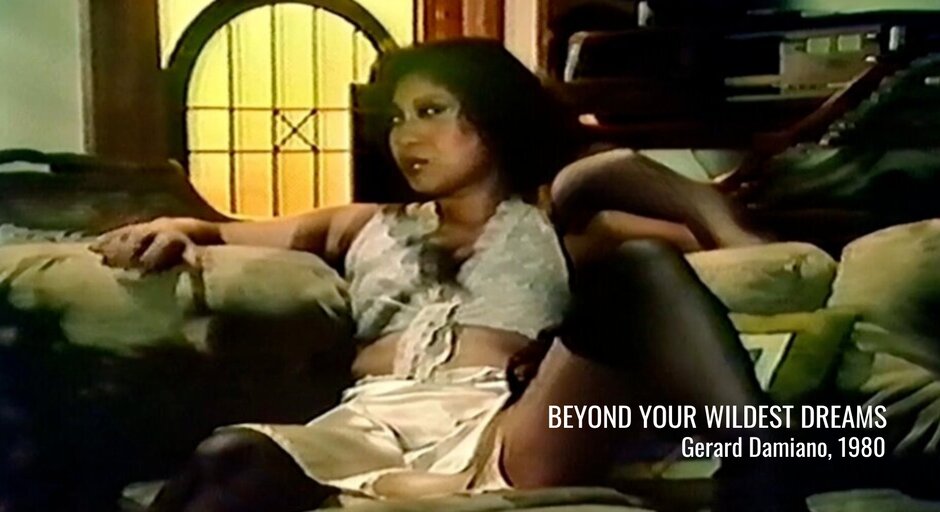
Cantara Christopher as Simona Wing in the Porn Classic, Beyond Your Wildest Dreams (1981, Gerard Damiano director), Just for the Man I Love, BBC Conductor John Wilson

From 2020. Yesterday, Thanksgiving, a fan (thanks, Brian!) sent me a screenshot from one of my later movies, Beyond Your Wildest Dreams.

I’m looking at you, John Wilson.

Beyond Your Wildest Dreams 940x512For Dream Girl #1: Carlos Santana’s hit “Oye como va” which I danced topless to in the 70s.


Lead in this feature was a fascinating woman named Juliet Anderson (here’s her interview in The Rialto Report), a classroom teacher who, in early middle age (39), started in porn and quickly became a star due to her talent in enthusiastic penilingism, plus she photographed well doing it. I was a little more delicate going about it but I think no less effective as an Oriental love doll. Fan Brian likens this pose to the one in “Cantara, 1973” except in 1973 I was 18 and this flick was shot 8 years later on a proper set.


FULL DRESS // A gifted mesmerist—a sinister composer—a naive young conductor from the north…inspired by an episode from the life of Rachmaninoff // DOWNLOAD FREE BOOK POSTER

Claptrap, a volume of poetry by Stephen Gyllenhaal (Cantarabooks, 2006)

Lest we forget the source of our lately grief, this is Steve’s one and only book, which my small press published in 2006. The poems were good. The poet was a schmuck. And I say that in deference to his lovely (ex-)wife, Naomi, to whom he dedicated this slim volume of confessional free verse. I wrote about this in my nutty memoir A Poet from Hollywood, available for free in pdf download here.

Claptrap by Stephen Gyllenhaal

Naomi, why do you purposely fail to believe me??? I turned the meathead down! Twice!! Above Stephen and Peter Sarsgaard (yes, that’s the back of Peter‘s head): Hugo Alfven’s “Swedish Rhapsody” arranged-conducted by Michel Legrand and played by his orchestra.


The dedication by Jamie Lee Curtis (she’s Jake‘s godmother so she did Naomi a favor by writing this for Steve, who was in a jam—well, just read about it here) is pretty adorable and for that sake I might try to hunt up the pdf galley and upload it here.

EXTRA! Not that he deserves the attention, but here are three of Stephen’s poems, recited by the idiot himself:

EXTRA EXTRA!


FULL DRESS // A gifted mesmerist—a sinister composer—a naive young conductor from the north…inspired by an episode from the life of Rachmaninoff // DOWNLOAD FREE BOOK POSTER

Cantara, 2009

Wearing Mother’s Day gift, a pendant from The Kid, who started adolescence as an Emo Goth.

Cantara 2002 Lightning

FULL DRESS // A gifted mesmerist—a sinister composer—a naive young conductor from the north…inspired by an episode from the life of Rachmaninoff // DOWNLOAD FREE BOOK POSTER

My First Music: The Pure Joy of St Trinian’s and The Inn of the Sixth Happiness by Malcolm Arnold

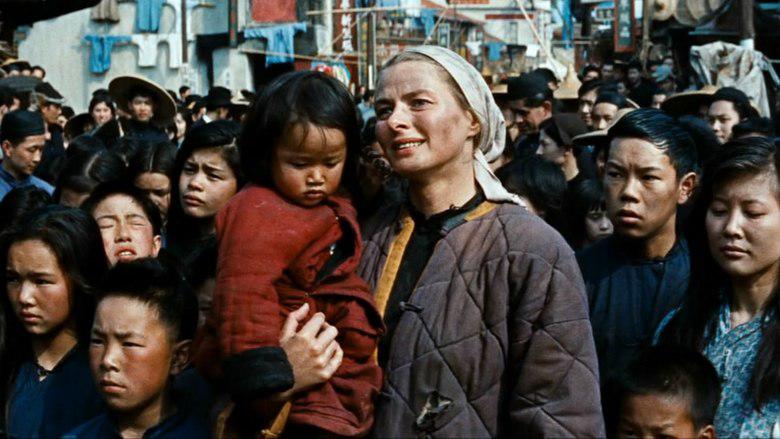
There must be something in the English character that enables the better artists among them to depict situations of unassuming, steady bravery with superior deftness, which is probably why their World War II pictures are better than ours. One of them, The Inn of the Sixth Happiness (20th Century Fox, 1958), doesn’t technically qualify either as a UK picture—Fox produced it; or as a WWII picture—it’s set during the Sino-Japanese War of 1938; but it does have unarmed peasantry scattering to the hills under Japanese gunfire, which is a theme that ran through my mother’s life starting with Pearl Harbor and ending in March, 1945 when American troops marched through the rubble-strewn streets of Manila, hunky victorious good guys. My mother’s first teenage romance was with a private in the 31st Infantry Regiment named Kelly, come to think of it.

Now, when I refer to better artists of English character I don’t mean the film’s producer, director, writer (American, American, American), or stars (Swedish, Austrian). But it’s because of: one, the true-life heroine the story was based on; two, the location shooting; three, the non-lead casting; and four and most importantly, the music, that I think of Sixth Happiness as an English film. The true-life heroine of the story was English-born, not to mention the film has Snowdonia standing in for the daunting terrain around Yangcheng and pretty near the entire Chinese heritage population of Liverpool standing in for Chinese nationals, with supporting roles portrayed by stalwarts of UK stage and screen. This is the first thing I ever saw Burt Kwouk in.

But to the music. This is not Malcolm Arnold’s finest score—Bridge On the River Kwai (Columbia, 1957) really is a superior composition—but it rates higher with me becauuuse, you guessed it, The Inn of the Sixth Happiness has a gorgeous Love Theme, which you can hear below as the Royal Academy of Music performed the suite back in 2014. You’ll also hear the bright, high fanfare brass that Arnold used in a few other of his movies, River Kwai and the one below, for examples. Also, I’m starting to develop a theory to satisfy myself that certain intervals, played with conviction, are the real sinews of English music: they make for that sound of “rightness”, which you can take one way or another, depending on the mood—or your mood, for that matter. Sixth Happiness has plenty of those.

Inn of the 6th Happiness.jpg

Besides the satisfying fanfare brass, Sixth Happiness shares with the satirical The Belles of St Trinian’s (British Lion, 1954) a bit in the score where there’s a song meant to be sung by children—in Sixth Happiness it’s “This Old Man”; in St Trinian’s it’s the school’s hilarious “Battle Cry”. I’m not posting the lyrics here, so click on the link in red to listen to those cheerfully bloodthirsty oaths. But can you imagine what a liberating tonic this ferocious roar from the depths of The Untamed Female Soul was to a little girl in the Catholic part of Minneapolis, watching this on Saturday matinee TV (a tonic, incidentally, I would not imbibe again till I heard Bernadine Dorhn mouth off a few years later)—?

Here’s the BBCCO doing the St Trinian’s suite at the Proms (Timothy West, narrator) bringing back almost all the familiar, funny-music leitmotifs to smile at, like George Cole’s character’s “Flash Harry”, a loping, rattling kind of tune (although lamentably there’s no sign of Joyce Grenfell’s scurrying “Ruby Gates”) before returning to that ghoulish school pageant march, lyrics I believe provided by Arnold himself.

In contrast, “This Old Man” is meant to be a “found” song, purportedly a children’s counting song, heard on the playground since the 19th century, and in a way that’s right, as the first time I heard “This Old Man” was on the playground—but only because it had become a hit on US radio first in 1959. It’s still impossible for me not to hear “This Old Man” and not think of the climactic scene in Sixth Happiness: the hundred children crossing the Yellow River into safe territory, ragged and exhausted but alive, marching into the unoccupied city to cheering crowds, loudly singing this song. Invariably it brings tears to my eyes, immigrants’ daughter that I am, and I remember the first time I watched—and heard—this film on TV with my mother, my mind nearly forming the question I never asked her, not then, not ever: “What happened to you in the war, mom?” Because the music was so ravishing, the love story was so satisfying, and my mother just wanted to enjoy an Ingrid Bergman film.


FULL DRESS // A gifted mesmerist—a sinister composer—a naive young conductor from the north…inspired by an episode from the life of Rachmaninoff // DOWNLOAD FREE BOOK POSTER

Lalo Schifrin’s Other Theme; Armenians in California; Black Actresses on 60s TV; a Seminal American Stage Work; and LA PI Beefcake

Mannix (1967-1975) was a long-running private-eye American TV show from the dynamo team of Geller-Link-Levinson. It was popular for several reasons, one being Mike Connors’s Hirsute Sex Appeal (here pictured); not to mention the show’s viscerally satisfying action scenes (Mister Beefcake gets beaten up a lot); its swingy, sexy theme composed by none other than Lalo “Mission: Impossible” Schifrin; and, not least, for Joe Mannix’s lovely secretary, Peggy Fair.

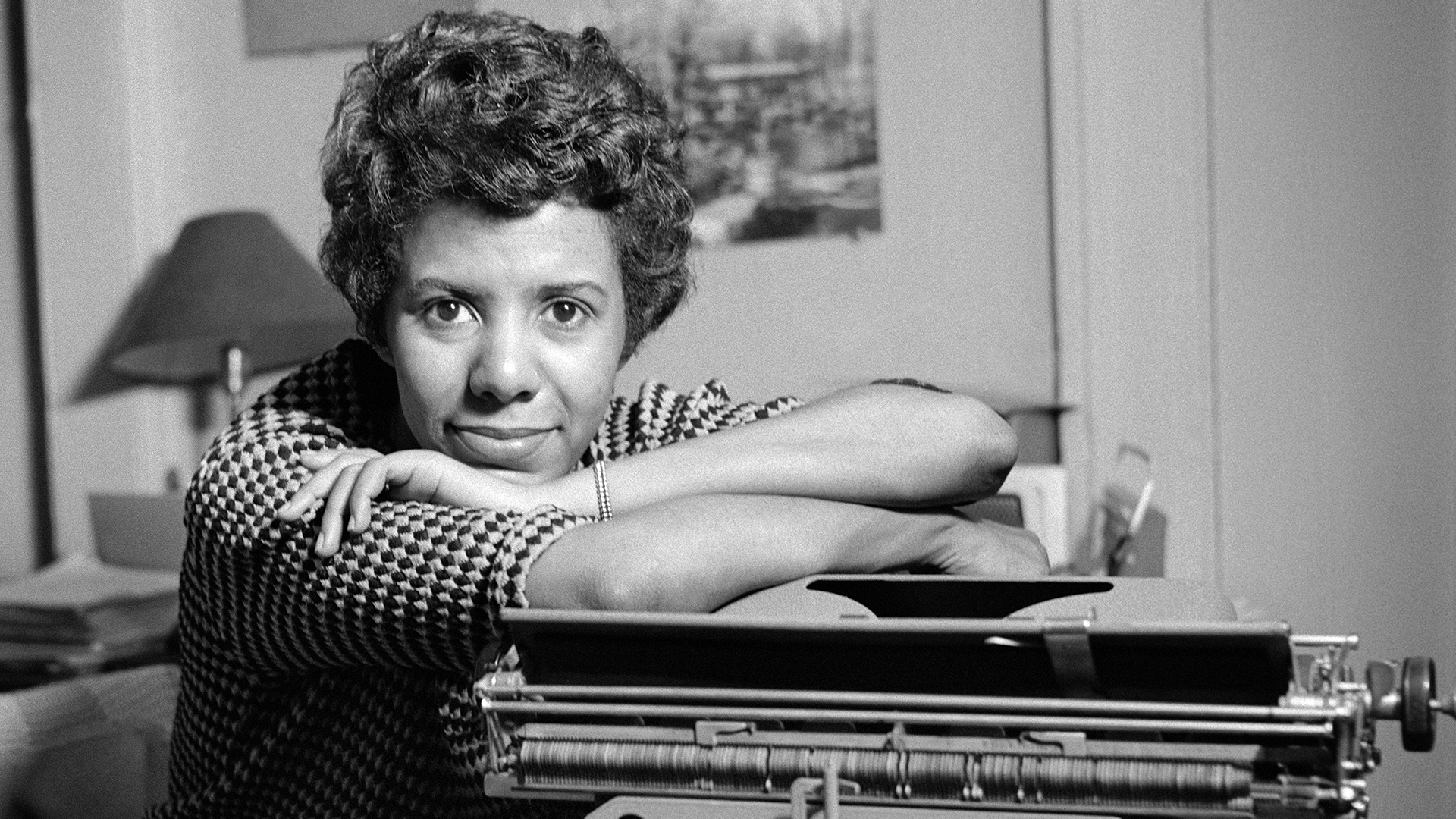
Peggy Fair (Gail Fisher) was a character very much in the tradition of capable cool-headed female helpmeets to the main investigator guy (think Della Street or Effie Perrine). In the mid-60s there was a bouquet of gorgeous black actresses in regular roles on prime time: Fisher; Diahann Carroll starring as Julia; and of course, Nichelle Nichols as Uhura in Star Trek. Not to mention there were frequent small-screen guest appearances by stage stars like Ruby Dee and Diana Sands and TV stalwarts like Mimi Dillard. And you know, looking back, I think I noticed these actresses particularly because they all reminded me of one particular black girl I had a crush on from her photos and her work, who’d died in the mid-60s only a few years after her historic stage triumph:

“MikeAbove sweet Lorraine Hansberry (1930-1965), playwright, author of the seminal American stage drama, A Raisin In the Sun: Lalo Schifrin’s tuneful syncopated 6/8 that’s the theme for Mannix, played by his orchestra.

Remembering the TV show Mannix also brings me back to something I quickly realized after moving to the Golden State: When you come to California, more sooner than later you will run into an Armenian. Heck, one of my first secretarial jobs in LA was for Tbilisi-born Rouben Mamoulian. Connors (1925-2017), who was born Krekor Ohanian in Armenian-strong Fresno, claimed to be a distant cousin of William Saroyan, author of The Time of Your Life and The Human Comedy, among other classic dramas of mid-20th century America.

Saroyan once made a memorable statement, “Wheresoever two Armenians meet, there is Armenia.” Which is something I’d like to apply to Filipinos as well.


FULL DRESS // A gifted mesmerist—a sinister composer—a naive young conductor from the north…inspired by an episode from the life of Rachmaninoff // DOWNLOAD FREE BOOK POSTER

Valentine’s Day, 2020

Fernando Amorsolo NudeFilipina nude painted by Fernando Amorsolo y Cueto, 1960, just for my bonny English conductor John Wilson.


FULL DRESS // A gifted mesmerist—a sinister composer—a naive young conductor from the north…inspired by an episode from the life of Rachmaninoff // DOWNLOAD FREE BOOK POSTER

Shostakovich’s Symphony No 1 and the Japanese Attack, 7 December 1941

Serge Koussevitsky, Leonard Bernstein’s mentor, was on the podium conducting the first symphony by the “new young Soviet composer” Dmitri Shostakovich in the CBS radio Sunday afternoon broadcast of the New York Philharmonic when, in the middle of the first movement, none other than famed NY correspondent John Charles Daly broke in with the news of Pearl Harbor. The Japs bombed the naval base at Pearl twice that morning, first at 8am Hawaii time, then again at 9:30am…then went on that same day to bomb the fuck out of Singapore, Hong Kong, Burma, Guam…

Dmitri Shostakovich.jpgThen about 6pm they finally got around to Clark Air Base and the RCA transmitter on the outskirts of Manila where my mom was going to high school


FULL DRESS // A gifted mesmerist—a sinister composer—a naive young conductor from the north…inspired by an episode from the life of Rachmaninoff // DOWNLOAD FREE BOOK POSTER

Silly Sexy Love Songs: “Goodness Gracious Me” Sung by Peter Sellers and Sophia Loren (1960)

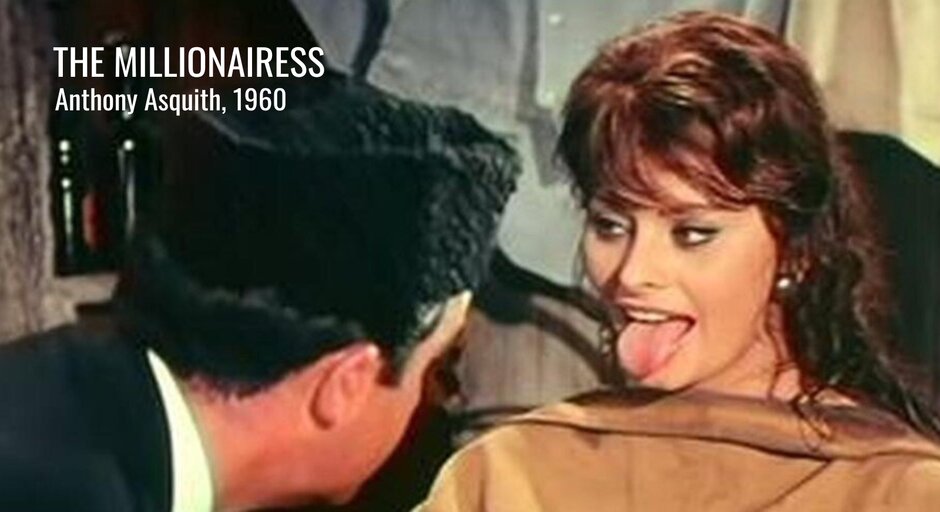
Sophia Loren is so incredibly sexy just singing this bouncy love duet she sexes up whoever she sings it with. Even blogy old Sellers…

Boom puddy-boom puddy-boom puddy-boom
Puddy-boom puddy-boom puddy boom-boom-boom

No idea what musical category to put this under, maybe I’ll make up a new one.

Peter Sellers and Sophia Loren in The Millionairess (20th Century Fox, 1960) and sing the tie-in jukebox hit “Goodness Gracious Me“. By the way, as an Asian-American, I have no problem with Peter Sellers playing a Muslim Indian doctor—or Anthony Quinn playing a Filipino war hero, for that matter. (If you’re looking for the BBC-TV show Goodness Gracious Me, here’s the pub sketch to start you off)


FULL DRESS // A gifted mesmerist—a sinister composer—a naive young conductor from the north…inspired by an episode from the life of Rachmaninoff // DOWNLOAD FREE BOOK POSTER

My First Music: Al Bowlly Sings Ray Noble’s “Goodnight, Sweetheart” in “City on the Edge of Forever” on the Original TV Show Star Trek (NBC, 1967)

The traditional closing number for any formal dance (the orchestra played this at every Rizal Day dance I ever attended in Minneapolis as a girl), the tender song “Goodnight, Sweetheart” was written in 1931 by the English composing team of Ray Noble, Jimmy Campbell and Reg Connelly. In the recording used in Star Trek it was played by the Ray Noble Orchestra and sung by Al Bowlly, that darkly good-looking singer who, at the height of WWII, was found in the rubble of his London flat after a blitz attack, dead, but without a mark on his handsome face.

City on the Edge of Forever
Above Joan Collins and William Shatner in this memorable final episode of the first season, 1967: “Goodnight, Sweetheart” sung by Al Bowlly.


FULL DRESS // A gifted mesmerist—a sinister composer—a naive young conductor from the north…inspired by an episode from the life of Rachmaninoff // DOWNLOAD FREE BOOK POSTER