In the first months of the third decade of the twenty-first century, an executive order emerged from Washington DC, that was called “Making Federal Buildings Beautiful Again”. It mandated that new federal buildings in the United States must be designed according to the classical architectural style of Roman temples as the “default style”. Predictably, this caused outrage among many and set up fake battle lines between America’s conservatives (the Republicans and President Donald Trump) and liberals (the Democrats and so-called progressives). Predictably, on February 24, 2021—a mere five weeks after his inauguration—Democratic President Joe Biden revoked the order.Beauty was the justification for the Trump’s administration’s order. Consistency and reference were the means to that end.
This is how young and free and full of hope Cantara’s feeling today. I just woke up with this song in my head:
Above: My cousin, Grammy-Award winning guitarist Larry Ramos with his old group, The Association, doing my favorite of theirs, “Goodbye, Columbus”, an upbeat song about youth and new roads, a jukebox tie-in with the 1969 film based on Philip Roth’s novella of the same name, about a couple of Jewish kids escaping boring old Ohio.
EXTRA! Courtesy of YT an entire episode of Groucho’s classic TV “game” show, You Bet Your Life from 5 December 1957, featuring American concert baritone and outspoken rock’n’roll hater, John Charles Thomas, plus the heroine of the most scandalous book in my mother’s forbidden library, The Big Love—the fetchingest teenager (15!) in Hollywood, Beverly Aadland! Just months before Errol Flynn swept her away! At 11:50 Beverly sings “All Shook Up” and Groucho dances a few steps solo, then with her, in a really sweet passage a deux.
I was an admirer of Korngold ever since I played violin in The Snowman in the orchestra in junior high (reduced score of course; here’s the full score of the Entr’acte), then as a solfeggist at ASCAP in NY around the time RCA was coming out with Charles Gerhardt‘s definitive recordings of Captain Blood, The Sea Hawk, Robin Hood, etc. Then years later in San Francisco I inherited a friend’s collection of Andre Previn and the London Symphony Orchestra, which included Korngold’s Symphony in F-sharp.
Maybe it was from associating the Previn recording with my friend’s death, but I grew to detest the sound of late Korngold. He began to sound false to me—the result, I reasoned, of all those corrupting years in Hollywood. And Previn was his perfect interpreter, of course, two Hollywood minds as one, you might say. Doesn’t, in fact, the first movement sound like a medley of The Ten Best TV Cop Show Themes and Their Underscorings? And then the ringer in the Adagio: The Private Life of Elizabeth and Essex (John Wilson+Sinfonia of London), so recognizable from the movie.
Bette Davis portrays Queen Elizabeth, Errol Flynn her faithful but ambitious lover in this sumptuous costume drama. Warner Bros, 1939
And so I was content to continue in this apprehension, until Chandos came out last week with a new recording of Korngold’s symphony, played by the newly re-formed Sinfonia of London and conducted by—wait for it—John Wilson. By now, I think I’ve made my feelings clear about John just a little. Whenever he gets really irritating though there’s one thing that I do: I make myself remember the times my bonny lad has absolutely astonished me. The first time was fourteen, fifteen years ago in a screening room in LA when the band from nowhere just ripped into that hack hit “Beyond the Sea” and made it truly soar. The second time was a few years later when I heard the sound, THE EXACT SOUND!!!, of that ultra-Judy number from Meet Me In St Louis, “The Trolley Song”, only bigger, more vibrant, more—present.
This is the third time. Who would have thought that a smaller, tighter orchestra, conducted by someone coming in without preconceptions but with a determination to follow through with the composer’s intent, could make a composition sound like an entirely different composition? John said somewhere once that he endeavors to give each musical piece he “takes on board” its correct coloring (which I might believe if he weren’t so maddeningly inconsistent) but here he does the remarkable: Where Previn colors all over the place, trying to make the music into something it’s not, John colors very little. Rather it sounds like, as I say, he actually worked out the composer’s intent to carry him through, and it’s pretty clear that Korngold meant for Symphony in F-sharp to take its rightful place in the Great Central European Repertoire, with its traditional wealth of tonal expressiveness.
So why oh why do some people insist this piece is movie trash? Is it because of that handful of notes from E+E? I swear to God I didn’t hear any other filmic callbacks, and I’m pretty good at catching tunes. But so what if there were? Korngold, unlike the majority of movie composers, retained legal possession of his studio work, which gave him the freedom to rework any of his past themes and phrases as he saw fit. He certainly wasn’t thinking of the flicks once he returned to Europe. Maybe his attachment to these notes was purely sentimental. We’ll never know. It’s a mystery, and I choose to believe that John, consummate musician, respects that mystery.
Anyway John, my signal, my flame, as you’ve done with so many other composers, thanks for leading me back to Erich Korngold. It’s a wonderful recording, a keeper, now the standard against which I’m judging every Korngold Symphony in F-sharp out there (and there are a lot of them, not just Previn’s, as you know), and I would’ve bought it even if I weren’t crazy in love with you.
6 September, 2021. Labor Day. (Bosses 2 – Labor 1) I suspect a few people in the UK might lately be visiting here as part of their Monday morning getting-into-gear ritual, so apologies for the lateness of this new posting, but I had to make the potato salad. Mister Grumble likes my potato salad.
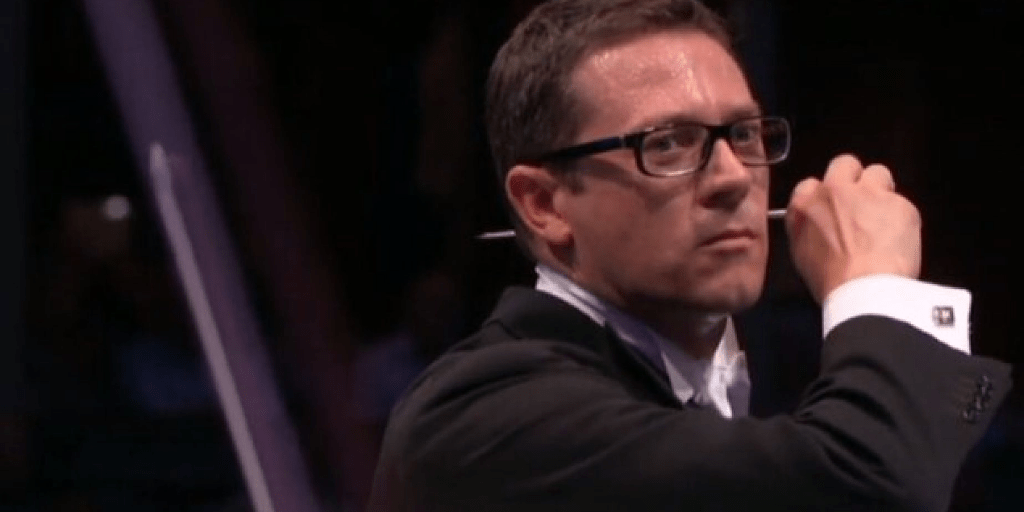
Another reason for the delay: I needed to see what John was wearing for this radio concert, because the work clothes my bonny chooses to wear for any particular program always convey a meaning to me—so I had to wait for his picture (forget the bullshit reviews) to come out in The Guardian or The Independent… As you can see below, he was attired in a simple concert tuxedo, which I truly hope was comfortable. (Still wore his lucky cufflinks, though.)
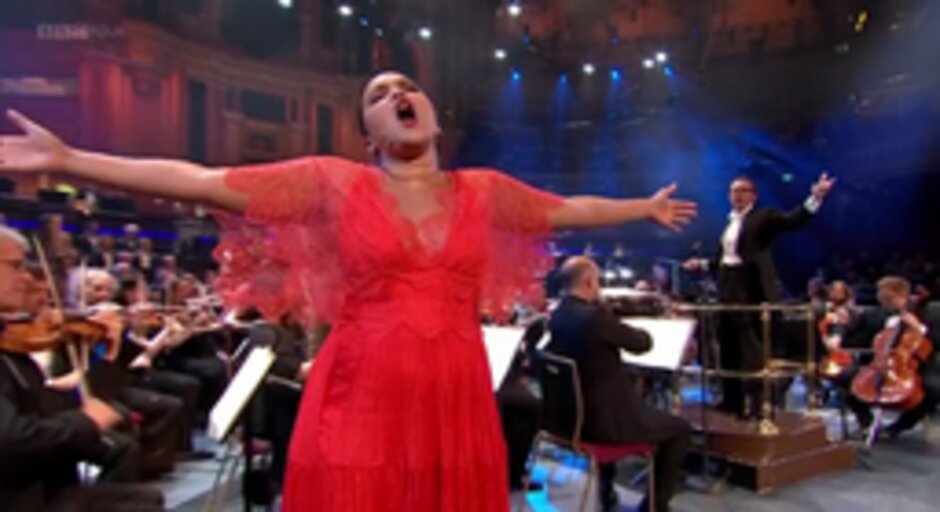
Above: Erich Korngold’s Symphony in F, Conducted by John Wilson and played by the Sinfonia of London, BBC Proms, September 2021.
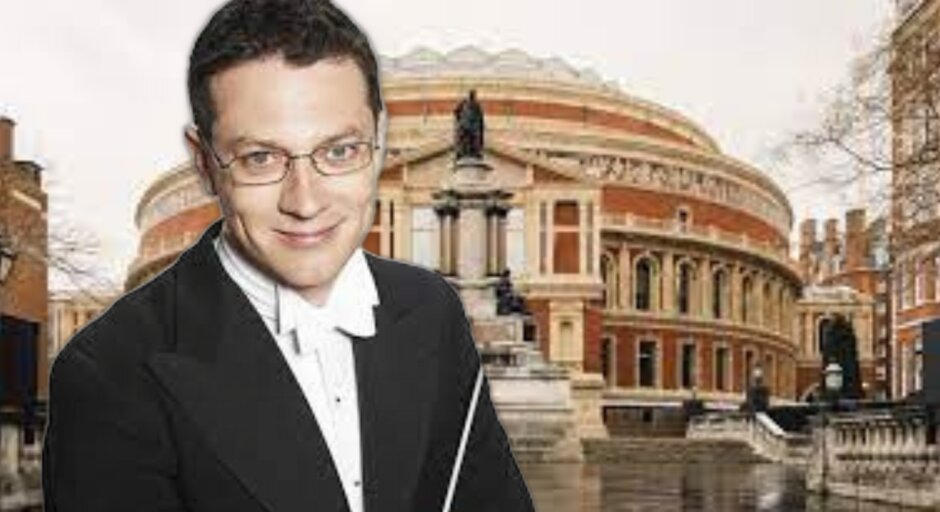
The importance of John Wilson’s white tie and concert tailcoat. This is what I couldn’t determine during the early days of my passion for John: Whenever he wore the tailcoat at the Proms conducting The JWO, his fancy showtunes orchestra, I wondered, was it because he was following in the historically deep tradition of maestros (Bernstein, Barbirolli etc) in dignified full dress…or was it just part of the show? So when John eschewed the tailcoat for his very important 4 September “Viennese” concert at the Royal Albert—where he could have so easily camped it up—this is what his choice said to me:
This music is serious. This presentation is serious. Spectacle doesn’t apply here. Sentimentality doesn’t apply here. Pay attention to the music! An assured, masterful bit of programming—not just some splashy entertainment, but a true, potentially life-changing encounter with Art. For only ten bucks a bottom-price ticket, I understand. I hope you Brits appreciate what you have.
John, dearest: It was only quite recently that I decided the satisfaction I get, devising interesting fantasies about making love to you in full dress (in my imagination we’re both in our work clothes, you in your tailcoat, me in my sarong), belongs best in a particular narrow stream of writing that has nothing to do with the way I regard you in real life: as a fellow artist I’d enjoy exchanging energies with. So, hooray for your concert blue suit, your concert tuxedo, your rehearsal T-shirt, all of which remind me that an actual human being strives and pulses behind the baton to create something beautiful.
Which brings us to the concert program. I don’t know the Berg so I’ll let that one alone, except to say the soprano has a nice strong tone. The Zemlinsky encore? You clever lad. Your Ravel waltz is as tight as when you conducted it at the Royal College, here even more ravishing coming from a fuller orchestra. I’d also get a kick reading your markings for Strauss’s Die Fledermaus Overture—have never quite heard those musical values brought out before. Very yummy.
The third movement of Erich Korngold’s Symphony in F. The Mister and I have exchanged a few strong words on this subject; however, since one cannot talk reason to a woman in love, I’m not going to include his remarks here. It’s a wonder that this single movement can bring out such contentiousness among people, even in someone like Mister Grumble, who wouldn’t’ve given a fig for Korngold if I hadn’t rediscovered Korngold through mywanton passion for conductor John Wilson andall the music that surrounds him. Even Leonard Bernstein and his protegee, John Mauceri, couldn’t agree: read my earlier post ”Leonard Bernstein Hears Korngold’s Symphony in F-sharp for the First Time”… [going off to make dinner, spaghetti with chicken-tomato sauce, back asap]
For you fans, here’s the program for my bonny‘s 4 September, 2021 concert:
Johann Strauss II: Die Fledermaus Overture (!!!) / O happy the audience who experiences this Viennese treasure at the Royal Albert with a full orchestra conducted by my beloved John
Before we get to what I think will be a nice and fair assessment of John Wilson’s 2020 recording, a word to some people.
I have always been aware of the tacit agreement that exists between my screen persona Simona Wingand her fans, but let me now take this opportunity to state my position clearly: You all have my blessing to do whatever you want with me in your fantasies.
I didn’t realize this was still a thing in the music world, but apparently opinions continue to be strongly divided as to whether Erich Wolfgang Korngold—a true heir, by the way, to The Great Mittel European Romantic Tradition—deserves inclusion in the canon some snooty farts call the Classic Repertoire. When you mention the name Korngold, even the most knowledgeable music lover’s first thought is of upmarket movie soundtracks (Anthony Adverse—The Adventures of Robin Hood—The Sea Hawk—Captain Blood) and likely never gets around to the fact that Korngold wrote, among other things, the most luscious symbolist opera of the 20th century, Die Tote Stadt, in 1920, and a hell of a gorgeous violin concerto 25 years later:
So it seems like every generation there has to be one nut who comes along and says, Let’s run Korngold past the hoi-polloi again and see if he’ll fly—and if you think I’m talking about you, John Wilson, you’ve got a swelled head. Because the nut I’m talking about is the nut in the CIA. The anonymous nut who got The Company to fund an enterprise back in the early 70s called “The Golden Age of Hollywood Music” and hence to elevate Korngold to the status of Hollywood Royalty—but through his film scores and his film scores only.
But that story later.
We’re here right now not just to size up a new Korngold recording, but to honor the decades-long musical relationship of Andrew Haveron, violinist, former Leader of The John Wilson Orchestra, current Leader of the Sydney Symphony Orchestra, and conductor John Wilson, whose career in orchestra building started at the age of 22 and hasn’t stopped since.
Korngold’s Violin Concerto in D, their latest Chandos release, was going to get my attention with or without the Winsome Lad of Low Fell anyway, as I’m a sucker for this particular style and era of music. But I was glad to learn about their actual friendship as well; for me it explains why the perfect communication that’s so evident here between Haveron and my John (and through him, to the estimable RTE Orchestra) has some of the magic of Barenboim+du Pré, back in the brief days when those two were cooking hot with Elgar.
This is soloist Haveron’s star turn: a warm, fresh, intimate—revelatory even—rendition of a piece that, let’s face it, is kind of like the “Nessun Dorma” of violin concertos. But this is John’s success too. So much of my bonny’s gift for conducting Korngold, as we know, has to do with his insistence on a technique his PR people call “shimmer” but is actually wrist vibrato on strings, a technique in fingering I learned about and taught myself when I was 14 because I liked the sound it made, although when the orchestra teacher put it down for sounding cheap and sloppy I quit it.
But I know the sound of shimmer and you do too. The John Wilson Orchestra practically patented it. John himself still calls for it whenever he conducts Tchaikovsky. It’s in all the high-toned movies of the 1930s. It’s also in Rouben Mamoulian’s classic film musical Love Me Tonight (complete film here) courtesy of Paramount’s musical director Nat Finston, who understood what he was talking about when, in a certain musical scene, he said he wanted “crying violins”. I could tell what he was talking about when Mamoulian told me this story 46 years later.
Happy 2021, my darling Low Fell Lad Made Good. I just tried getting on your management’s website for you (johnwilsonconductordotcom) to check for your January gigs when I was sent to the sinister Your connection is not private page, which perturbs me a bit as it sounds like the server might’ve been hacked.
[Sorry, have to go be with Mister Grumble for a while. More later, promise.]
[2 Jan 2021 14:20] Later. I’m back, dear. Glad to see that fixed, for now. Mister Grumble and I had a date to listen to what I just found on YT: the 1978 NYE Grateful Dead concert from The Closing of Winterland—you know, the one where [legendary band manager] Bill Graham glides down to the stage on a giant lit joint (as I described it to my blind angel which he recognized at once)—and really, it was a great night, or so the Mister tells me. The Mister is the one who turned me on to The Dead, back at our old commune in San Francisco.
But here I go rambling on about American things when I’m sure what you really want to hear is how you made out in 2020. Well honey, as you know, you did fine with your recordings on the Chandos label: Your 2 Korngolds, the symphony and the violin concerto, your Respighi, and the French dudes. I’m sorry you couldn’t conduct Tchaikovsky in Chile (sharing the same time zone with you would have been pretty cosmic), but you did “save” The Turn of the Screw at Wilton’s Music Hall, and that’s très chic.
[making dinner now, Bavarian-style pork chops with sauerkraut and boiled potatoes; I’ll come back to wrap this up as soon as I can, promise]
[6 Jan 2021 14:21] Okay, now that I’ve served all your wonderful fans around the world, let me have my say.
The BBC Proms 2017 semi-staged production of Oklahoma! pissed off 3 people I care about even though one of them is dead: Mister Grumble, a proud Oklahoman, who hated to see this nuanced Sooner tale turn into some weird English panto; original 1943 director Rouben Mamoulian, who even though dead howled in his grave at your dismissive use of his name in promos, oh, and for perpetuating a “mistruth” about him and his artistic relationship with Agnes de Mille; and me for two things: one, your use of the Robert Russell Bennett orchestration (which was never meant to play to a room the size of the Albert) instead of the film orchestration (by Bennett+Courage+Sendry+Deutsch) which, if I remember rightly, you actually used in your 2010 show for the last number, “Oklahoma!”, and it was gorgeous; and two—Marcus Brigstocke as Ali Hakim!!!??? Who the hell at the BBC was responsible for thatwhitewashing? And why didn’t the UK press call the Beeb on it? (I mean, if you’re all going to be hoity-toity over Maria in West Side Story…) Now, I can lay the former at your door but maybe not the latter, as the Beeb seems to have gone off its rocker on its own… But c’mon.
But let that pass. What really impresses me about my lust for you is that it started me on the road to thinking about The Old Man again. And actually, really, I should thank you for that. Mamoulian ought to be remembered—not for being a cranky old has-been, but for having directed some classic pictures and classic stage musicals like, you know, Oklahoma! I knew him. Our minds matched. That there was some weird man-woman friction going on between us toward the end makes no difference. It fries me how little regard he gets nowadays, even in the film buff world.
But now my love, here’s the last item and I hope I can finish it before I have to go in to make dinner.
Okay. Here’s the connection between you and Mamoulian, and it has nothing to do with you as a musician. It has to do with that damn full dress of yours, which has aroused such a surprising fetish in me I’m exploring it in a special place.
Listen carefully to this 1938 piece by American composer Samuel Barber and you’ll hear the stirrings and inspiration for English progressive rock group King Crimson’s classic “In the Court of the Crimson King”.
I created this posting just for John Wilson, Conductor fans (and as a lagniappe for the lad himself). By the way, the third movement is the one you want if you want to hear violinist Andrew Haveron shine:
In 1988, I brought a recording of Erich Wolfgang Korngold’s Symphony in F-sharp to Leonard Bernstein’s country home in Fairfield, Connecticut. It was a rare event to have dinner with him and no one else. After dinner, I asked if he would be willing to hear something I had discovered and found particularly interesting.
I played the first movement of the symphony. Bernstein only knew that it was a symphony and therefore might have expected it to be in four movements. After intently listening to the twelve-minute movement, he had no idea who the composer was, but he liked the music enough to ask to hear the second movement. And so it went, after each movement I gave him a chance to beg off. The symphony’s third movement—its emotional climax—inspired him to jump to the piano and repeat its opening motif and the devastating substitution in its harmonic structure that happens twenty seconds into it. After the last movement, I told him who had composed it. I also told him that though the piece was completed in 1952, its concert premiere did not take place until 1972, fifteen years after the composer’s death.
On first hearing, Bernstein thought the symphony should have ended with the third movement, which would have made it a very tragic symphony indeed. I suspect he heard it in terms of Mahler, which is appropriate enough. He had not predicted—or perhaps wanted—its upbeat finale that takes the gentle second theme of the first movement and transforms it into a positive march, albeit with a dark warning before its conclusion.
Be that as it may…I am sure that he would have turned his attention to Korngold had he not passed away in 1990. Ironically, one of his mentors, Dimitri Mitroupoulos, had stated in 1959 that he had finally found “the perfect modern work” and planned to perform the Korngold the next season with the New York Philharmonic, but his death intervened.
from For the Love of Music: A Conductor’s Guide to the Art of Listening by John Mauceri (Knopf, 2019)
Well, John, this isn’t a Joan Crawford movie so there’s no gold cigarette case but as I’m still in love with you and want to give you nice things, I’ll give you my honest appraisals, which is something I’ve been doing all along anyway (I hope you’ll agree) and not throwing myself into Long Island Sound for your sake. So let’s do this organized, going down the numbers in the program one by one because, as you recall, I used to work at ASCAP:
“We’re In the Money” (from Gold Diggers of 1933) / Harry Warren, Al Dubin Count on you to include the lyrics in pig Latin.
“The Desert Song” (from the 1953 film) / Sigmund Romberg, Oscar Hammerstein II Meh. I think the only reason you worked this in is because Kim Criswell’s singing a Romberg song in your 5 January concert in Stockholm, “Softly, As In a Morning Sunrise”, which is a hot, HOT number. In fact I can’t believe you’re going to stand on the same stage when she sings that song and not get incinerated. But that’s just you I guess.
The Treasure of the Sierra Madre (suite; from the 1948 film) / Max Steiner God, I forgot how repetitive Max Steiner can be when he’s not cribbing from Herman Hupfeld.
The Old Man and the Sea (suite, 1st movement; from the 1958 film) / Dmitri Tiomkin One movement, mercifully short.
“Seventy-Six Trombones” (YT) (from The Music Man, 1962) / Meredith Willson I lost a bet to Mister Grumble that you would never, never, EVER do this number, ever. (Because, you know, it’s so OBVIOUS.) But…yeah, it was okay. No Andre Rieu though.
“Blues in the Night” (from Blues In the Night, 1941) / Harold Arlen, Johnny Mercer A low-voiced woman should sing this. Preferably a woman who’s been there.
Auntie Mame (main title; from the 1958 film) / Bronislav Kaper You know, I’d forgotten how much I like this sweet waltz.
“The Man That Got Away” (from A Star is Born, 1954) / Harold Arlen, Ira Gershwin [in an obvious nod to the movie’s latest remake] Of all your singers, Louise Dearman is the only one who could’ve carried these two numbers in this room particularly, and whatever luck or good judgment (and I’m nuts about you dear, but I’m never completely confident about your judgment in these matters) brought her there I’m glad.
“Get Me to the Church On Time” (from My Fair Lady, 1962) / Frederick Loewe, Alan Jay Lerner A little harkening back to your 2012 Proms triumph, eh?
25-MINUTE INTERVAL Proms Plus Talk: a discussion of some of the great film scores being played tonight [Hah! In a pig’s eye] with Matthew Sweet, David Benedict and Pamela Hutchinson
Gypsy (overture; from the 1962 film) / Jule Styne, arr Ramin and Ginzler I still have the clip of you conducting this at the 2012 Proms (the other one). This one is sooo much hotter.
Now, Voyager (suite; from the 1942 film) / Max Steiner John, I’m afraid I really didn’t give this number a fair hearing the first time so I’m going to listen to it again and compare it to your Chandos 2022 recording. But you know, I almost missed the old dear telling Katie Derham that YOU wrote this arrangement because the Mountview kids down on the floor were leading a cheer [@1:05:00].
“The Deadwood Stage” (from Calamity Jane, 1953) / Sammy Fain, Paul Francis Webster [a Doris Day tribute] O-kay! A FULL number from a musical, complete with chorus—this is the very thing that made your name. All is forgiven.
“It’s Magic” (from Romance On the High Seas [correction, BBC: “On”, not “In”], 1948) / Jule Styne, Sammy Cahn [again, a Doris Day tribute] What in the name of heaven possessed whoever decided to include the worst song Jule Styne ever wrote? Redeemable only—only—if Bugs Bunny (YT) sings it.
A Streetcar Named Desire (main title; from the 1951 film) / Alex North Oh, you’re going to have fun with this one when you have to give sexy program notes to the audience from the podium, like you did in Brighton.
“The Days of Wine and Roses” (YT) (from the 1962 film) Henry Mancini arr Nelson Riddle, Johnny Mercer Nelson Riddle!? You used the freakin’ Nelson Riddle arrangement?? What are you trying to do, send love signals to Seth MacFarlane?
“Tomorrow” (from The Constant Nymph) / Erich Wolfgang Korngold You had this and your Prince Charming from Cendrillon, Kate Lindsey, up your sleeve! What a nice surprise.
ENCORE “I Could Have Danced All Night” (from My Fair Lady, 1962) / Frederick Loewe, Alan Jay Lerner Every soprano in the world wants to hear this song done right. She passes.
The following was translated on Google from the Czech and transcribed by me—except for minor grammatical emendations—verbatim:
PRAGUE DAILY | 24 SEPTEMBER 2007 – John Wilson has brought restored film music to the Prague Autumn and is preparing to pay his respects to John Williams.
From the point of view, conductor John Wilson gives the impression of an intelligent young man. He is one of those rare people who is a joy to meet. In addition, he finished a several-hour rehearsal with the Czech Radio Symphony Orchestra. He has prepared a concert for the Prague Autumn Festival, called “Famous Film Music from Hollywood”, which will be performed twice due to great interest. At the age of thirty-five, Wilson has gained a recognition that many might envy. Some time ago, for example, he performed at the prestigious BBC Proms music festival, but he still remains modest and immediately attracts listeners with a helpful, understanding speech.
It surprises me that at your age, you are so interested in early film music. One would expect that a witness would be more enthusiastically interested in the archives.
I would like something really valuable to be left behind. That is why I try to concentrate a large part of my energy and diligence on the restoration of old, often non-existent or directly lost sheet music scores. [I do this] most often in collaboration with the Hollywood studios Warner Bros and MGM. In the 1960s, the MGM studio liquidated its entire music library, which was one of the largest and most valuable of its time. At the time, people simply did not think that film music needed to be preserved for future generations. The only thing that has survived are the movies. I’m trying to correct their mistake now.
Musical archeology
This must be extremely challenging.
Yes, it really is. It is necessary to listen to the whole composition from the film second by second and to the smallest detail. I’ve seen “The Wizard of Oz” at least two hundred times. With all your will and senses, you focus on each and every measure. You must not miss anything if you want to get the most accurate description possible. You spend all day working hard and eventually find that you have two or three seconds of music. You have to be patient, but I think it’s worth it.
Will we hear the result of your efforts at your Prague concert?
Yes. The first in the first part, which will focus mainly on music “for witnesses”, will be heard, for example, the remembered “Wizard of Oz”. In the second half, however, I would like to pay tribute to John Williams. Not only because he is one of the best modern composers of film music, also successful and popular, but also because Williams is more based on tradition than anyone else. Therefore, I hope that the listeners will notice the context, which I would like to point out non-violently at the concert.
Do you mean, for example, the work of Erich Wolfgang Korngold, a Czech native famous during The Golden Age of Hollywood?
Naturally. Williams’s orchestration, for example, is almost identical to his. This is clearly evident in “Star Wars”, which, of course, cannot be missing from the program. You must understand that Williams began as a pianist in Hollywood recording studios in the 1950s and came into direct contact with the generation that laid the foundations of modern film music. In addition to Korngold at the time, Max Steiner and Alfred Newman, who is the composer of perhaps Hollywood’s most famous tune, a fanfare of 20th Century Fox, were still active. At the same time, I hope that the audience will recognize how much Williams still remains himself and in the true sense of the word, an original.
Last of the Mohicans
Are you well acquainted with the past of film music, but how do you look at its future?
You know, Williams is seventy-five years old this year, and even though he’s still active and still composing great music, he won’t be here forever. I don’t think there’s anyone in the current generation who can replace him. That’s why I’m afraid the whole era of film music will leave with John Williams.
But that sounds pretty hopeless.
Maybe a little. On the other hand, I am convinced that the hope of film music can be the current generation of European composers, who come up with cultured, intelligent and imaginative music. In Hollywood, on the other hand, music is basically declining, becoming flatter and flatter by the day. Sure, it helps the film become great, but I prefer music that will stand up on its own. My concert is also trying to point out that. I try to prove that good film music is not lost in concert halls.
At the same time, film music is struggling for recognition, and many musicologists still see it as an indecent, used form.
In the words of a classic: “Who ever built a monument to a critic?” I will not say at all what the critics say. The attitude of such people is not so critical or professional, but rather snobbish. But attitudes and opinions are changing. Constantly. In July, for example, I conducted British film music with great success at the BBC Proms, a large and acclaimed festival. No one would have dreamed of that ten years ago.
Glück, das mir verblieb,
rück zu mir, mein treues Lieb.
Abend sinkt im Hag
bist mir Licht und Tag.
Bange pochet Herz an Herz
Hoffnung schwingt sich himmelwärts.

Wie wahr, ein traurig Lied.
Das Lied vom treuen Lieb,
das sterben muss.

Ich kenne das Lied.
Ich hört es oft in jungen,
in schöneren Tagen.
Es hat noch eine Strophe—
weiß ich sie noch?

Naht auch Sorge trüb,
rück zu mir, mein treues Lieb.
Neig dein blaß Gesicht
Sterben trennt uns nicht.
Mußt du einmal von mir gehn,
glaub, es gibt ein Auferstehn.
 Above: My cousin, Grammy-Award winning guitarist Larry Ramos with his old group, The Association, doing my favorite of theirs, “Goodbye, Columbus”, an upbeat song about youth and new roads, a jukebox tie-in with the 1969 film based on Philip Roth’s novella of the same name, about a couple of Jewish kids escaping boring old Ohio.


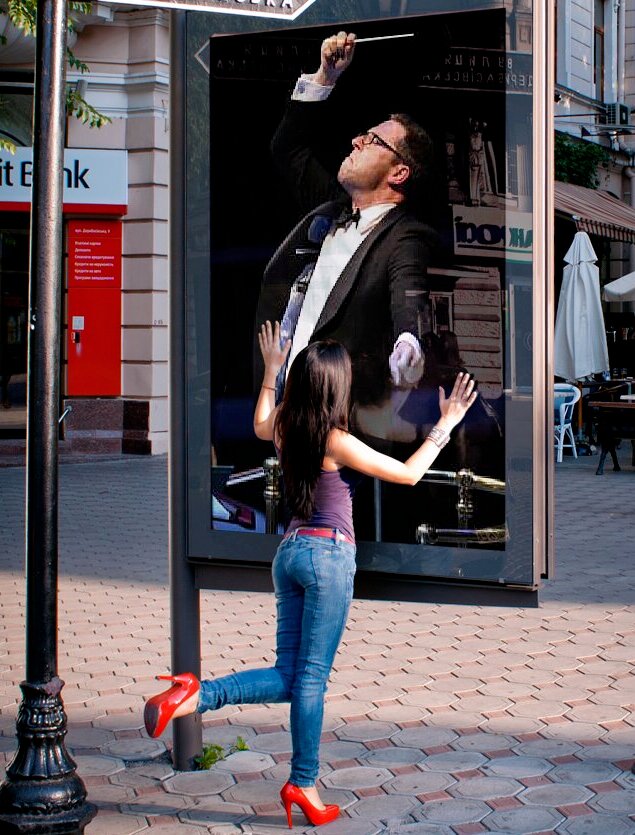
 Above Mister Personality: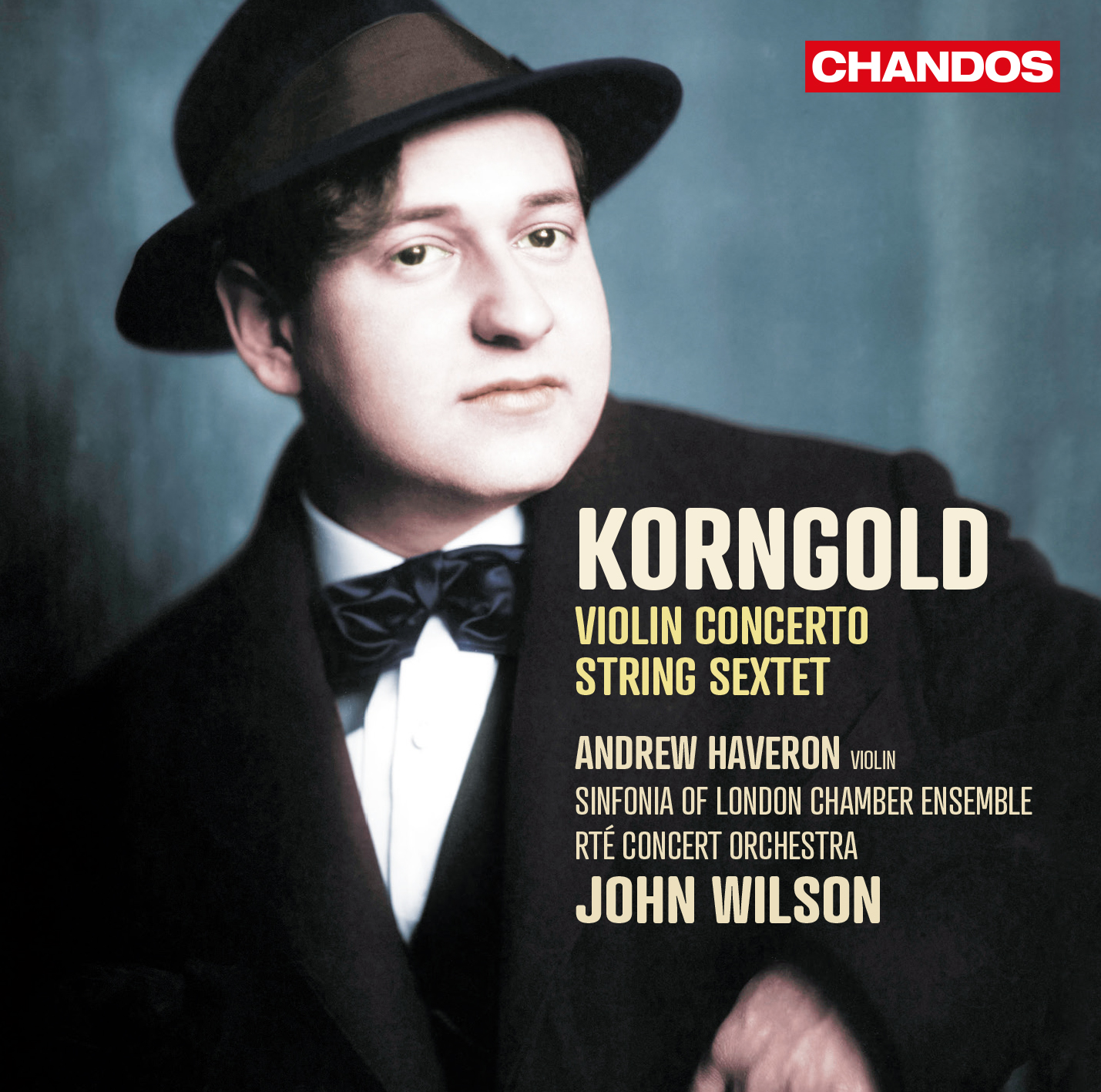
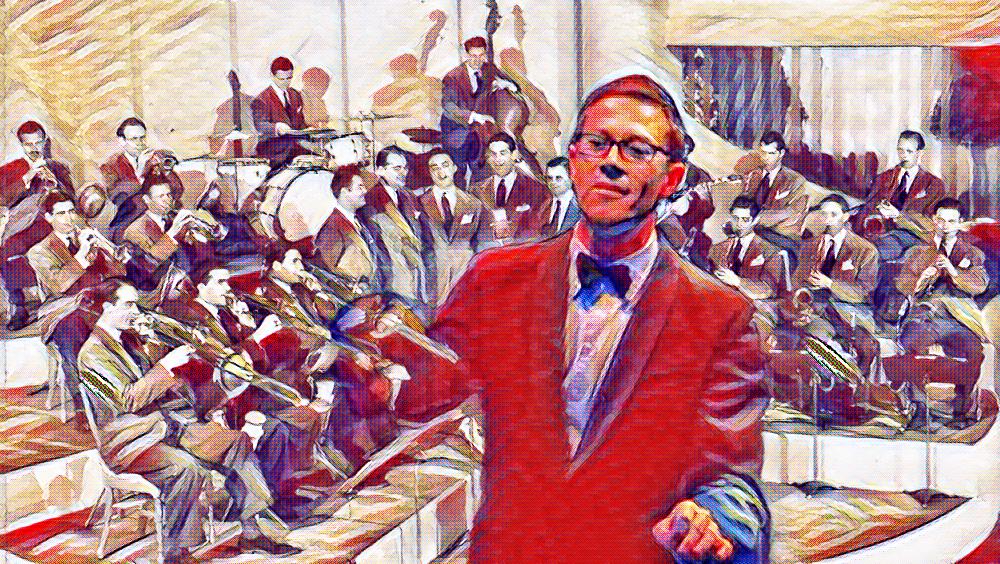 Above John conducting his dream swing band in sweat-soaked silk shirt:
  As part of the 50th anniversary of their founding (in October 1969) King Crimson will be touring the States with members of Frank Zappa’s band through summer 2020. Above:
 "I'll Be Dead Before You Break My Heart"