Benjamin Britten’s The Turn of the Screw with Peter Pears and the EOG, 1954; and at Wilton’s Music Hall, 2020, Filmed by Opera GlassWorks and Conducted by My Beloved John Wilson

AVAILABLE 30 JAN 21: Opera Glassworks’s filming of their fully-staged TURN OF THE SCREW streamcast at Marquee.tv


EXTRA! John speaks in this half-hour BBC4 radio show about the re-staging of Turn of the Screw at Wilton’s Music Hall, 2020


A new production of The Turn of the Screw from Opera Glassworks, conducted by John Wilson at London’s Wilton’s Music Hall, was three days from opening in March 2020 when the first lockdown hit.

Director Selina Cadell and producer Eliza Thompson managed to rebook the cast of six singers and 13 musicians (from John’s own orchestra, the Sinfonia of London) for a run in October. But as weeks of lockdown turned into months, it looked like the project would be scuppered.

At which point, they rethought it for film.

The stage director and producer took the opportunity to experiment. “We weren’t interested in live capture,” says Thompson. “But we didn’t want the fact that it was intended to be a stage production to be lost.”

This influenced not just their approach with singers and a working method with camera director Dominic Best across the 6-day shoot, but also with the individual players forming John Wilson’s orchestra.

With the perfectly captured, decayed grandeur of its main, high-vaulted space dating back to 1859, the thrillingly atmospheric, Victorian-era Wilton’s Music Hall translates perfectly into the chilly, remote country house and garden in which the ghostly actions occur. Designer Tom Piper seized the opportunity to make the entire building a film set.

“Covid restrictions meant we couldn’t have all the musicians there together,” says Thompson. “So with the auditorium completely filled, becoming a Suffolk reed bed, we’ve planted the musicians throughout the film. As the story progresses, it becomes more anarchic.”

Cadell and Thompson have capitalised on the opera’s unique construction, individual scenes interspersed with an instrumental theme and 15 variations, to enhance the work’s filmic, non-linear nature.

The performance, still in the edit prior to being distributed via arts channel Marquee TV, is an equally impressive advance born out of Covid necessity. The vocals were filmed live, with the singers using microphones but without the orchestra. Instead, using monitors, John Wilson conducted them against live keyboards. Once the singers’ tracks were laid down, the orchestra was recorded to fit the singers’ interpretations, which is how it should be. ~David Benedict, from The Stage, 20 Nov 2020

*Catch a glimpse of the man I love on the monitor at 00:33 or here at rehearsal.

The Turn of the Screw at Wilton's, 2020When I was back in grad school, I did a paper on the novella this opera is based on, The Turn of the Screw, my take being that the whole thrust of the story had to do with, at its core, author Henry James’s weird revulsion to/fear of sexualityany sexuality—gay, straight, bi, kinky, whatever… Which in my ignorant prejudice I took to be typical of all English men anytime, anywhere—until I remembered that James was born not just American but, like my son, a native New Yorker (used to take The Kid to the playground in Washington Square near James’s old house) and he turned out fine. So it was fascinating to hear and watch OperaGlass Works‘s no-emotional-holds-barred production with my brilliant, bonny conductor John Wilson at the musical helm. Above Opera GlassWorks’s filmed production at Wilton’s Music Hall (2020): Britten’s 1954 The Turn of the Screw, with a superior libretto by poet Myfanwy Piper. Singers: Jennifer Vyvyan, Peter Pears, Arda Mandikian, Joan Cross, Olive Dyer, and as the young and beautiful boy Miles, David Hemmings! The English Opera Group was conducted by the composer.

FULL DRESS // A gifted mesmerist—a sinister composer—a naive young conductor from the north…inspired by an episode from the life of Rachmaninoff // DOWNLOAD FREE BOOK POSTER

Royal Gala at Windsor Castle for the Royal College of Music, May 2019

On Thursday 16 May 2019, His Royal Highness The Prince of Wales, President of the Royal College of Music (RCM), held a special gala concert at Windsor Castle. The concert showcased some of the RCM’s most acclaimed alumni, including Sir Thomas Allen, Dame Sarah Connolly and Conductor John Wilson, performing alongside Maxim Vengerov, Polonsky Visiting Professor of Violin, and the talented young musicians in the RCM Chamber Orchestra. The evening included a performance of George Frideric Handel’s Overture to an English Opera (here played by the Little Orchestra of London).

Windsor Castle Gala 2019 news itemI’d know the back of that head anywhere.

FULL DRESS // A gifted mesmerist—a sinister composer—a naive young conductor from the north…inspired by an episode from the life of Rachmaninoff // DOWNLOAD FREE BOOK POSTER

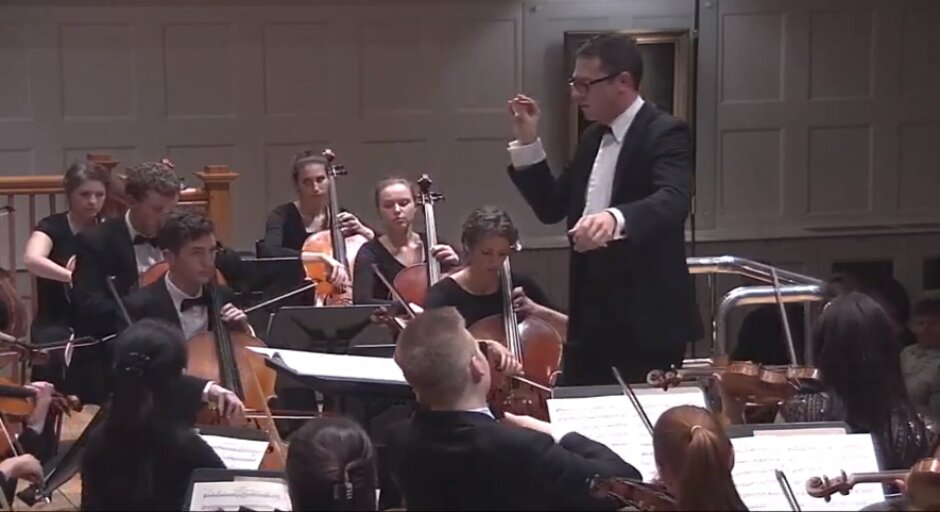
My Beloved John Wilson, RCM Alumnus, Conducts Fellow RCM Alumnus Benjamin Britten’s Sinfonia da Requiem with the Royal College of Music Symphony Orchestra, November 2013

Recorded on 7 November 2013 in the Amaryllis Fleming Concert Hall at the Royal College of Music in London.

john-wilson-rcm-britten-2013Above John: I Lacrymosa 00:00 / II Dies Irae 09:22 / III Requiem Aeternam 14:56.

A passionate expression of the composer’s pacifism, penned amid the conflict of 1940, Britten’s Sinfonia da Requiem is also a memorial to his parents. A powerful and enduring work, one of Britten’s most abiding from the earlier part of his career.


FULL DRESS // A gifted mesmerist—a sinister composer—a naive young conductor from the north…inspired by an episode from the life of Rachmaninoff // DOWNLOAD FREE BOOK POSTER

Joan Sutherland Sings “When William, at Eve” by Composer William Shield, Local Swalwell Lad Made Good

From November 2018: There’s a memorial cross in the churchyard of St Mary the Virgin, Church Clare, Whickham, in memory of the composer William Shield, one of Gateshead’s most illustrious sons.

Dame Joan was the one who got me interested in classical singing, if not doing it myself then listening to and appreciating it. This really tasty ditty comes from the pen of William Shield of Swalwell (which is right next door to my bonny John Wilson‘s childhood neighborhood of Low Fell), Gateshead, who rose to be the king’s Master of the Musicians and was buried in Westminster. “When William, at Eve” is from his comic opera Rosina (1782).

Shield was born in the village of Swalwell on 5 March 1748 and baptized in this church. The house in which he was born, opposite the Three Tuns pub (now in Low Fell), was demolished in 1936. Apprenticed to a boat builder, Shield studied music with Newcastle-born composer and church organist, Charles Avison (1709-1770), was heard playing violin by Italian composer and violinist Felice Giardini (1716-1796) and encouraged to take up music professionally.

On Giardini’s invitation, he became a member of the Italian Opera (aka The Haymarket Opera House / His Majesty’s Theatre) in London and one of London’s leading viola players. He was also a friend of Haydn. He wrote many successful pieces and songs, and in 1817 was appointed Master of the King’s Musick.

Shield’s main claim to fame, however, is that it has now been proven he wrote the tune of “Auld Lang Syne”. It was supposed that Robert Burns, who wrote the words, had also written the music, basing it on a folk song. Indeed, Burns claimed to have written it in 1788, inspired by a man singing in a pub. Recent research shows, however, that the tune comes from the Overture to Rosina, a music drama written by Shield five years earlier.

The original score for Rosina is in Gateshead Central Public Library. He also provided the music for another Burns song: “Comin’ Thro the Rye”. Shield died at his home in Berners Street on 25 January 1829 and is buried in Westminster Abbey.

~ from The Classical Map of Musical Britain by Richard Fawkes


FULL DRESS // A gifted mesmerist—a sinister composer—a naive young conductor from the north…inspired by an episode from the life of Rachmaninoff // DOWNLOAD FREE BOOK POSTER

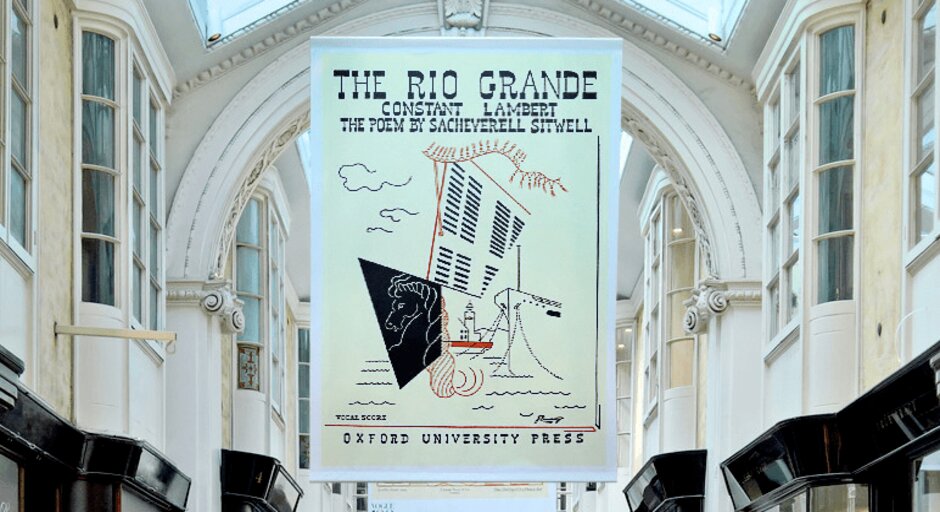
The Rio Grande by Constant Lambert, Broadcast Live from the Royal Albert Hall, 12 September 1959

A very nifty, lively, jazzy modernist piece written by Constant Lambert (The Who manager Kit Lambert’s dad) in 1927. Australian virtuoso Eileen Joyce, who famously played the heart-wrenching Rachmaninoff in the film Brief Encounter (entire film here), is at the piano here. County Antrim-born Jean Allister, contralto soloist, joins her with the BBC Symphony Orchestra and the BBC Chorus. At the podium is Sir Malcolm Sargent.

Lambert Picadilly Arcade 940x512

Composer-novelist Anthony Burgess, in his autobiography Little Wilson and Big God (Burgess’s original name was John Wilson; his middle family name was Burgess and his confirmation name was Anthony) wrote,“Lambert, who admired Duke Ellington and proclaimed his harmonic roots in Frederick Delius (who in his turn had taken them from Debussy), was a fearless reconciler of what the academies and Tin Pan Alley alike presumed to be eternally opposed. I was present at that first performance, and so was my father. And, in 1972, on a plane from New York to Toronto, I found myself sitting next to Duke Ellington, who spoke almost with tears of the stature of Lambert, admitted that he had learned much from both Delius and Debussy, and expressed scorn for the old musical division, which had been almost as vicious as a colour bar. He had lived to see it dissolve and jazz become a legitimate item in the academic curricula.” [More Burgess on Lambert here.]


FULL DRESS // A gifted mesmerist—a sinister composer—a naive young conductor from the north…inspired by an episode from the life of Rachmaninoff // DOWNLOAD FREE BOOK POSTER