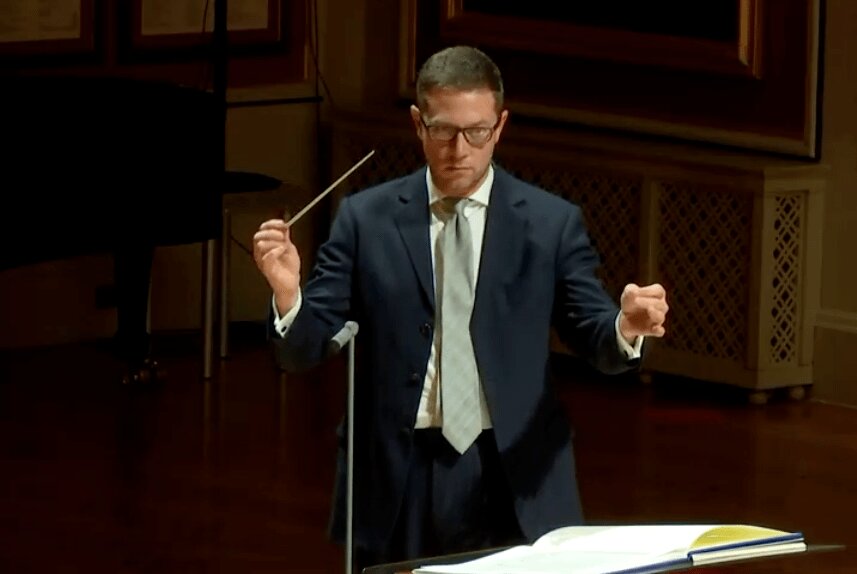
I don’t know what I did to please the gods but on one October morning in 2020, somehow, I took a perfect screenshot of John conducting, while watching the (UK time) 7:30pm performance of the Royal Academy of Music (Finzi, Strauss). “Metamorphosen” is from his new album on Chandos.
It’s John’s “I mean business” look that keeps me going. Above: John conducting the Sinfonia of London in Strauss’s “Metamorphosen” (Chandos, 2022)
It’s a funny coincidence, but the first—the very first—music article I wrote was for the University Chorus’s newsletter, a review of Ken Russell’s 1968 film, A Song of Summer. It just happened to have been on TV that month, May 1972, the month we were performing Frederick Delius’s 1916 Sea-Drift (available here on YouTube with accompanying score) and seemed like a natural to talk about…
Above: “Late Swallows” , the 3rd movement from Frederick Delius’s String Quartet in E minor, originally published in 1916 and re-arranged by Eric Fenby. My beloved John Wilson conducts his Sinfonia of London (Chandos)
[more later—my blind baby angel Mister Grumble‘s dictating his latest work to me, tentatively called The Last Bohemia; meanwhile amuse yourselves with his first here available in pdf, a comic novel of aliens, hippies, FBI agents, and cheap beer, Tales From the Last Resort…or this novella, Quality Time, about a day in the life of a young San Francisco heartbreaker…as for me, right now I’m re-readingDelius, As I Knew Him by Eric Fenby (G Bell & Sons, 1936)]
Since John’s management has long ago ditched his site johnwilsonconductor.com I went over to Bachtrack to find this info, and will probably end up going there and elsewhere evermore for more info on my bonny lad’s—w or w/o his Sinfonia of London—performances. (I also have John on Google Alert, plus I donate to the Royal College and the Royal Academy to get their email newsletters, plus I follow the Sinfonia and RTE on Facebook…plus if he’s scheduled to play movie music somewhere I can get that info from Juliet Rózsa…)
Know why I like this picture? ‘Cause there’s a devil face in the red vainly trying to get at my beloved through the impenetrable white light of my love. So there, John. I told you The Queen of Heaven had her eye on you
UPDATE! Some kind soul in the UK (probably my travelling writer friend Helen Ducal, and if it is you, Helen, thanks!) subscribed me a few days ago to the John Wilson & Sinfonia of London website, which promptly sent me the ballot ClassicFM put out for best classical recordings of 2023. So okay, I voted for his Vaughan Williams but NOT his compleat Oklahoma! out of respect for the memory of my old boss, Rouben Mamoulian, who John—prompted I’m sure by the BBC—saw fit to throw a little shade on when he conducted R&H back in 2010. (John’s still my guy, though. I’m sooo used to snarky artistic types.) So I’ll probably be getting the SoL schedule as they know it. But I still have to hunt up his other appearances.
The dates link to the ticket sites. The other highlights link to available recordings and YT appearances.
Sat 27 Jan 2024 19:30 Sheldonian Theatre Oxford, UK Oxford Philharmonic Orchestra Leonard Elschenbroich (cello)
From June 2023. Sorry for my shaky handwriting but while listening to this I had a fantasy that gave me the giggles: John being interviewed by my favorite ohne palones—prime purveyors of the gay-gypsy-theatrical patois called polari—Julian and Sandy. Played of course by the inimitable Hugh Paddick and Kenneth Williams on Round the Horne. (This more-than-usual musical episode of Kenneth Horne’s 1967 radio show also includes Rambling Syd Rumpo, the Fraser Hayes 4 singing off-key not on purpose, and the screamingly funny takeoff sketch, “Young Horne with a Man”.)
Now John, John / Glorious John, I know that you know, and I know that you know that I know, that my long-distance lovemaking to you is being observed by a few; not many, just a few. So this rundown is for them, love:
Here are the main points I took away from this podcast: “What I do try to do as a conductor is carry my sound around with me… It’s almost—I don’t really feel comfortable talking about because you know music is basically a doing thing and not a talking thing… My deepest musical creed is wrapped up with how an orchestra sounds…” Which pretty much confirms what I’ve suspected all this time about him.
John, fire of my loins, I respect your process.
Now, as heard on Monty Python:
Fantasia on “Greensleeves” Ralph Vaughan Williams, composer Barbirolli Conducts English String Music RCA, 1963 first issue The Sinfonia of London John Barbirolli, conductor
EXTRA! Here are 2 interviews with John from BBC 2 Radio: one (8 min long) from 24 April 2016 with Michael Ball, and one (4 min long) from 4 November 2013 with Steve Wright.
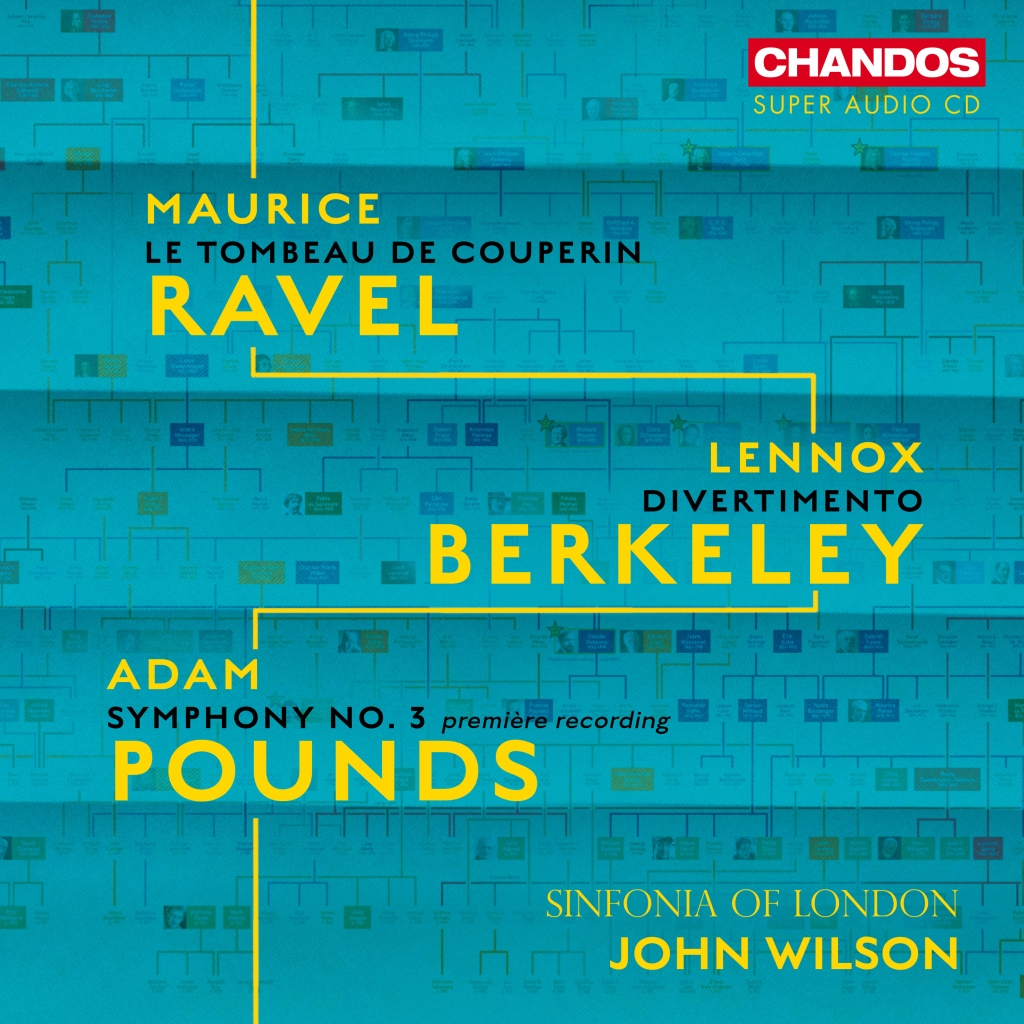
From February 2023: The three composers whose works appear in this album are interconnected—Ravel was a mentor to Lennox Berkeley, and Berkeley to Pounds.
Adam Pounds studied privately with Berkeley in London during the late 1970s, and in his own music has perpetuated the firm commitment of the two earlier composers to clarity and accessibility in everything they wrote.* His Third Symphony was written in 2021 and is a response to the national [UK] lockdowns in 2020 and 2021 prompted by the COVID-19 pandemic. Pounds states that the piece captures the ‘sadness, humour, determination and defiance’ which everyone faced at this time—not least musicians. Scored for relatively modest orchestral forces, the work is dedicated to Sinfonia of London and John Wilson, who give the work its world première recording.
It happened one evening in July, 1973. I was 18. I had just gotten that job as night solfeggist at ASCAP only a couple of weeks earlier, which is in itself a very interesting story I’ll have to tell you one of these days. Only now let’s get back to me walking down Broadway from 63rd. I loved walking home to the Village after work on a summer evening, when all of midtown was still buzzy with life and good times. After the night shift, some of my fellow solfeggists would go across the street to O’Neal’s Balloon to drink with the fancy Lincoln Center crowd (here’s my own favorite table showing up in Annie Hall), but I got a bigger kick being below 54th with all the theater people. On this particular evening I was approaching 46th…and right there on the corner of 46th stood a really good-looking guy, tall and blond and nicely dressed, who seemed to be scoping out one by one all the passers-by. For some reason he lit upon me. He got my attention. Then he asked me if I knew where a good jazz club could be found, the way you might ask any passer-by about a mailbox or the way to the Empire State Building… I told him I was new in town. Then he suggested we (“we”!) buy a newspaper and sit down somewhere and check the listings together. Oh, I was game. My first New York adventure! We went across the street to Howard Johnson’s where he bought me a hamburger and told me about himself. He told me he was an agent. He’d just put his client on the plane that day—his client having just been on The Dick Cavett Show promoting his new film, a comedy-horror flick that’s now a classic—and he himself was going back to London in the morning. He told me his client’s name, which I recognized at once, and then he gave me his card, which I kept for years until I gave it to an actor friend who said he was “looking for a UK rep”… Then he asked me about myself, all the nice polite questions a man’ll ask you beforehand… But we also talked about show business, shows, show music. I told him I liked Man of La Mancha. Having found no jazz clubs worth going to that night, we left HoJo’s and walked over to 5th Avenue, where we strolled back to his hotel room at the St Regis. I was ready for anything, expecting nothing. Even when he pulled the line, “Let’s get out of these hot clothes, shall we?” with that gorgeous limey accent of his, I still wasn’t sure we were on the road to making it…until we started making it. At that point we hadn’t even kissed. But oh, how he made up for it! I wasn’t a virgin, but here was the first man I ever slept with who actually knew how to take his time pleasuring a woman. By the time I was under him, gazing down at the back of his incredibly sexy legs, an electric shock went through me, and for the first time in my life, I orgasmed. So that’s the story of my first New York hookup. We parted in the morning, wishing each other well, and I even made it back to the boarding house in time for breakfast. A perfect sexual encounter with a happy ending.
I’m telling you this, John, because what Michael Linnit made me feel that night is nothing compared to how you made me feel when you conducted Elgar’s Bach Fantasia in Sydney three years ago. I’m not kidding. I had just fallen in love with you when I saw you shimmy to a Jule Styne tune in some video… But this time (it was about 2 weeks later) there was only you and the music on the radio. I’m not even crazy about Elgar, I was waiting for your Prokofiev. But I was so keyed up—for the past couple of weeks I had been vibrating with desire for you—that when a certain chord was played in the Elgar, a wave rolled through me, it was just so yummy… But that wasn’t all. As I lay there gasping, a little voice in my head went, You fool! Don’t you remember who’s doing this? And so I came again, this orgasm coming over me like a wave meant to drown…and I reached for you and knocked the lamp off the night table.
One day I’ll tell you about the other times (Vaughan Williams, Richard Rodgers). But I just wanted to let you know now how much you’ve meant to me, how much you still mean, even when you’re not wearing full dress.
JOHANNES BRAHMS Variations on a Theme of Josef Haydn “The Philharmonia 75th anniversary CD box set contains some really thrilling performances from a dazzling array of soloists and conductors—Karajan, Giulini, Klemperer, Kletzki and Cantelli among them—but the ones I’m most fascinated by are the concerts Toscanini gave with the orchestra at the Royal Festival Hall in 1952 which provide a wonderful snapshot of the Philharmonia Orchestra live on stage in its first decade.” / John’s right on this one, can’t do better than Arturo Toscanini at the RFH in ’52 with the Philharmonia
MAURICE RAVEL Daphnis et Chloe Suite no 2 “Once it became apparent that we would all be spending our days at home, I decided to embark on a project I had been putting off for years:correcting all of the many thousands of errors in Ravel’s masterpiece, Daphnis et Chloe. I soon became thoroughly absorbed in this rather epic task and ended up completing a brand new edition of the whole ballet which I will be recording next year. Here’s the peerless Charles Munch conducting the Second Suite.” / Listen, you. If you can do better than Charles Dutoit (Montreal, 2005—the FULL 56 minutes, with CHORUS) I’ll plotz. (No matter what, you’ll always be number one with me, that won’t change.)
EDWARD ELGAR The Dream of Gerontius “I’ve been making my way through all 109 discs of the new Warner Classics Barbirolli box set—a conductor whose work I come back to time and time again. There’s a fervour and intensity to his music making that is utterly compelling and this legendary performance of Elgar’s greatest work has, for me, no equal.” / Elgar, a devout Roman Catholic, was something of a religious mystic and this is evident in his much of his work, no more so than in this looong, stately but yummy setting to Cardinal Newman’s musing on death and redemption
TEDDY WILSON Don’t Blame Me by Jimmy McHugh and Dorothy Fields “I love, love, love Teddy Wilson’s piano playing—I’ve had his solo piano discs on a loop for days…” / Nah. If you want to hear one of the greatest swing* pianists ever at his best, here he is doing “I Got Rhythm” by the Gershwin brothers
KEELY SMITH Cocktails for Two by Arthur Johnston and Sam Coslow “Songs—in all their guises(!!!)**—have always been at the centre of my musical life. The great American songwriters from the first half of the last century gave us so many treasures and I’d never want to be without them. Last week my trombonist friend, Andy Wood, reminded me just how great Keely Smith is.” / When I was a little tiny teeny girl, I thought listening to Keely Smith singing this lush Charles Trenet-Albert Beach songbook standard “I Wish You Love” on the radio was like walking through an enchanted forest
*I am astonished that John actually, correctly, described Teddy Wilson as a Swing musician rather than put him into the catchall Jazz bag, which I’d have expected him to do, considering who was his teacher. His teacher was Richard Rodney Bennett. My teacher (at CUNY) was YUSEF LATEEF (download his 1957 album Jazz Mood here in full).
**John, are you conflating song with melody, or what? Only asking as a humble member of your audience.
Today, Easter, I found this work by an esteemed composition teacher of your alma mater, the Royal College of Music, the same day I also spotted the perfect illo to go with this Scotch-English ballad. I am dedicating it to you, John, because the lyrics make me shiver.
Reign of Guilds is a massively multiplayer online role-playing game (MMORPG) now in its trial run as of February 2023. Above: The heartbreaking choral Adagio from “The Trees So High” by early 20th century English composer Patrick Hadley (1899-1973). Swiss-born Matthias Bamert conducts the Philharmonia.
The trees they grow high,
the leaves they do grow green
Many is the time my true love I've seen
Many an hour I have watched him all alone
He's young,
but he's daily growing.

Father, dear father,
you've done me great wrong
You have married me to a boy who is too young
I'm twice twelve and he is but fourteen
He's young,
but he's daily growing.

Daughter, dear daughter,
I've done you no wrong
I have married you to a great lord's son
He'll be a man for you when I am dead and gone
He's young,
but he's daily growing.

Father, dear father, if you see fit
We'll send him to college for another year yet
I'll tie blue ribbons all around his head
To let the maidens know that he's married.

One day I was looking o'er my father's castle wall
I spied all the boys a-playing at the ball
My own true love was the flower of them all
He's young, but he's daily growing.

And so early in the morning
at the dawning of the day
They went out into the hayfield
to have some sport and play;
And what they did there,
she never would declare
But she never more complained of his growing.

At the age of fourteen, he was a married man
At the age of fifteen, the father of a son
At the age of sixteen, his grave it was green
Have gone, to be wasted in battle.
And death had put an end to his growing.

I'll buy my love some flannel
and I will make a shroud
With every stitch I put in it,
the tears they will pour down
With every stitch I put in it,
how the tears will flow
Cruel fate has put an end to his growing.
From The Guardian, Fiona Maddocks: “The final work, Elgar’s “Enigma” Variations, was one of the best, most alert and detailed performances you could hope for. Wilson, whose gestures on the podium are so unassuming he appears to do nothing more than beat time, had scrutinised the score, and asked probing questions about every familiar phrase, making it fresh. The Sinfonia of London, mostly a recording ensemble, is made up of leading principals or chamber musicians who want to play for Wilson. You can hear their devotion.”
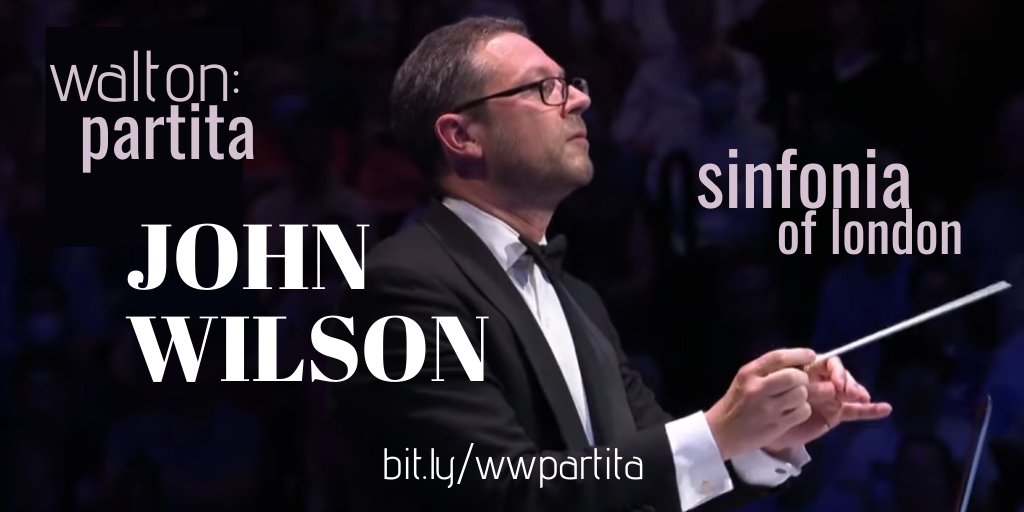
[Proms Director] David Pickard and I had a conversation about Sinfonia Of London’s connection in the past to English music, principally John Barbirolli’s famous record of English music for strings and it is as we know Ralph Vaughan Williams’s 150th anniversary so I thought opening with the Tallis Fantasia would be (a) good thing. And built that around I guess the English romantics and a fairly recent work by a living composer, Huw Watkins, who is Welsh and one of my favorite composers and a piece which he actually happened to write for Adam Walker, who’s our principal flute. The rest of the program con-sists of things you might know and you might not know. Walton’s Partita, which is a tour de force but it’s rarely done, and I think that’s because it’s so impossibly difficult. … Very difficult! One of the first violins came up to me and he said, “This is absolutely bloody murder!” We really sweated over it, and I—I hope to pull it off.
Above: Partita for Orchestra by William Walton (1957) written originally for the Cleveland Orchestra.
Sat 16 July 2022 18:30 Royal Albert Hall London, United Kingdom Sinfonia of London Adam Walker (flute)
From 4barsrest.com, an online publication that serves brass instrumentalists: The critically acclaimed big band and orchestral conductor (that’s my lad!) has accepted the role of Honorary President of the Yorkshire band Black Dyke. Chairman of the Board of Black Dyke Band Trustees, Trevor Caffull stated, “We are delighted that John Wilson has agreed to be our Honorary President and very excited with some of the initial thoughts shared regarding potential collaborations. In his early life, John was steeped in brass band culture. He has clearly lost none of his enthusiasm for the genre and we are very optimistic that this will evolve into a mutually rewarding association.”
Above John shaking hands with Prof Nicholas Childs, Music Director: Metropolis 1927, the Black Dyke Brass Band performing this extravagantly yummy piece, inspired by Fritz Lang’s film, composed by Lanarkshire-born Peter Graham. Sidebar: NOTES for Fanfares (Chandos, 2018) can be found here.
About Fanfares: I fell in love with John the spring of 2018. The summer of 2018 was The Bernstein Summer. The summer my beloved John tried to oedipally murder Leonard Bernstein before an arena of cheering thousands at the Royal Albert; the summer I finally heard on YT his Proms Oklahoma! from 2017 with Mister Grumble and having to end up apologizing to my Oklahoman husband the rest of the year; but more importantly, this was the summer I decided to try to make as comprehensive a chronology as I could of John’s musical paths, as evidenced by the dates of live performances whether videoed or not, radio broadcasts, album recordings and so forth. In this way I hoped to be able to follow him on those various paths, perhaps to be rewarded, even if only for a moment, with hearing music as he hears it, or perceiving if only for a moment what he feels when he conducts. So when I bought Fanfares, it was not a completely whimsical purchase. When I read later on that, a few months after he recorded with Onyx at St Jude’s, John went on to tame the raucous festival orchestra of Circus Roncalli at their New Year’s show in Berlin, I knew I was on the right track.
So this is what I garner from John’s travels in brass. His Gateshead working-class background stands him in good stead in this field; as it’s in the north of England, among the factory and mine workers who were also dedicated amateur instrumentalists, that the uniquely British form of brass ensemble was not simply allowed to grow and thrive, but achieve such a high excellence of sound and musicality that concert composers were, and continue to be, attracted to write works for it, for example this ravishing masterwork by Scottish-born composer Peter Graham for the 165-year-old, 28-piece Black Dyke Band of Yorkshire.*
It was in and around groups like these, as a percussionist, as well as in amateur musical pit orchestras, as a conductor, where my beloved John Wilson as a teenager got his start, and where he first developed his “ear”.
Which brings us back to Fanfares played by the London-based Onyx Brass, or to be more accurate, the Onyx Brass 5 plus 6 friends. In this trailer @00:24, John gleefully declares his pleasure at hearing such a rich clear loud sound (“shatteringly loud” he laughs, “a thrilling sound”) from such a relatively small chamber group. A little brass does go a long way.
The album is a tribute to the impressive range of John’s genuine knowledge of the repertoire. The selections are grouped under each of the 15 featured composers, themselves grouped very loosely by era. If one listens seriously and openly to the entire record—there are 58 cuts—even an absolute neophyte to the field of British brass might be able to discern qualities in the music itself that distinguish traditional British music in general: for instance those certain intervals I talked about in “The Pure Joy of St Trinian’s and The Inn of the Sixth Happiness by Malcolm Arnold” that suggest stability, cohesiveness, and “rightness”. This is the music of pageantry.
John begins the collection with famed Master of the Queen’s Music, Arthur Bliss, near the top, and the Onyx Brass does his “God Save the Queen” with the reverence and swelling pride it deserves. Tuneful Arnold, who played first trumpet in the BBCSO, is well-represented here, as are Albert Ketelbey, Arnold Bax, Frederic Curzon, Eric Coates, etc etc. But the real gems come from Imogen Holst (Gustav’s daughter, 1907-1984) with her “Leiston” Suite (1967); Elisabeth Lutyens with her typically odd but compelling Fanfare for a Festival (1975); Michael Tippett with the “Wolf Trap” Fanfare (1980); and also Joseph Horovitz, my beloved John’s composition teacher at the Royal College of Music, with his “Graduation” Fanfare No 2”, which debuted in 2013 at the graduation ceremony of the Royal College.
Each of these later pieces may stretch the definition of what a fanfare actually is, but all of them contribute a superior musicality to the brass repertoire. John’s championing of these works—particularly Holst’s suite, which deserves to be included in general concert programs—shows me not only where his heart is, but also his head. And John Wilson’s head is something that’s been on my mind for the last four years.
*A brief look at the score excerpt of Graham’s “Metropolis 1927” will give you an idea of how large and fully-complemented a British brass band can be.
Come again
Sweet love doth now invite
Thy graces that refrain
To do me due delight
To see, to hear
To touch, to kiss
To die with thee again
In sweetest sympathy
Come again
That I may cease to mourn
Through thy unkind disdain
For now left and forlorn
I sit, I sigh
I weep, I faint
I die, in deadly pain
And endless misery
Gentle love
Draw forth thy wounding dart:
Thou canst not pierce her heart;
For I that do approve
By sighs and tears
More hot than are
Thy shafts, did tempt while she
For scanty tryumphs laughs

~ Anonymous
Ed Lyon tenor, Benjamin Appl baritone, and Susanne Bernhard soprano are the soloists. The Choir of Hanover and the Liverpool Cathedral Choir round out the voices. Orchestra is the NDR Radiophilharmonie, Andrew Manze is the conductor. 2018. Above: War Requiem, written in 1962 by Benjamin Britten.
I sang in the chorus of War Requiem around the time you were going on 1. It was the last concert of the Minnesota Orchestra’s ’72-73 season in Minneapolis; guest conductor was Kurt Adler of the Metropolitan Opera. (Don’t remember the soloists.) It was the greatest musical experience of my life. I know the Decca recording is out there somewhere, but the broadcast above from Radio Hanover is the closest I’ve found to the feeling I got being in the middle of all that gorgeous sound…
Which brings me to address yet another one of those sundry feelings I have about you, and have had about you, lo these several years: besides tenderness, gratitude, annoyance, and raging lust, just a trace of envy that you ascend to such an exquisite sonic plane so often…
But the envy goes when you bring it on home to us, which you always do. And then I’m filled with the pure joy of loving you.
 Above:
 Above Cantara and her lust:
 Reign of Guilds is a massively multiplayer online role-playing game (MMORPG) now in its trial run as of February 2023. Above: The heartbreaking
  Above:
  Above John shaking hands with Prof Nicholas Childs, Music Director:
 Ed Lyon tenor, Benjamin Appl baritone, and Susanne Bernhard soprano are the soloists. The Choir of Hanover and the Liverpool Cathedral Choir round out the voices. Orchestra is the NDR Radiophilharmonie, Andrew Manze is the conductor. 2018. Above:
  "I'll Be Dead Before You Break My Heart"