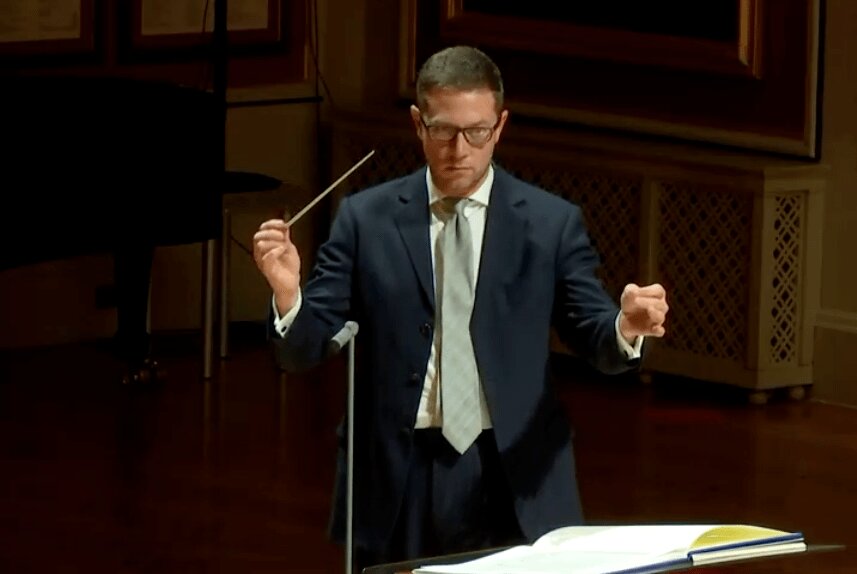
I don’t know what I did to please the gods but on one October morning in 2020, somehow, I took a perfect screenshot of John conducting, while watching the (UK time) 7:30pm performance of the Royal Academy of Music (Finzi, Strauss). “Metamorphosen” is from his new album on Chandos.
It’s John’s “I mean business” look that keeps me going. Above: John conducting the Sinfonia of London in Strauss’s “Metamorphosen” (Chandos, 2022)
My beloved John Wilson returns to the Royal College of Music to conduct the RCM Symphony Orchestra in Rachmaninov’s orchestral work in three movements. The last major orchestra composition completed by Rachmaninov, the suite is based around motifs found in Russian ecclesiastical music.
NEW! John’s 4-Part 2023 Video Interview on Marquee TV
I was 17 and my voice was not going to get me to the Met, but I enjoyed singing to the tiny group that gathered on Friday afternoons in Room 204 of Northrup Auditorium at the U in Minneapolis. The month my draftee boyfriend Jesse got out of the army (May 1972, just before he joined the Black Panthers) my teacher lent me an album of Teresa Stich-Randall and I picked out this number to do. It’s not a hard piece to learn but whoa, that breath control… That I managed to make it to the very end with some grace is due to Bach’s blessing to singers—all that forward motion impels you. But the effort was worth it. What a high!
Bach composed BWV 51 during a period when he composed church cantatas only irregularly, some of them to complete his earlier cycles. Both the soprano part, which covers two octaves and requires a high C, and the solo trumpet part, which at times trades melodic lines with the soprano on an equal basis, are extremely virtuosic. The cantata is one of only four sacred cantatas that Bach wrote for a solo soprano. The first aria, “Jauchzet Gott in allen Landen” (“Exult in God in every land”), is in da capo form, with extended coloraturas. The theme, with a beginning in a triad fanfare, is well suited to the trumpet. It is first developed in a ritornello of the orchestra and then constantly worked in the soprano part. At least, that’s what I remember.
Performed at the 1800-seat Fairfield Halls in Croydon. If you look fast you’ll notice 2nd violins leader Sir Neville Marriner (at the time former professor at the Royal College of Music, recent founder of the chamber orchestra St Martin in the Fields, and to-be music director of the Minnesota Orchestra). Note that touching moment at the end when the members of the LSO refuse to rise, at Bernstein’s insistence, for the applause of the audience, instead remaining seated and applauding Bernstein themselves. Now that’s respect.
Mahler’s “Resurrection” was voted the fifth-greatest symphony of all time in a survey of conductors carried out by BBC Music Magazine. (I wonder if my beloved conductor John Wilson voted.)
Above Cebuana New York-based soprano Evelyn Mandac (b 1945), who remains one of my role models (listen to her float over the fifth movement), the only Filipino singer ever to play the Met: Mahler’s entire glorious second symphony.
Although now lauded as monuments of vision and creativity, in their time Mahler’s symphonies were occasionally reviled but more often dismissed as a conductor’s egotistical indulgence. A critic of the time called his work “one hour or more of the most painful musical torture” (and that assault was directed toward his lovely pastoral Symphony no. 4!). As late as 1952, a detractor still moaned that “an hour of masochistic aural flagellation, with all of its elephantine forms, fatuous mysticism and screaming hysteria … adds up to a sublimely ridiculous minus-zero.”
The problem wasn’t so much a matter of grasping Mahler’s musical style. As the culmination of the long line of Viennese symphonists, his ideas were firmly rooted in the conservative structures of Haydn, Mozart, Beethoven, Schubert and Bruckner. Rather, the challenge lay in its emotional premises. As critic Herbert Reid later posited, “Mahler sensed the imminent upheavals that were to shatter the rationality and optimism that had driven Western civilization up to World War I. His symphonies are spiritual quests that reflect a wholly modern ambivalence of joy and pain, faith and doubt, transcendence and perdition. Mahler was way ahead of his time. Only by the 1960s did his private anxieties at last become our own.”
The Resurrection was Mahler’s favorite symphony, which he led on many auspicious occasions, and it had the longest gestation of any of his works. The opening was completed in 1888 as “Totenfeier” (“Funeral Rites”), a stormy symphonic poem to bear the hero of Mahler’s recently-completed First Symphony to his grave, amid torment over the meaning of his life. The middle movements awaited Mahler’s summer vacation of 1893 and reflected his fascination with the same medieval folk poetry which provided the texts for most of his songs.
The first movement is hugely dramatic; according to Mahler’s own program notes it aims to convey nothing less than a search for the meaning of life. The second, representing long-forgotten pleasure, is a gentle, old-fashioned dance of lilting grace, yet challenged by creeping shadows. The third is a grotesque and wickedly sarcastic waltz, shot through with anguished outcries. The fourth is a child’s song, naïve and wistfully introspective.
And then comes the vast finale, which depicts the full terror and glory of a pagan last judgment and resurrection. It begins with a huge crash and progresses through episodes of hushed expectancy, quivering tension, funeral dirges, hopeful fanfares and fevered misgiving, culminating in a triumphant apocalyptic chorale, one of the most glorious and powerful climaxes in all of music. Mahler adds to the awesome wonder with extraordinary instrumental effects, including offstage brass, a massive battery of percussion and ultimately the sheer visceral excitement of the potent sound produced by hundreds of singers and players. ~ Peter Gutmann, Classical Notes
Meanwhile, those of us who are still earthbound can treat our heads and ears to Oxford-trained harpsichordist Matthew Halls’s rendition of the complete Goldberg Variations of Johann Sebastian Bach (for which exists a cute story why it’s called that I won’t get into right now, although if you know/like the Variations you probably know it anyway).
“Emotions are the key. Everybody is welcome to my concerts. We open our hearts for the audience and the audience opens their hearts for us. Every night my orchestra and I see people dancing and singing in the aisles, enthusiastic and carefree. Together we spend evenings that we do not forget. When people write to tell me that they need two weeks to come down after my concerts, it makes me the happiest man in the world!”
From their rousing entrance to the tune of “76 Trombones” by Meredith Willson (that’s two l’s, thank you) to their invariable sign-off pieces: the Maastricht city anthem; Strauss Sr’s “Radetsky March”; “An der schönen blauen Donau” (of course); (no Shostakovich’s Jazz Waltz No 2 this year, though—here’s the 2010 performance on YT); “Can’t Help Falling in Love” (from “Plaisir d’amour” by Jean-Paul-Égide Martini, 1784); Austrian composer Robert Stoltz’s “Adieu, mein kleiner gardeoffizier”; and the Rocco Granata standard “Marina” (played every year at the San Gennaro Festival in Little Italy, NYC), there’s two hours here of sheer delight, not to mention drinking and dancing. It’s always a special afternoon when I get to play the entire Maastricht concerts for me and Mister Grumble, I open a bottle and dance around the room and he grins and drinks. Just like in our old commune back in San Francisco in the 70s.
The program (with comments, if any, as they come to me):
0:02 : 01. “76 Trombones” / Meredith Willson
5:38 : 02. “Old Comrades” (Alte Kameraden) / Carl Teike
10:25 : 03. “Granada” / Ernesto Lecuona
15:47 : 04. “Tiritomba” / Guglielmo Cottrau
20:20 : 05. “Nessun Dorma” / Giacomo Puccini
27:07 : 06. “Snow Waltz” (Schneewalzer) / Thomas Koschat
34:39 : 07. “Pie Jesu” / Andrew Lloyd Webber
41:18 : 08. “Olé Guapa” / A Malando
47:40 : 09. “You’ll Never Walk Alone” / Rodgers & Hammerstein
2:02:32 : 26. “Can’t Help Falling In Love” / Peretti-Creatore-Weiss (from “Plaisir d’amour” by Martini)
2:05:39 : 27. “Het Wilhelmus” anthem of Maastricht / Adrianus Valerius
2:07:40 : 28. “Maastricht, City Of Jolly Singers” / Armand Preud’homme
2:10:28 : 29. “Adieu, Little Captain Of My Heart” (Adieu, Mein Kleine Gardeoffizier) / Robert Stoltz, Ralph Benatzky)
2:14:11 : 30. “Marina” / Rocco Granata
As for their North American tour, it’s selling out fast, but here’s the itinerary: The US routing begins 12 Sep at Chicago’s Credit Union 1 Arena at UIC. Stops include Detroit’s Little Caesars Arena, Elmont NY UBS Arena, and Boston’s TD Garden. The Canadian dates start 21 Sep in Quebec in Centre Vidéotron, followed by gigs in Montreal, Ottawa and Toronto. More info at https://www.andrerieu.com/en/am2023.
JOHANNES BRAHMS Variations on a Theme of Josef Haydn “The Philharmonia 75th anniversary CD box set contains some really thrilling performances from a dazzling array of soloists and conductors—Karajan, Giulini, Klemperer, Kletzki and Cantelli among them—but the ones I’m most fascinated by are the concerts Toscanini gave with the orchestra at the Royal Festival Hall in 1952 which provide a wonderful snapshot of the Philharmonia Orchestra live on stage in its first decade.” / John’s right on this one, can’t do better than Arturo Toscanini at the RFH in ’52 with the Philharmonia
MAURICE RAVEL Daphnis et Chloe Suite no 2 “Once it became apparent that we would all be spending our days at home, I decided to embark on a project I had been putting off for years:correcting all of the many thousands of errors in Ravel’s masterpiece, Daphnis et Chloe. I soon became thoroughly absorbed in this rather epic task and ended up completing a brand new edition of the whole ballet which I will be recording next year. Here’s the peerless Charles Munch conducting the Second Suite.” / Listen, you. If you can do better than Charles Dutoit (Montreal, 2005—the FULL 56 minutes, with CHORUS) I’ll plotz. (No matter what, you’ll always be number one with me, that won’t change.)
EDWARD ELGAR The Dream of Gerontius “I’ve been making my way through all 109 discs of the new Warner Classics Barbirolli box set—a conductor whose work I come back to time and time again. There’s a fervour and intensity to his music making that is utterly compelling and this legendary performance of Elgar’s greatest work has, for me, no equal.” / Elgar, a devout Roman Catholic, was something of a religious mystic and this is evident in his much of his work, no more so than in this looong, stately but yummy setting to Cardinal Newman’s musing on death and redemption
TEDDY WILSON Don’t Blame Me by Jimmy McHugh and Dorothy Fields “I love, love, love Teddy Wilson’s piano playing—I’ve had his solo piano discs on a loop for days…” / Nah. If you want to hear one of the greatest swing* pianists ever at his best, here he is doing “I Got Rhythm” by the Gershwin brothers
KEELY SMITH Cocktails for Two by Arthur Johnston and Sam Coslow “Songs—in all their guises(!!!)**—have always been at the centre of my musical life. The great American songwriters from the first half of the last century gave us so many treasures and I’d never want to be without them. Last week my trombonist friend, Andy Wood, reminded me just how great Keely Smith is.” / When I was a little tiny teeny girl, I thought listening to Keely Smith singing this lush Charles Trenet-Albert Beach songbook standard “I Wish You Love” on the radio was like walking through an enchanted forest
*I am astonished that John actually, correctly, described Teddy Wilson as a Swing musician rather than put him into the catchall Jazz bag, which I’d have expected him to do, considering who was his teacher. His teacher was Richard Rodney Bennett. My teacher (at CUNY) was YUSEF LATEEF (download his 1957 album Jazz Mood here in full).
**John, are you conflating song with melody, or what? Only asking as a humble member of your audience.
One of these is a true vocalise, sung by soprano Anna Moffo and conducted by the legendary Leopold Stokowski.
The other is a strictly instrumental vocalise (which is perfectly all right, Rachmaninoff wrote it for instruments, too) played by the Sinfonia of London, conducted by my bonny John Wilson.
By the way John, if it were in your power to enter the mind and body of any orchestra conductor who ever lived—while they were conducting a particular piece at a particular time and place—who would be that conductor? and what would be the piece, and where and when?
Back in October 2019, on extremely short notice, my brilliant, bonny John Wilson substitute-conducted the state-run radio orchestra of Ireland, RTE, in a program of Brahms’s Variations on a Theme by Joseph Haydn, Robert Schumann’s Violin Concerto in D minor, and Dvořák’s quite listenable Symphony No 8 in G major.
Pinch-hitting for a sick colleague in Glasgow a month later, John conducted Brahms’s Haydn Variations, as well as Dvořák’s crowd-pleasing Symphonic Variations.
But it’s John’s performance of Britten’s Serenade for Tenor, Horn and Strings that really made me sit up. Written by Benjamin Britten for his live-in sweetie Peter Pears—who sang it (above) in 1943—Serenade, with its unlikely musical combination, is a remarkably rich work, just the kind of music that John should be involved in at this point in his career. Of course he conducted it splendidly in Glasgow.
From The Herald, April 2017: What does Englishness mean in early 20th century orchestral music? Is there a discernible sense of national identity woven through the symphonies of Elgar, Walton and Vaughan Williams, the tone poems of Holst and Bax and Delius? And if so, does it mean the same thing when we hear it now as it did then? These are contentious opening gambits. In 2017, in Scotland, in Britain, in Europe, we should know better than to prescribe any essentialising nationalistic attributes to a disparate group of artists. Yet for conductor John Wilson there is something in it, just not in any flag-clutching way. “The connection I can make with national identity is that there’s something about the melancholy of this music which is actually at the heart of the English character,” says John. “That’s what I respond to. That longing for something that was probably never there in the first place. It’s a peculiar English romance.”
John Wilson is the BBC Scottish Symphony Orchestra’s new associate guest conductor, taking over the role that Andrew Manze held from 2010 to 2014. He’s planning to use his position as an advocate for 20th century English, as well as American, music. Next week he’s in Glasgow to conduct Britten’s Serenade for Tenor Horn and Strings with tenor Ian Bostridge and horn player Christopher Parkes. Also on the programme is Elgar’s Third Symphony—a score that was unfinished until 1997, when composer Anthony Payne completed it using Elgar’s abandoned fragments. The aspects of struggle, doubt and nagging melancholy that linger just under the surface of so much of Elgar’s music are all there in the symphony, but they are made doubly poignant by the thwarted potential of a work that could have changed the scope of English orchestral music. For Wilson, Elgar’s finest moments equate to the musical clout of Beethoven.
Wilson is best known as a conductor of light music. He founded the John Wilson Orchestra in 1994, when he was just 22, and since then his dedication to the music of Hollywood’s golden age has achieved a two-way thing. On the one side, he has enticed fans of light music into the concert hall, and on the other, his attention to detail and the calibre of the musicians in his hand-picked band (including BBCSSO violinist Greg Lawson) have brought new status to music once dismissed as gushy and camp. If the classical music world now shows respect for the film scores of vintage MGM musicals, that shift in attitude can be largely attributed to nearly 25 years of period-performance championing by Wilson.
By branding his specialist orchestra with his own name, Wilson designated which repertoire he would be most widely associated with. Yet although he will always stand up for light music, in his various other conducting ventures he’s keen to emphasise that his passion extends to other repertoire. “I didn’t study MGM musicals at the Royal Conservatory of Music, I studied conducting,” he says. “I got a reputation for doing light music because that got all the publicity, but really light music was my dessert.” He smiles. ”I’ve always taken dessert seriously. As Karajan said, ‘light music was my medicine.’”
Wilson was born in Gateshead and grew up without anyone telling him what qualified as proper music and what should be considered naff. “The whole light music repertoire belonged to a couple of generations above me,” he told me. “This was the music they danced to, courted to, got married to. A lot of people have a nostalgic connection to it. Some of my professors were sniffy because they were too close to it, because it was the pop music of their youth and therefore something to be scorned at, but that doesn’t exist for my generation. We can see that a Cole Porter song is as serious in its craft as a Brahms symphony.”
Besides his admiration for the BBCSSO’s musicians (“am I allowed to say they are even better than I remembered? These dazzlingly good string principals”) Wilson says he was drawn to his new Glasgow position because this orchestra’s management never pigeonholed him as an MGM guy when others in the industry did.
“I first conducted the BBCSSO donkey’s years ago”—it was 2002—“doing light music and Christmas classics, that kind of thing. Then they kept asked me back to do interesting work that reflected my musical development. They weren’t always trying to shoehorn me into what everyone else thought I did exclusively. As I broadened my repertoire, they were happy to let me explore that. That’s why the relationship has lasted and why I’ve kept coming back.”
Now he’s looking forward to regular Glasgow visits for radio broadcasts and recordings for the Chandos label, starting with the music of Richard Rodney Bennett: “There’s a whole body of really eloquent fine music there that needs recording,” he enthuses. Next season his concert programmes include Elgar’s Cello Concerto and Walton’s First Symphony; Copland’s Appalachian Spring and the Third Symphony by American composer Roy Harris. In past interviews he has told me that his Desert Island Discs choices would include the Elgar symphonies, the Vaughan Williams symphonies and possibly American music by Copland, John Adams and Harris: next season he’ll be doing well by his wish list.
And, of course, there is next week’s billing of Elgar and Britten. “I can’t speak for anyone else,” Wilson says, “but I play these English programmes because I think that English music needs advocates. For years it was the province of a handful of English conductors, and when they died it went a little bit into the wilderness. I’m keen for it to come out of its old-fashioned straight jacket and to be seen for what it was, which was the flowering of a national school. It’s not just pretty pastoral wanderings.”
“Oddly enough,” he adds, back on the national identity train of thought, “some of the occasional pieces of Walton or Elgar might carry political implications, but they were never meant to be the great music of these composers. These were world composers and they knew it, even if the world at the time didn’t. They expressed global human sentiment. Vaughan Williams is a towering figure in terms of the great human statements—his Ninth Symphony and Sea Symphony are blazing visionary works for all of humankind. There’s a certain amount of reclaiming that needs to happen. There you go: does that amount to a mission statement?” ~Kate Molleson
6 September, 2021. Labor Day. (Bosses 2 – Labor 1) I suspect a few people in the UK might lately be visiting here as part of their Monday morning getting-into-gear ritual, so apologies for the lateness of this new posting, but I had to make the potato salad. Mister Grumble likes my potato salad.
Another reason for the delay: I needed to see what John was wearing for this radio concert, because the work clothes my bonny chooses to wear for any particular program always convey a meaning to me—so I had to wait for his picture (forget the bullshit reviews) to come out in The Guardian or The Independent… As you can see below, he was attired in a simple concert tuxedo, which I truly hope was comfortable. (Still wore his lucky cufflinks, though.)
Above: Erich Korngold’s Symphony in F, Conducted by John Wilson and played by the Sinfonia of London, BBC Proms, September 2021.
The importance of John Wilson’s white tie and concert tailcoat. This is what I couldn’t determine during the early days of my passion for John: Whenever he wore the tailcoat at the Proms conducting The JWO, his fancy showtunes orchestra, I wondered, was it because he was following in the historically deep tradition of maestros (Bernstein, Barbirolli etc) in dignified full dress…or was it just part of the show? So when John eschewed the tailcoat for his very important 4 September “Viennese” concert at the Royal Albert—where he could have so easily camped it up—this is what his choice said to me:
This music is serious. This presentation is serious. Spectacle doesn’t apply here. Sentimentality doesn’t apply here. Pay attention to the music! An assured, masterful bit of programming—not just some splashy entertainment, but a true, potentially life-changing encounter with Art. For only ten bucks a bottom-price ticket, I understand. I hope you Brits appreciate what you have.
John, dearest: It was only quite recently that I decided the satisfaction I get, devising interesting fantasies about making love to you in full dress (in my imagination we’re both in our work clothes, you in your tailcoat, me in my sarong), belongs best in a particular narrow stream of writing that has nothing to do with the way I regard you in real life: as a fellow artist I’d enjoy exchanging energies with. So, hooray for your concert blue suit, your concert tuxedo, your rehearsal T-shirt, all of which remind me that an actual human being strives and pulses behind the baton to create something beautiful.
Which brings us to the concert program. I don’t know the Berg so I’ll let that one alone, except to say the soprano has a nice strong tone. The Zemlinsky encore? You clever lad. Your Ravel waltz is as tight as when you conducted it at the Royal College, here even more ravishing coming from a fuller orchestra. I’d also get a kick reading your markings for Strauss’s Die Fledermaus Overture—have never quite heard those musical values brought out before. Very yummy.
The third movement of Erich Korngold’s Symphony in F. The Mister and I have exchanged a few strong words on this subject; however, since one cannot talk reason to a woman in love, I’m not going to include his remarks here. It’s a wonder that this single movement can bring out such contentiousness among people, even in someone like Mister Grumble, who wouldn’t’ve given a fig for Korngold if I hadn’t rediscovered Korngold through mywanton passion for conductor John Wilson andall the music that surrounds him. Even Leonard Bernstein and his protegee, John Mauceri, couldn’t agree: read my earlier post ”Leonard Bernstein Hears Korngold’s Symphony in F-sharp for the First Time”… [going off to make dinner, spaghetti with chicken-tomato sauce, back asap]
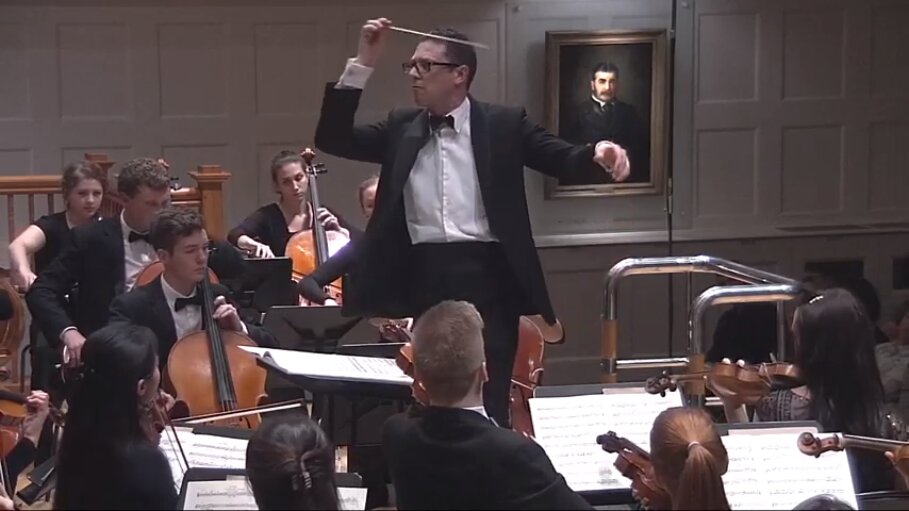 Above John:


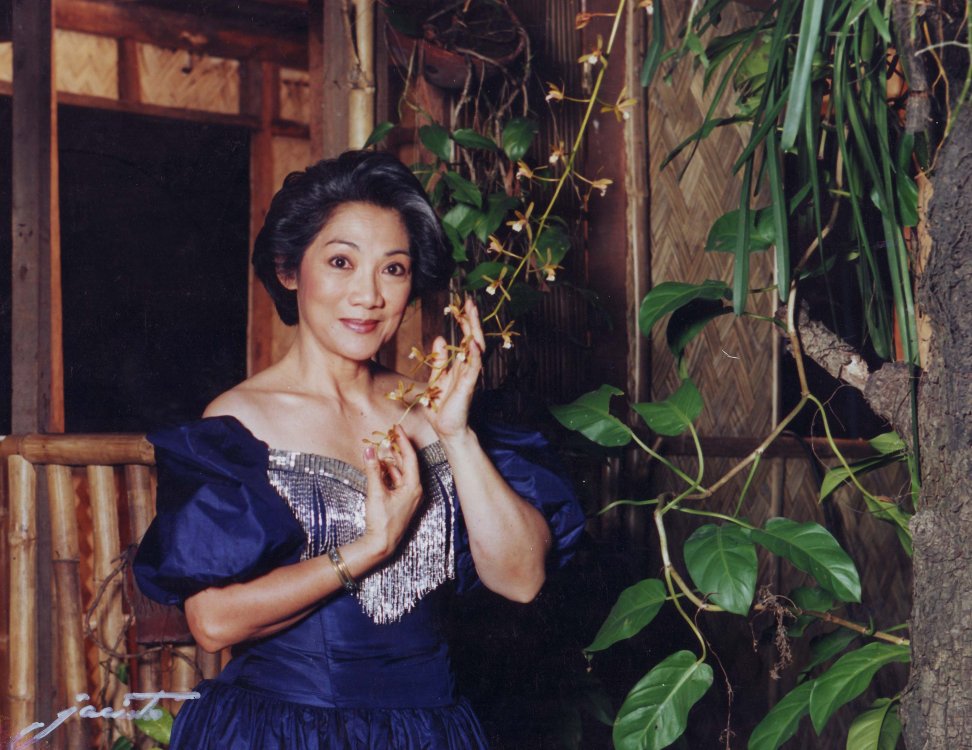 Above Cebuana New York-based soprano Evelyn Mandac (b 1945), who remains one of my role models (listen to her float over the fifth movement), the only Filipino singer ever to play the Met: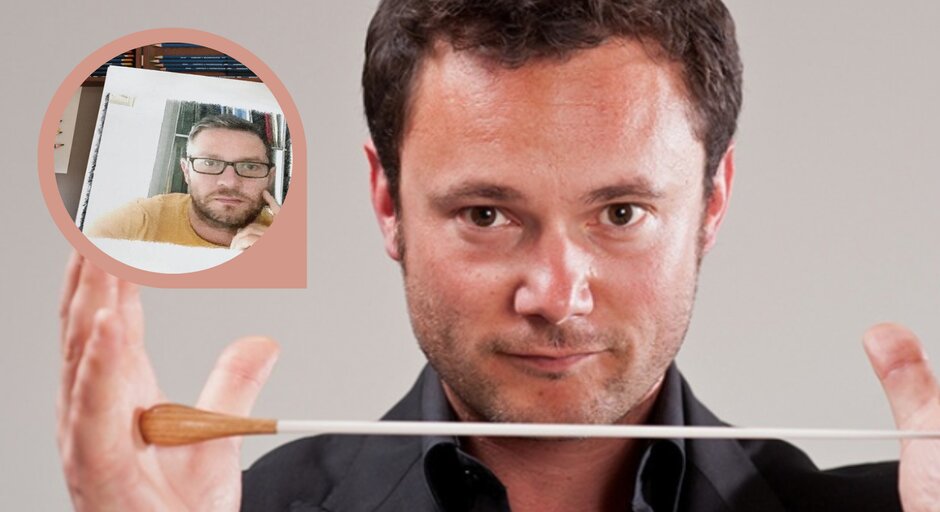
 The complete annual summer concert of

 No, not
  I’ve decided that our
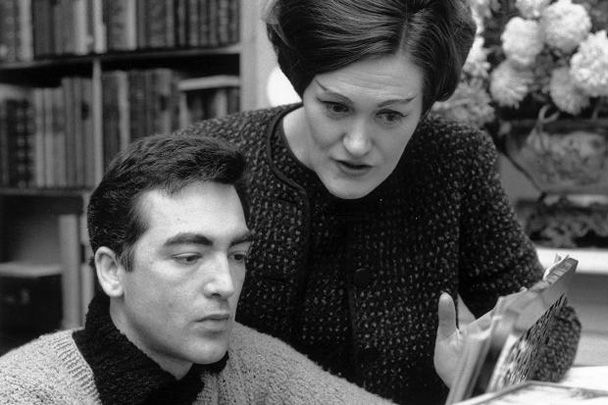 Australian-born conductor Richard Bonynge and soprano Joan Sutherland; they married in 1962.
 "I'll Be Dead Before You Break My Heart"