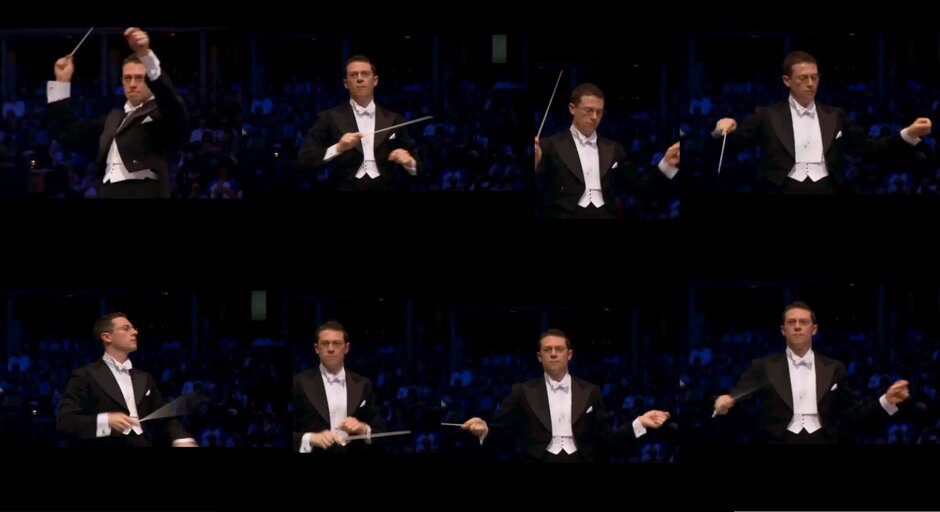
John Wilson, The John Wilson Orchestra, and That Beyond the Sea Soundtrack (Warners, 2004)

From 2021: About 15 or so years ago, I was somebody’s plus-one on an industry pass to go to a preview of the showbiz biopic Beyond the Sea, which was being shown in a really good theater with an above-average sound system. I wasn’t a particular fan of Bobby Darin or even of Kevin Spacey (for all that he is the definitive Jamie Tyrone of our generation and frankly I don’t care about anything else); actually I just wanted to find out how cheesy the production could get. Well honestly, it did start off pretty cheesily, every element that should’ve contributed some genuine worth—like, you know, the lead acting, the directing, design, (makeup! prosthesis!) etc—was utter bad-phony, not good-phony, bullcrapand then they struck up the soundtrack orchestra

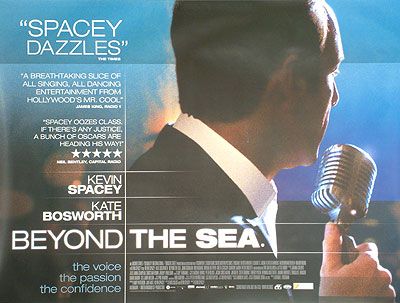
Beyond the Sea Poster.jpgAbove Spacey: “Beyond the Sea” as only my beloved John could do it.

If I could’ve exclaimed “Holy mackerel!” out loud the moment that gorgeous snap hit my ears I would’ve exclaimed it out loud, but you don’t do that at an industry screening, so I exclaimed it in my mind. I hadn’t heard a commitment like that coming from a track orchestra in a very long time. This was no session, no pick-up crew, this was one tight unit, and they were hitting the musical values like nobody’s business. I vowed to remember the name of this bright new conductor-arranger—which of course I promptly forgot (There are a lot of John Wilsons in the world, as Anthony Burgess would be the first to tell you) and didn’t remember again until last May. Recorded by my darling and his O for the Warner Bros film at Pinewood Studios, 2003. A 2006 Grammy nominee in the Best Compilation Soundtrack Album for Motion Picture, Television or Other Visual Media category (composers Charles Trenet-Jack Lawrence, arranger Dick Behrke, producer Phil Ramone). Available on Rhino Records, that notorious niche label, and I really must find out who at Warners moved it to that catalog.

FULL DRESS // A gifted mesmerist—a sinister composer—a naive young conductor from the north…inspired by an episode from the life of Rachmaninoff // DOWNLOAD FREE BOOK POSTER

My Beloved English Conductor John Wilson’s Concert Schedule, 13 Oct 2024 – 29 Jun 2025 Including His Tour of Rodgers & Hammerstein Just for the Limeys

What did I tell you? I had to piece this schedule from emails from The Glasshouse and the Sinfonia of London.

[JOHN’S PAST AND PRESENT CONCERT SCHEDULES]


WHAT YOU’LL HEAR
A message from John Wilson

The centrepiece of our concert is Rachmaninov’s rarely heard First Symphony. Why it’s rarely heard is a mystery to me, I’d even say it’s the greatest of his three symphonies. It’s a work of tremendous emotional power and drama and I’m telling everyone I know about this because I want them to come and hear it. Sinfonia of London have recorded the Second Symphony and we’ve played quite a lot of Rachmaninov over the past few years, I feel like it’s become part of our DNA.

Kenneth Hesketh is a great friend of mine, we were at college together, and he’s the most marvellous composer. I love his music. PatterSongs, a short piece to open the concert, is taken from his opera The Overcoat and has all the qualities I associate with Ken’s music. It’s mercurial, dazzling, brilliantly orchestrated, quirky and the perfect way to open the concert.

The great cellist Sheku Kanneh-Mason won the BBC Young Musician of the Year competition when he was 16 years old, playing Shostakovich’s First Cello Concerto. We’re thrilled he’s invited us to play the Second Cello Concerto on this tour, it’s a real masterpiece, the kind of pure music that gets under your skin. Once you’ve heard it, it’s a difficult piece of music to leave.

This is an evening of really great music, some of which is rarely played, and it’s a real thrill for me to be performing it with Sinfonia of London. I hope to see you there.

Tue 13 Oct 2024 16:00
Bristol Beacon
Bristol, UK
Sinfonia of London
Sheku Kanneh-Mason (cello)

  • Kenneth Hesketh: PatterSongs
  • Dmitri Shostakovich: Cello Concerto No 2
  • Sergei Rachmaninov: Symphony No 1

___

Tue 15 Oct 2024 19:30
Barbican Hall
London, UK
Sinfonia of London
Sheku Kanneh-Mason (cello)

  • Kenneth Hesketh: PatterSongs
  • Dmitri Shostakovich: Cello Concerto No 2
  • Sergei Rachmaninov: Symphony No 1

___

Fri 18 Oct 2024 19:30
The Glasshouse
Gateshead, UK
Sinfonia of London
Sheku Kanneh-Mason (cello)

  • Kenneth Hesketh: PatterSongs
  • Dmitri Shostakovich: Cello Concerto No 2
  • Sergei Rachmaninov: Symphony No 1

___

Sat 19 Oct 2024 19:30
Royal Concert Hall
Nottingham, UK
Sinfonia of London
Sheku Kanneh-Mason (cello)

  • Kenneth Hesketh: PatterSongs
  • Dmitri Shostakovich: Cello Concerto No 2
  • Sergei Rachmaninov: Symphony No 1

___

Wed 13 Nov 2024 20:00
Philharmonie de Paris
Paris, France
Orchestre de Paris

___

Thu 14 Nov 2024 20:00
Philharmonie de Paris
Paris, France
Orchestre de Paris

___

Sun 05 Jan 2025 17:00
Konserthuset
Stockholm, Sweden
Royal Stockholm Philharmonic Orchestra
Julian Ovenden (dishy vocalist)

___

Wed 14 Feb 2025 19:30
Royal Academy of Music
London, UK
RAM Symphony Orchestra
Adriana Bec (violin)

  • Peter Tchaikovsky: Violin Concerto in D, Op 35
  • Sergei Prokofiev: Suite from Romeo and Juliet

To John: …My love is deep / The more I give to thee / The more I have / For both are infinite…

___

Sat 29 Mar 2025 19:30
BBC Philharmonic Orchestra
Manchester, UK
Jonathan Scott (organ)
Alice Coote (mezzo-soprano)

___

And here starts John’s concert tour of his famous pop classics, in which he gets to butcher my dear old boss Mamoulian’s Okla-freakin-homa! all over again.

Prepare to be enchanted as John Wilson and Sinfonia of London bring the timeless music of Rodgers & Hammerstein to life in a spectacular concert featuring beloved songs from some of the greatest musicals of all time including South Pacific, The Sound of Music, Oklahoma! Carousel and The King and I. Audiences will be treated to classic hits such as ‘Oh What a Beautiful Morning’, ‘People Will Say We’re In Love’ ‘Some Enchanted Evening’, ‘Younger Than Springtime’ and more!!!

18 Jun 2025 18:15
Brighton Dome Concert Hall
Brighton and Hove, UK
Sinfonia of London
Louise Dearman, Nathaniel Hackmann Scarlett Strallen (vocalists)

19 Jun 2024 18:30
Lighthouse, Poole’s Centre for the Arts
Poole, UK
Sinfonia of London
Louise Dearman, Nathaniel Hackmann Scarlett Strallen (vocalists)

21 Jun 2025 19:00
Royal Concert Hall
Nottingham, UK
Sinfonia of London
Louise Dearman, Nathaniel Hackmann Scarlett Strallen (vocalists)

22 Jun 2025 19:30
The Bridgewater Hall
Manchester, UK
Sinfonia of London
Louise Dearman, Nathaniel Hackmann, Scarlett Strallen (vocalists)

23 Jun 2025 19:00
Bristol Beacon
Bristol, UK
Sinfonia of London
Louise Dearman, Nathaniel Hackmann, Scarlett Strallen (vocalists)

24 Jun 2025 19:30
The Anvil
Basingstoke, UK
Sinfonia of London
Louise Dearman, Nathaniel Hackmann, Scarlett Strallen (vocalists)

26 Jun 2025 19:30
The Royal Albert Hall
London, UK
Sinfonia of London
Louise Dearman, Nathaniel Hackmann, Scarlett Strallen (vocalists)

27 Jun 2025 19:00
Symphony Hall
Birmingham, UK
Sinfonia of London
Louise Dearman, Nathaniel Hackmann, Scarlett Strallen (vocalists)

28 Jun 2025 19:00
Royal Concert Hall
Glasgow, UK
Sinfonia of London
Louise Dearman, Nathaniel Hackmann, Scarlett Strallen (vocalists)

29 Jun 2025 19:30
The Glasshouse International Centre for Music
Gateshead, UK
Sinfonia of London
Louise Dearman, Nathaniel Hackmann, Scarlett Strallen (vocalists)


FULL DRESS // A gifted mesmerist—a sinister composer—a naive young conductor from the north…inspired by an episode from the life of Rachmaninoff // DOWNLOAD FREE BOOK POSTER

John Wilson Conducts The John Wilson Orchestra in the Overture to The King and I, BBC Proms 2010

There has been much discussion here about the music that gets the show going, some of which has addressed the ‘Mont Blanc’ of Broadway overtures, that to The King and I.

The King and IAbove Ken Watanabe and Kelli O’Hara in 2015 Broadway’s sexy production of The King and I, my beloved Brit John Wilson conducts his John Wilson Orchestra in the Albert Hall in the Overture.

Amusingly, orchestrator Robert Russell Bennett tagged it ‘Le roi et moi’. One can only imagine whom the ‘roi’ is meant to be. However, those of you who have come across the French will also be familiar perhaps with this expression, typically seen in a famous cartoon set in a restaurant where a waiter is dealing with a complaint from a diner: ‘Le client est roi: le patron est dieu’ [The customer is king; the boss is god].

Anyway, like Mont Blanc, there are different ways up it (and back down again), which vary according to how much snow and ice or wind or wet or hot weather have to be negotiated. A lot of versions of score, arrangement and style of performance can be heard, and they are all interesting. At this present moment, however, I am quite taken with Lesko’s 1977 recording, under Milt Rosenstock’s supervision, of a truly involving reading of the overture. Their approach is intensely ‘musical’ and it triumphs for that reason, whatever differences there may be in substance compared with other performances.

How do I judge this? I put myself in the shoes of someone who has turned up to the theatre and knows the name of the show (this is now frequently projected onto a drop curtain at the start, to help the slow-witted) and nothing else. The King and I is a very sensible title, presenting two ideas: royalty and an anonymous first-person narrator. Royalty is far away from the experience of most people, but it is recognised as being an ‘absolute’ beyond which further progress cannot be expected: ergo, a ‘King’ doesn’t usually have much to strive for, no goal to reach, and thus tends to make for a bad protagonist (unless you’re watching them fall!). Therefore, subconsciously the audience is already rooting for the unidentified ‘I’. (Incidentally, the heroine narrator of Rebecca is only identified by that single letter, and there are other examples.)

What then follows is something that appears to be an ‘overture’ in the Broadway manner, comprising a list of big tunes from the upcoming entertainment. Subconsciously, though, it can also be read as a programmatic tone-poem offering a summary of the events leading up to the start of the drama proper. My hypothetical punter might understand it as follows:

1) The Hammer-Blows of Fate fall and send everything flying—these are the two musical ideas out of which the rest of the overture (and score) is constructed
2) Melancholic love arises, moving slowly, chordally, perhaps recalling a lost romance, maybe a death
3) Sudden change of mood interrupts this and jerks us into youthful, childlike chirpiness, which jars
4) An abrupt relapse follows into deeper desires, barely grasped, but insistent, driven by powerfully expressed longing, yearning
5) Gently undulating movements surge forward in the bass and high strings, with a long tune bobbing rhythmically through them, rather like a sea voyage
6) Triple-time acceleration of the ‘journey’ then propels us along faster, where the steady treading of chords and the opening scales have been brought much closer together, yet without quite actually joining, before the music culminates in—
7) Arrival at the destination, announced by a more emphatic restatement of the opening grand chords. Curtain up on ship arriving in Bangkok Harbour.

Or something like that.

To be perfectly honest, the Prelude to Tristan und Isolde does the same thing. The whole is held together by the orchestration, which is phenomenal. Furthermore, in the same way as one does not need to ‘know’ what Wagner’s four-note rising and falling and rising chromatic motifs ‘mean’ in order to ‘feel’ their tidal effect, nor to feel in one’s very marrow what those ‘tides’ relate to in oneself, it is immaterial what specific incidents have brought ‘I’ to this place. A closer musical theatre example might be for some the overture to The Mikado, perhaps; in terms of musical complexity it is less challenging although it certainly seems to begin similarly, but the emotional depth of R&H far exceeds that of the skilful D’Oyly Carte parodists.
Crucially, Rodgers draws on the big guns of the past to learn from them; Sullivan plunders his predecessors in order to send them up.

Here, because of the terseness of the musical argument, the best performances are those which are most involved in the ‘music’ to the exclusion of any ‘intrusive phrasing’. I mean by this, musical phrasing which seems to articulate the sense of the ‘text’: Particularly when dealing with a very familiar score, any approach at conducting ‘the big tune’ runs the risk of simply luring the audience into ‘singing-along’: and how they do. In fact, once they feel they have ‘permission’ to do this, there is no knowing when the audience might feel moved to accompany ANY member of the cast in whatever they have to sing. I have lost count of the number of productions I’ve seen where this occurs. However, I have also paid careful attention to when it does NOT happen.

In this single example, then, an excellent rendition of the overture—or prelude—to The King and I. Some people may find this approach at analysis unnecessarily fussy if not a tad precious; on the other hand, there might be some mileage in it.

~Julian Eaves, Composer from Musical Theatre Orchestrations


FULL DRESS // A gifted mesmerist—a sinister composer—a naive young conductor from the north…inspired by an episode from the life of Rachmaninoff // DOWNLOAD FREE BOOK POSTER

To Beloved Conductor John Wilson: Eugene O’Neill and My Old Boss, Classic Film/Stage Director Rouben Mamoulian

From December, 2018. John Wilson, fire of my loins: You are a true musician, you command the finest magical mechanism Western Civilization has ever invented: the symphony orchestra, and you do this for a living. All life is asking you to do is to groove on it, and the fact that I’ll be continuing to make love to you long distance indefinitely.

Now, there are far more interesting exercises in the world of Schenkerian analysis  (kidding, kidding!) than one huffy American ex-porn actress taking the piss out of a popular middle-ranking, BBC-scripted, English conductor… If it weren’t for the fact that ex-porn actress happens to have fallen in love with aforementioned Conductor and longs for him regularly. Therefore she takes Conductor’s pronouncements a little more seriously, a little more discerningly than she would, say, the pronouncements of her own musical compatriots—Alsop, Tilson Thomas, Mauceri etc… Additionally, Conductor reveals in his public statements more about himself than I think he’d prefer, John.

So as much as I’d enjoy ragging you for the impudent (and ultimately self-revealing) remarks you made about Mrs Bernstein and Mrs Coates, I really should finally get down to the one single thing (aside, of course, from your tearass tempi, your overuse of percussion, your rushing of singers, your astonishing lack of color in certain critical pieces) that has bugged me since the day I first encountered it: your juvenile dismissal of my old boss, film/stage director Rouben Mamoulian, and his creative contribution to the original 1943 production of Oklahoma! Now, I know you were only riffing off info you got from some book or Andre Previn, who likely socialized with The Old Man when they were both at MGM. But, as I mentioned in an old posting, of all his stage and screen work The Old Man liked to talk about, the one he liked to talk about the most was Oklahoma! And I turned out to be his perfect audience, because early on I’d confessed to him that I was a big Rodgers & Hammerstein fan. (Filipinos are big Rodgers & Hammerstein fans, for obvious reasons.)

But before I get to the point about Oklahoma! I have to tell you a side—though relevant—story about Mamoulian and Eugene O’Neill.
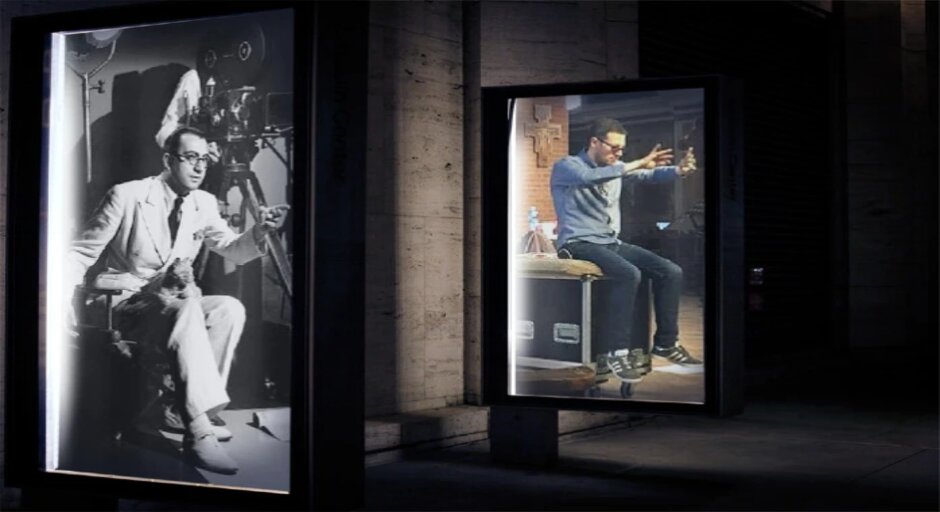
John and MamoulianRouben Mamoulian and John Wilson at around the same age (40), 80 years apart.


MAMOULIAN’S AND MY EUGENE O’NEILL STORY

This is the second story Mamoulian ever told me back in 1978 when he was 81 and I was 23, which he told me in a way that was flattering as hell, which was he didn’t ask if I knew who Eugene O’Neill was, although I did say “Wow” at the mention of the name, so he might have sized up my interest that way, and just went right into the story.

Seems that when he was living an emigre’s life in New York, trying to make a go of it in stage work, he scored his greatest career triumph to date: The Theater Guild wanted him to direct a play by Eugene O’Neill. Now, O’Neill had already won the Pulitzer and he’d already had several successes, not to mention his other new play, Strange Interlude, was already generating a lot of pre-opening night buzz, so we’re talking King of 1928 Broadway here. O’Neill agrees to meet Mamoulian in his hotel room (that is to say, O’Neill’s hotel room. It seems like the best stories about O’Neill take place in hotel rooms) to talk over any directorial concerns O’Neill, the playwright, might have, and if he has any advice to give this youngster concerning his play.

“Actually, Mr O’Neill,” says Mamoulian, trying to sound like himself at thirty, you know, the brash but confident whiz-kid, “I know exactly how to fix your play.”

“You will change not a word. Not a word!” says O’Neill. And here The Old Man doesn’t bother to actually imitate O’Neill, although in time I heard him do some good impressions of other people, mostly actors.

“Look here, Mr O’Neill,” says young Mamoulian, opening the bound script of Marco Millions that he brought with him. “I can show you exactly where the speeches slow the play down, and where we can achieve the same ends using action. Here—” And here The Old Man imitates taking a blue pencil and gleefully slashing a diagonal line across a rejected page like editors do— “—and here—” He goes on to recreate his turning the pages of the script one at a time— “and here—here—here—” with a slash! slash! slash! And all the time I’m thinking with a kind of growing horror: You CUT Eugene O’Neill!!!?

“But in the end,” Mamoulian assures me, “he saw that I was right, and we got along splendidly.”

But that’s not the end of the story. About a year after Mamoulian and I go our separate ways, I get a chance to attend opening night of Marco Millions at Berkeley Stage Company up in the Bay Area, as the plus-one of some guy I was seeing. This was around the time BSC was on its “classics” kick, making it clear in news and ads and publicity sheets that this wasn’t just any old O’Neill revival, this was an extra-special homage to the master playwright of our great theatrical heritage. Scenes cut from the 1928 production had been restored in order that this fruit of O’Neill’s genius be presented intact and full; Mamoulian’s name was hardly mentioned.

Well, I watch this big lumbering thing, right through the parts that dragged on and on with their interminable speeches about the redistribution of wealth and so on, and I’m thinking, this must be where he cut, here— Then here— And here  And almost like he’s whispering in my ear “See? See?” I realize that The Old Man was right to make the cuts, and that Marco Millions probably could have been a fine piece of theater if they’d stuck to the original opening night version.

But I swear, it was not on my mind to argue this during lobby talk after the curtain. The big thing on my mind was that I had the perfect story to share at this particular time, in this particular space, and yeah, I wanted to share it. I was with the guy who brought me, a cokehead freelance lighting designer who was always hitting up people for jobs. Together we went up to the artistic directors, a married couple, my date immediately starting in with the whole buttering up thing, you know, You look fabulous what have you been doing to yourself, etc etc etc.

I break in with something like, “You know, I have a great story about this play I got straight from (and here I made sure to stress the second syllable like he preferred) Rouben Mamoulian and how he worked with—”

And here the guy, my date, takes me aside and mutters as urgently but tenderly as is possible for him, “Sweetheart, would you please shut up while I’m talking business.”

Reader, I did.

So everyone, this is the first time—the very first time—in thirty-eight years I’m telling this story.

And you, Tom Stocker. Just for that, I regret having given you the most explosive blowjob of your life, the one that made you howl like a wolf.


FULL DRESS // A gifted mesmerist—a sinister composer—a naive young conductor from the north…inspired by an episode from the life of Rachmaninoff // DOWNLOAD FREE BOOK POSTER
“They Call the Wind Mariah” by Lerner + Loewe Sung by the Smothers Brothers, Rescuing a Fine Song from the Smelliest, Most Offensive Movie Musical Ever

Of course there’s no “h” in the actual title but I’m putting it in anyway to alert singers to the long vowel because the money-grubbing whore who wrote the lyrics to this Broadway musical standard didn’t give two shits for singers.

Above: After some silliness, the boys deliver a splendid rendition of the Frederick Loewe standard, “They Call the Wind Mariah” from Paint Your Wagon (Broadway, 1951)

I, however, have a lot of affection and admiration for Berlin-born-and-trained composer Frederick Loewe, who wrote the most tuneful, singable melodies on Broadway, up there with Richard Rodgers and Jerome Kern. Loewe was right not to want to have anything to do with the big-screen disaster, Paint Your Wagon, which plowed on without him (Paramount, 1969), messing up Josh Logan, Paddy Chayefsky(!), Jean Seberg, Lee Marvin, Clint Eastwood, et al, in its trail…

The only way to read the 1969 film (and I don’t recommend watching it for pleasure ever ever ever, not even for yummy Clint) is to look at it like a late-60s hippie festival, complete with trees, mud, and crazy sex. (You know, like Woodstock…) The absolutely unreal pluralism of the background characters—Jews, Italians, whites (but no blacks), Chinese dressed in brocade with their wives(!?) all living in this dirty mining camp (a dirty mining camp where men politely doff their hats to white women) peacefully together—is another hippie fantasy, with a dollop of Chayefsky the liberal (of Marty and Network fame) added.

The one good thing in this pile of offal is the song, “They Call the Wind Mariah”, sung incongruously by Harve Presnell; but beautifully and hauntingly here by, of all people, the Smothers Brothers, the shining jokester-balladeer heroes of my youth. (Adding to their luster: as wartime US Army brats, they spent part of their childhood in the Philippines.)

Here’s hoping you haven’t watched/heard Paint Your Wagon. If you have, and the Andre Previn interpolations made you (like me) sick*, here are two lovely selections from the pen of Frederick Loewe, rendered by my bonny John Wilson and his various orchestras:

*…And that blustering Hollywood chickenshit should’ve punched Woody Allen in the nose.


FULL DRESS // A gifted mesmerist—a sinister composer—a naive young conductor from the north…inspired by an episode from the life of Rachmaninoff // DOWNLOAD FREE BOOK POSTER

John Wilson and His Sinfonia of London Tour UK, Including His Home Town of Gateshead, with Hollywood’s Greatest Hits, 04 – 15 November 2023

John’s pop fans in Britain have nothing to worry about—all the goodness of The John Wilson Orchestra (1994-2019) is now squeezed into his new/old/new group, the Sinfonia of London in their brand-new “Hollywood’s Greatest Hits” tour. Thank Kennedy Street Productions, who brought Barry Manilow and Gladys Knight to UK’s shores, for this shrewd spectacular run aimed at the 2023 Holiday Season. Now we’ll hear the rest of the movie music John’s been transcribing all these years.

[JOHN’S PAST AND PRESENT CONCERT SCHEDULES]

Above: John’s own overture, “Hooray for Hollywood” for his 2011 appearance at the Royal Albert.

More info to come as I find it. I understand since 2 December 2022 tickets have been flying off the box office shelves.

Glad you asked. Here’s the Sinfonia’s jam-packed “Hollywood’s Greatest Hits” tour schedule:

Sat 4 November 2023 19:00

The Anvil Theatre
Basingstoke UK
Get Tickets Here

___

Sun 5 November 2023 19:00

Brighton Dome
Brighton and Hove UK
Get Tickets Here

___

Mon 6 November 2023 19:30

Royal Albert Hall
London UK
Get Tickets Here

___

Tue 7 November 2023 19:00

St David’s Hall
Cardiff UK
Get Tickets Here

___

Thu 9 November 2023 19:30

Symphony Hall
Birmingham UK
Get Tickets Here

___

Sat 11 November 2023 19:30

Sage Gateshead
Gateshead UK
Get Tickets Here

___

Sun 12 November 2023 19:30

Philharmonic Hall
Liverpool UK
Get Tickets Here

___

Mon 13 November 2023 19:30

Royal Concert Hall
Glasgow UK
Get Tickets Here

___

Tue 14 November 2023 19:30

Theatre Royal & Royal Concert Hall
Nottingham UK
Get Tickets Here

___

Wed 15 November 2023 19:30

The Bridgewater Hall
Manchester UK
Get Tickets Here


FULL DRESS // A gifted mesmerist—a sinister composer—a naive young conductor from the north…inspired by an episode from the life of Rachmaninoff // DOWNLOAD FREE BOOK POSTER

My Darling John Wilson Conducts The John Wilson Orchestra in Jule Styne+Sid Ramin+Red Ginzler’s Overture to Gypsy (1959) at the BBC Proms, 2012

The indication “burlesque strip stylewas actually written on the music right around 4:00. Both Ramin and Ginzler cut their teeth writing swing arrangements; lead trumpet in the original Gypsy pit was Dick Perry, late of the Tommy Dorsey Orchestra. Solo trumpet Mike Lovatt here lays it down fine. Some people obviously know something about burlycue. Composer Jule Styne was pleased with this overture’s orchestration.


The entire 2012 BBC Proms concert The Broadway Sound with The John Wilson Orchestra is available on YT here


John Wilson SOLAbove the man of my desire: The entire audio recording of The Broadway Sound…plus at 4:00 of this clip on YT of the Overture John shimmies like a brazen hussy. That was the moment I fell in love with you, John mi vida. That lovely luscious moment when I stumbled onto that clip of you at the Royal Albert and got your number


FULL DRESS // A gifted mesmerist—a sinister composer—a naive young conductor from the north…inspired by an episode from the life of Rachmaninoff // DOWNLOAD FREE BOOK POSTER

Stephen Sondheim, Earl Wrightson, and Irwin Kostal, Leonard Bernstein’s Legendary Orchestrator, On American Musical Theatre, WCBS, 15 October 1961

In an episode of this television series (available on my YT channel here), originally broadcast exclusively in New York City, Sondheim speaks before a workshop of NYC high school students, discussing the genesis of such songs as “Small World”, “I Feel Pretty”, and “One Hand, One Heart,” which are performed by Martha Wright and Ralph Curtis.

This show also includes question and answer period with Irwin Kostal, arranger and conductor for West Side Story. Hosted by Earl Wrightson. Produced by Ned Cramer. Directed by Neal Finn.

  • Everything’s Coming Up Roses – The CBS Orchestra
  • Small World – Martha Wright
  • Maria – Ralph Curtis
  • I Feel Pretty – Martha Wright
  • Tonight (Balcony Scene) – Ralph Curtis and Martha Wright
  • One Hand, One Heart – Ralph Curtis and Martha Wright
  • Mambo – The CBS Orchestra
  • Cool (Fugue) – The CBS Orchestra
  • Everything’s Coming Up Roses (reprise) – The CBS Orchestra

Sondheim, Wrightson, KostalAbove: Lyricist-Composer Stephen Sondheim, Baritone/Host Earl Wrightson, Orchestrator-Conductor Irwin Kostal. Again, here’s the clip on YT that provides a rare glimpse into the creative life of Sondheim and Kostal.


Here’s an excerpt transcription:

Mr Kostal, what is the difference between an orchestrator and an arranger?

It refers specifically to what you find on the music. When a composer composes a piece of music, we hope that it’s a complete piece of music, and when a man like Mr Bernstein composes the music (short laugh) it is. So all you do, you just discuss with him what he’d like to hear, flutes, violins…and you follow exactly what is written on the paper. This is what I call orchestration. Now, I get to do very little of that kind of work…because nowadays composers don’t bother with too much detail…

Steve [Sondheim] here is the kind of man we need because he’s studying music, and believe me that is a rarity on Broadway, because most composers don’t… At one time in history, composers actually did their own orchestration. They had the time in those days…but also, they could do it. For instance, Victor Herbert was a tremendous orchestrator. On one television show I did recently I actually used Mr Herbert’s scores as he wrote them in 1916—I couldn’t do ‘em any better. He knew what he was doing. Kurt Weill was the last one to do this. George Gershwin never did it on Broadway, but he—after he became a successful songwriter—studied music and learned how to orchestrate so that by the time he did Porgy and Bess he was able to do a very good job on the orchestrations.

Now, in arranging—if the composer does not do his job properly, the orchestrator has to come in and finish the job for him. Now, you’d be surprised how many times I do Broadway shows where I get roughly a one-line melody, a lead sheet, and I have to add the bass line, the harmony, the chords, and if it goes on for four minutes or a routine I have to think of things for the flutes to play and the violins to play etcetera, and it becomes a hefty job and I really feel like I am a composer’s partner when I do this*… You know, the more you do of this sort of work, the less the composer likes it. Because he’s kind of mad at you because he didn’t do it himself, I think anyway. And it serves him right. He should do it himself. I think he should go to school himself and learn. We have too many lead sheets—sure, the melody is the most important thing in music, but too many of our composers have decided to write only the melody. They have separated melody from music. Now, the art of melody writing is not a separate art from music, it’s a part of music. And when they have written this top line and leave the rest to me, they’ve got to be dissatisfied because they didn’t do it themselves. Let them get down to their business and go to school and learn to write!

[*I wonder who’s he’s talking about. Shinbone Alley’s George Kleinsinger? Fiorello’s Jerry Bock? Surely not The Music Man’s Meredith Willson—Willson went to Juilliard.]


FULL DRESS // A gifted mesmerist—a sinister composer—a naive young conductor from the north…inspired by an episode from the life of Rachmaninoff // DOWNLOAD FREE BOOK POSTER

My Darling John Wilson Conducts The John Wilson Orchestra in a Semi-Staged Concert of My Fair Lady at the Royal Albert Hall, BBC Proms, 14 July 2012

From 2020: Completely bummed out that John’s 21 January concert with the LSO at the Barbican was completely canceled, so here’s my bonny lad at the 2012 BBC Proms with his eponymous orchestra in a really classy (for once) semi-staged concert of the complete 1956 Broadway musical, My Fair Lady, book and lyrics by Alan Jay Lerner and music by Frederick Loewe; orchestration (for the movie score) by Andre Previn, orchestration enhancement by John Wilson. Cast: Anthony Andrews, James Fleet, Alun Armstrong, Julian Ovenden etc, and as Eliza, Annalene Beechey.


EXTRA! John Wilson and the Sinfonia of London play the Embassy Waltz from their new album, Hollywood Soundstage (Chandos, Sep 2022)


FULL DRESS // A gifted mesmerist—a sinister composer—a naive young conductor from the north…inspired by an episode from the life of Rachmaninoff // DOWNLOAD FREE BOOK POSTER

Jake Gyllenhaal Sings “Finishing a Hat” by Stephen Sondheim from Sunday In the Park with George, Hudson Theatre NYC, 2017

I know, Steve and I are still on the outs but his son sings this song so beautifully (no Mandy Patinkin though) I have to share it with you.

That however you live
There's a part of you always standing by
Mapping out the sky
Finishing a hat
Starting on a hat
Finishing a hat
Look, I made a hat
Where there never was a hat

Jake and StephenTaken by Oscar-winning cinematographer Robert Elswit (Waterland, Paris Trout) one Sunday afternoon May 2006. Steve gave me the pic above which I used for the cover for A Poet from Hollywood and he’s not getting it back. He just doesn’t understand what a good shot this is.

EXTRA! In 1997 Sondheim sat down for a series of interviews conducted by Mark Eden Horowitz of the Library of Congress focusing on the composition of his music; here’s the full 6-hour audio 


FULL DRESS // A gifted mesmerist—a sinister composer—a naive young conductor from the north…inspired by an episode from the life of Rachmaninoff // DOWNLOAD FREE BOOK POSTER

Kiss Me Kate, Another Cole Porter Musical with Dirty Lyrics, Played by The John Wilson Orchestra and Conducted by John Wilson, BBC Proms 2014, Complete

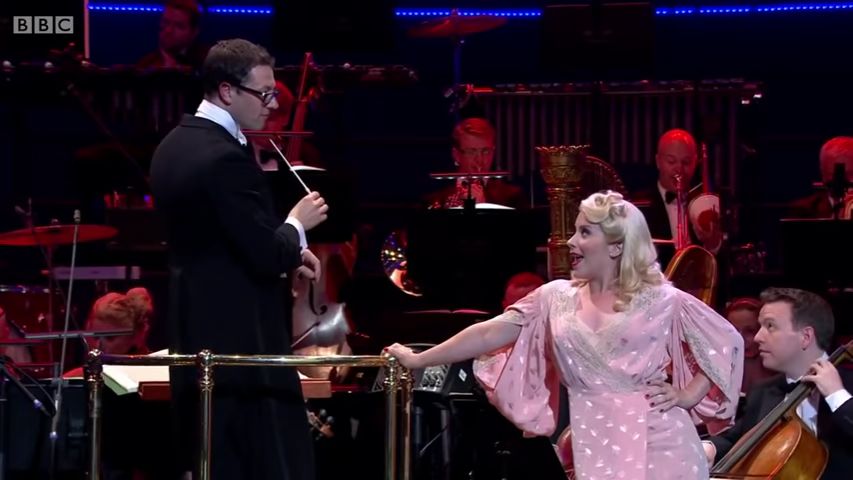
John and O don’t always perform semi-staged fully-voiced musicals badly at their BBC Proms appearances at the Royal Albert Hall—their 2012 My Fair Lady was pretty much all right, no shenanigans there (pronounced The Guardian, “John Wilson’s adapted score—which borrows from Andre Previn’s movie arrangement—adds a sparkle to even the most drearily expository songs: the flutes somehow sound cheekier, the brass ruder, the strings zingier”). And in fact their 2014 Kiss Me Kate was as it was meant to be: big, sexy and playful. Winsome John even gets a speaking part!

Kiss Me Kate
Above John and the hilarious Louise Dearman as singer/sexworld adventuress Lois Lane (Yes I swear to God, that’s the name the writers of this classic 1948 Broadway musical gave her—get it?): The entire audio recording of BBC Proms 2014’s Kiss Me Kate.


Now, we all know about “Too Darn Hot” with its descriptions of nice normal congress (“I’d like to sup with my baby tonight / Play the pup with my baby tonight”) and “Tom, Dick or Harry” with its lyrics “I’m a maid mad to marry and would take double quick / Any Tom, Dick or Harry, any Tom, Harry or Dick” and the lilting refrain “A-dick-a-dick dick dick, a-dick-a-dick dick dick”…

But did you ever stop to think about the song “Always True to You in My Fashion”? Which was one of my party pieces years and years ago (alternating with “I Cain’t Say No” from Oklahoma). I’ve given it some thought and what I worked out is this: Lois isn’t just your ordinary sex supplier—no, she specializes in those extra-special somethings that make a man (well, certain men) happy and willing to pay top dollar for them. Not to mention that in every verse she pretty much announces her rates for rough stuff, plus a type of sex play I could never get into:

  • There’s a madman known as Mac
    Who is planning to attack
    If his mad attack means a Cadillac, okay!…
  • I would never curl my lip
    To a dazzling diamond clip
    If a clip meant “Let ‘er rip!”
    I’d not say nay…
  • There’s an oilman known as Tex
    Who is keen to give me checks
    And his checks I fear
    Means that sex is here to stay…

…ending always with the last line, “But I’m always true to you darling in my fashion / Yes I’m always true to you darling in my way.” Which to me is the number-one indication she keeps it hot with her boyfriend because with him it’s, like I said, nice normal congress. You know, vanilla. But with her clients? As you may recall I was in The Business, where scenarios abound. (Remember Basingstoke?) All this to say it amuses me to no end to watch Lois size up within two seconds The Conductor, cunningly portrayed by my beloved John Wilson. Because I know exactly what’s going on in her head, in descending order:

  • How much do orchestra conductors make, anyway?
  • Tell mama what your kinks are.
  • Hey, he’s kinda cute. Skinny, but cute.

But don’t blame me, take it up with Cole Porter.


The entire 2014 BBC Proms concert Kiss Me, Kate with The John Wilson Orchestra is available here


FULL DRESS // A gifted mesmerist—a sinister composer—a naive young conductor from the north…inspired by an episode from the life of Rachmaninoff // DOWNLOAD FREE BOOK POSTER

“Everybody Ought to Have a Maid” by Stephen Sondheim, Sung by Carol Burnett and Bronson Pinchot

Sondheim: The use of songs in it I hope will be different than the so-called “integrated musical” where the songs and the story constantly flow in and out of each other. It’d been going on for so many years now, I think a rather tired formula, that

Host: Well, it was a good thing when it happened. I remember all those years in operetta, bursting into song for no reason… But that’s not what you’re going to do with this.

Sondheim: Oh, we might. It’s fun as long as it works.

Stephen Sondheim talking about his new show,
A Funny Thing Happened On the Way to the Forum

Everyone Ought to Have a MaidAbove Carol and Bronson: Jason Alexander and LA cast sing “Comedy Tonight”.


Here’s the show’s most lascivious number, cunningly retooled for modern times, from the 1999 Broadway revue highlighting Sondheim’s music, Putting It Together:

Everybody ought to have a maid
Everybody ought to have a working boy
Everybody ought to have a lurking boy
To putter around the house...

FULL DRESS // A gifted mesmerist—a sinister composer—a naive young conductor from the north…inspired by an episode from the life of Rachmaninoff // DOWNLOAD FREE BOOK POSTER

Joan Diener Sings “Pourquoi fait-il toutes ces choses” from Man of la Mancha, 1968

Three years after Man of La Mancha was a major hit on Broadway, Belgian music legend Jacques Brel licensed the staging rights, adapted the book, translated the lyrics, directed the production, and starred as Don Quixote with the original Dulcinea herself, Joan Diener.

Man of La Mancha

Here’s a song that’ll tear your heart out (English lyrics by Joe Darion; music by Paul Hindemith-trained Mitch Leigh; French lyrics by Jacques Brel):

Pourquoi fait-il toutes ces choses?


FULL DRESS // A gifted mesmerist—a sinister composer—a naive young conductor from the north…inspired by an episode from the life of Rachmaninoff // DOWNLOAD FREE BOOK POSTER

Julie and Carol at Carnegie Hall, 11 June 1962, Directed by Joe Hamilton and Written by Mike Nichols

This nine-minute medley sung by Julie Andrews and Carol Burnett, called “History of Musical Comedy”, is a variety-show tour de force enough for the first six minutes; then at 6:00 it rises to high art in the most affecting soprano duet in the repertoire of American lyric theater.

Julie and Carol at Caarnegie Hall 2.jpeg


FULL DRESS // A gifted mesmerist—a sinister composer—a naive young conductor from the north…inspired by an episode from the life of Rachmaninoff // DOWNLOAD FREE BOOK POSTER