How cultured is Susie Myerson? In episode 2 of season 2 we see Susie explore the strange new world (to her) that is the Weissman apartment, getting into the bathroom cabinet and using Rose’s fancy soap; getting into Midge’s drawers and secret stash (she finds the tape measure and uses it on herself, plus she finds the jointLenny Bruce gave Midge and smokes it); reading the kids’ books (she cries over Charlotte’s Web)…and when she encounters Abe’s baby grand, what does she do? Not only does she play it, she tunes it! Susie plays the very familiar rondo from Beethoven’s Piano Sonata in C minor, the movement of a piece that once upon a time was the mark of a cultured person (back when cultured people were encouraged to be able to play, at least, a little piano).
Does this mean Susie can read music? Or did she pick up this passage by ear? Are these 8 bars possibly the only piece of piano work she knows?
The other piece of similar fame, by the way, isMozart’s Sonata K545, which toddler Esther plays in episode 7 of season 5. I mention it in another posting.
But back to Susie and a couple more musical observations. She obviously has a good ear. She chided Jackie at the Gaslight in another episode for his lousy musical taste (ocarinas!?). She is enchanted by the flute.
So what was Susie’s major at Pembroke? And on what basis did she get her scholarship? She doesn’t strike me as a music student. In season 3 she avers that she never heard of Strindberg, and I believe her—yet as a sophomore she knew enough of theater to dress for a costume party as Lady Macbeth. Now that was an interesting choice. Did Hedy her lover teach her about The Scottish Play, as she “taught” Gordon her husband about Shirley Jackson’s “The Lottery”?
(Remember, they got into a fight after this party. Was Susie’s costume actually directed at Hedy?)
Pembroke had and has a strong showing in Liberal Arts (a former president of Lincoln Center is an alumna) and it’s possible she went in with an undeclared major, leaving her with enough free time to hang out in the post-war beatnik clubs of Providence.
To sum up, however “cultured” or “uncultured”, Susie is and was a thoroughly real-to-life fascinating and attractive woman. I see in her what Hedy saw.
And as a reward for those of you who read this to the end, here’s Valentina Lisitsa playing that Beethoven sonata.
God, Danny Sibolboro was such a weenie. Taken December 1963 at one of the many, many dances of the Moveable Filipino Club, Minneapolis, Minnesota. Geraldo was playing. Filipinos love Geraldo.
Nobody learns Latin in school anymore, says Cleese. But God, this is a funny exchange and still resonates with anyone who ever studied with a maniacally strict grammarian.
I am sitting beside the shade of my favorite Brit and Number One Language Guy, fellow state-educated Catholic Anthony Burgess (a sourpuss in life, a bit of a giggle in death), and we’re both enjoying a hearty snort over this scene. But John Cleese is cutting it out of the musical!
Centurion: What’s this then? “Romanes eunt domus”? People called Romanes they go to the house? Brian: It says, “Romans go home!” Centurion: No it doesn’t. What’s Latin for Roman? Come on! Brian: Romanus? Centurion: Goes like? Brian: Annus? Centurion: Vocative plural of annus is— Brian: Anni? Centurion: Romani. (corrects graffito) “Eunt”? What is “eunt”? Brian: Go! Centurion: Conjugate the verb “to go”. Brian: Uh…”ire”, uh…”eo”…”it”…”imus”…”itis”…”eunt”… Centurion: So “eunt” is—? Brian: Ah, uh, third person plural…uh, present indicative. Uh, “they go”. Centurion: (pulling him up by his hair) But “Romans go home” is an order, so you must use the…? Brian: (howls in pain) The imperative! Centurion: Which is—? Brian: Um—”I”! “I”! Centurion: How many Romans? Brian: Aaah! “I”! Plural. Plural. “Ite”. “Ite”. Centurion: “Ite”. (correcting graffito) “Domus”? Nominative? (reads) “Go home”? This is motion towards. Isn’t it, boy? (pulls out sword and puts it to Brian’s throat) Brian: (shrieking) Aaah, dative, sir! No, not dative! Not the dative, sir! No! Ah! Aaah, the…accusative! Accusative!! Aah!!! “Domum”, sir! “Ad domum”! Centurion: Except that “domus” takes the…? Brian: The locative, sir! Centurion: Which is…? Brian: “Domum”. Centurion: “Domum”. (corrects graffito) “-um”. Understand? Brian: Yes, sir. Centurion: Now, write it out a hundred times. Brian: Yes, sir. Thank you, sir. Hail Caesar, sir. Centurion: Hail Caesar. If it’s not done by sunrise, I’ll cut your balls off.
Above: I’m afraid nothing on this list arouses my delight except the Martin-Blane standard, “Love”, here suavely sung by the co-composer himself, Ralph Blane; kickass arrangement by Ralph Burns, who 6 years later orchestrated Richard Rodgers’s No Strings.
The dates link to the ticket sites. The other highlights link to available recordings.
Wed 14 September 2022 19:30 Göteborgs Konserthus Gothenburg, Sweden Gothenburg Symphony Orchestra Leonard Elschenbroich (cello)
So speaks my beloved conductor John Wilson: ‘I am delighted beyond words to be taking Sinfonia of London on our first live tour, playing in some of the UK’s most exciting venues. All ninety of us are looking forward to welcoming audiences who know the orchestra through our recordings, our televised appearances at the BBC Proms, as well as anyone coming to hear us for the first time. We hope our programme will thrill and inspire you!’
Sat 26 November 2022 19:30 Symphony Hall Birmingham Birmingham, United Kingdom Sinfonia of London Martin James Bartlett (piano)
Conductor, composer and arranger John Wilson joins “Netty for Tea” in the latest episode. They delve into themes that are close to the heart of the OAE. John also recalls some interesting memories including his revelational trips to HMV, and his (nervous) first encounter with the OAE…
John Wilson, who joined us in the summer as conductor for our Princess Ida production, shares his journey into the world of music. There are compelling conversations about his skilful ability to piece back together scores that were destroyed, experiences of orchestrating a film and the intersection of discipline, expression and freedom in performance and composition.
Tea with Netty is our podcast hosted by viola player Annette Isserlis (Netty). Over a cuppa (or something a little stronger…), Netty chats with a variety of conductors, players and other guests as she ‘spills the tea’ on the side of classical music you don’t normally hear.
___
Wed 8 June 2023 19:00 Queen Elizabeth Hall London, United Kingdom Orchestra of the Age of Enlightenment
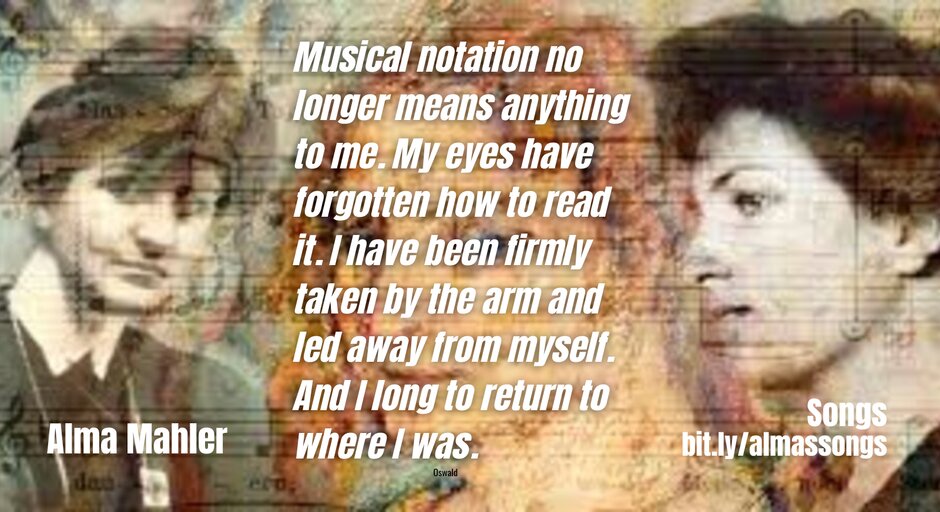
Before his death, Gustav Mahler was counseled by his analyst, Sigmund Freud, to encourage his young wife Alma Mahler to compose again after she’d abandoned her work upon their marriage. Whether Mahler had truly prevented or forbade Alma from continuing an independent music career continues to be debatable; it must be noted that in his final years he arranged for the publication of 14 of her songs. Her manuscripts being lost to time, these vocal pieces are the only evidence of Alma’s considerable melodic talent.
Songs (author of verse in parentheses):
“Die stille Stadt” (Richard Dehmel) 0:00
“In meines Vaters Garten” (Otto Erich Hartleben) 3:13
“Laue Sommernacht” (Gustav Falke) 9:31
“Bei dir ist es traut” (Rainer Maria Rilke) 12:16
“Ich wandle unter Blumen” (Heinrich Heine) 14:43
“Licht in der Nacht” (Otto Julius Bierbaum) 15:55
“Waldseligkeit” (Richard Dehmel) 20:14
“Ansturm” (Richard Dehmel) 22:57
“Erntelied” (Gustav Falke) 25:06
“Hymne” (Novalis) 28:34
“Ekstase” (Otto Julius Bierbaum) 34:20
“Der Erkennende” (Franz Werfel) 37:00
“Lobgesang” (Rcihard Dehmel) 40:18
“Hymne an die Nacht” (Novalis) 43:55
“Leise weht ein erstes Blühn” (Rainer Maria Rilke) 47:24
Here’s another new film clip on my YT page, a mashup of Steve’s one and only featured film appearance (in the movie Crashing, written and directed by Gary Walkow, 2007) and the Swingle Singers rendition of Mozart’s Turkish March. Last time I looked, this vid made it into Funny Or Die.
“The Tenth Symphony remained dormant until, in 1941 [thirty years after Mahler’s death], a Canadian airman in London, Jack Diether, decided there was one man who could finish Mahler’s Tenth. He wrote, during the Siege of Leningrad, to Dmitri Shostakovich, who declined, saying, ‘This calls for deep penetration into the spiritual world of the composer.’ Diether shared his setback with [civil servant] Joe Wheeler, who played in a Saturday-afternoon orchestra on a widow’s farm in Essex. Wheeler started tinkering with the sketches that Alma Mahler had published in facsimile and tried them out with his amateur ensemble. … [He] test-drove four versions with his farmyard band, one of whose members was Deryck Cooke, a BBC employee who wrote classical schedules for the listings magazine Radio Times. Hearing that the classical Third Programme was planning a cycle of Mahler symphonies for the 1960 centenary of the composer’s birth, Cooke proposed a radio documentary about the unheard Tenth. To conduct the orchestra he booked Berthold Goldschmidt, a German emigre with strong Mahlerian antecedents. On December, 1960 the Cooke-Goldschmidt version of the Tenth went out on the air into British homes and was commented upon abroad.” ~Norman Lebrecht, Why Mahler? (Faber & Faber, 2010)
Above Gustav Mahler, his wife Alma’s young lover, architect-in-the-making Walter Gropius, and Alma herself at 30: Daniel Barenboim conducts what Leonard Bernstein deems Mahler’s greatest symphony, the song cycle “Das lied von der erde”. Waltraud Meier and Sigfried Jerusalem, vocalists.
JOHANNES BRAHMS Variations on a Theme of Josef Haydn “The Philharmonia 75th anniversary CD box set contains some really thrilling performances from a dazzling array of soloists and conductors—Karajan, Giulini, Klemperer, Kletzki and Cantelli among them—but the ones I’m most fascinated by are the concerts Toscanini gave with the orchestra at the Royal Festival Hall in 1952 which provide a wonderful snapshot of the Philharmonia Orchestra live on stage in its first decade.” / John’s right on this one, can’t do better than Arturo Toscanini at the RFH in ’52 with the Philharmonia
MAURICE RAVEL Daphnis et Chloe Suite no 2 “Once it became apparent that we would all be spending our days at home, I decided to embark on a project I had been putting off for years:correcting all of the many thousands of errors in Ravel’s masterpiece, Daphnis et Chloe. I soon became thoroughly absorbed in this rather epic task and ended up completing a brand new edition of the whole ballet which I will be recording next year. Here’s the peerless Charles Munch conducting the Second Suite.” / Listen, you. If you can do better than Charles Dutoit (Montreal, 2005—the FULL 56 minutes, with CHORUS) I’ll plotz. (No matter what, you’ll always be number one with me, that won’t change.)
EDWARD ELGAR The Dream of Gerontius “I’ve been making my way through all 109 discs of the new Warner Classics Barbirolli box set—a conductor whose work I come back to time and time again. There’s a fervour and intensity to his music making that is utterly compelling and this legendary performance of Elgar’s greatest work has, for me, no equal.” / Elgar, a devout Roman Catholic, was something of a religious mystic and this is evident in his much of his work, no more so than in this looong, stately but yummy setting to Cardinal Newman’s musing on death and redemption
TEDDY WILSON Don’t Blame Me by Jimmy McHugh and Dorothy Fields “I love, love, love Teddy Wilson’s piano playing—I’ve had his solo piano discs on a loop for days…” / Nah. If you want to hear one of the greatest swing* pianists ever at his best, here he is doing “I Got Rhythm” by the Gershwin brothers
KEELY SMITH Cocktails for Two by Arthur Johnston and Sam Coslow “Songs—in all their guises(!!!)**—have always been at the centre of my musical life. The great American songwriters from the first half of the last century gave us so many treasures and I’d never want to be without them. Last week my trombonist friend, Andy Wood, reminded me just how great Keely Smith is.” / When I was a little tiny teeny girl, I thought listening to Keely Smith singing this lush Charles Trenet-Albert Beach songbook standard “I Wish You Love” on the radio was like walking through an enchanted forest
*I am astonished that John actually, correctly, described Teddy Wilson as a Swing musician rather than put him into the catchall Jazz bag, which I’d have expected him to do, considering who was his teacher. His teacher was Richard Rodney Bennett. My teacher (at CUNY) was YUSEF LATEEF (download his 1957 album Jazz Mood here in full).
**John, are you conflating song with melody, or what? Only asking as a humble member of your audience.
Today, Easter, I found this work by an esteemed composition teacher of your alma mater, the Royal College of Music, the same day I also spotted the perfect illo to go with this Scotch-English ballad. I am dedicating it to you, John, because the lyrics make me shiver.
Reign of Guilds is a massively multiplayer online role-playing game (MMORPG) now in its trial run as of February 2023. Above: The heartbreaking choral Adagio from “The Trees So High” by early 20th century English composer Patrick Hadley (1899-1973). Swiss-born Matthias Bamert conducts the Philharmonia.
The trees they grow high,
the leaves they do grow green
Many is the time my true love I've seen
Many an hour I have watched him all alone
He's young,
but he's daily growing.

Father, dear father,
you've done me great wrong
You have married me to a boy who is too young
I'm twice twelve and he is but fourteen
He's young,
but he's daily growing.

Daughter, dear daughter,
I've done you no wrong
I have married you to a great lord's son
He'll be a man for you when I am dead and gone
He's young,
but he's daily growing.

Father, dear father, if you see fit
We'll send him to college for another year yet
I'll tie blue ribbons all around his head
To let the maidens know that he's married.

One day I was looking o'er my father's castle wall
I spied all the boys a-playing at the ball
My own true love was the flower of them all
He's young, but he's daily growing.

And so early in the morning
at the dawning of the day
They went out into the hayfield
to have some sport and play;
And what they did there,
she never would declare
But she never more complained of his growing.

At the age of fourteen, he was a married man
At the age of fifteen, the father of a son
At the age of sixteen, his grave it was green
Have gone, to be wasted in battle.
And death had put an end to his growing.

I'll buy my love some flannel
and I will make a shroud
With every stitch I put in it,
the tears they will pour down
With every stitch I put in it,
how the tears will flow
Cruel fate has put an end to his growing.
Apo Whang-Od, a 106-year-old tattoo artist from the Philippines, is now the oldest Vogue cover model. Whang-Od is considered her country’s oldest mambabatok — or traditional Kalinga tattooist. (Kalinga being one of the tribes in the middle of the big island, Luzon.) Her tattoos use an age-old hand-tapping technique, which she perfected as a teenager using just a bamboo stick, a thorn from a pomelo tree, water and coal. Her work is now internationally known, and she told Vogue Philippines she’s training her granddaughters in this stunning and meaningful art form.
Encouraged by Maestro Mauceri, I now look for the musical influences on games composers, hence my “Coplandesque” remark on FB about Michael Giacchino’s Medal of Honor theme below. Listen to my beloved and desired English conductor John Wilson helm the BBC Philharmonic in Copland works every American knows: “Fanfare for the Common Man” (commission, 1942) and the “Simple Gifts” part of the ballet Appalachian Spring. And just for good measure! “Hoedown” from the ballet Billy the Kid ’cause I enjoy a good steak.
Somewhere in my blog (“My First Music: The Pure Joy of St Trinian’s and The Inn of the Sixth Happiness by Malcolm Arnold“) I wrote about particular chords and intervals that, to me, give music a particularly “English” sound—well, I’m coming around to understand that Copland, far from being a lazy minimalist, was actually one of the founders of the “American” sound (along with Joplin, Dvorak, Gershwin, Schoenberg and, of course, Copland’s pupil Bernstein). I’m so glad my bonny John “gets” it. His Copland almost makes up for his 2017 butchery of Oklahoma! at the Royal Albert. As for Copland’s influence, listen for it in certain tunes of Jerry Goldsmith and, as I said above, games composer Michael Giacchino.
So, Michael Levine, you tell me your chum Marin Alsop says “There’s finally a movie about a female conductor and she’s a sociopathic narcissist”? So freakin what? Tell her to tighten up her Adagietto.
Did she even see the film? I did. You know what I saw? Something NONE of you gwilo morons (“unidentified Asiatic country”—sheesh!) saw—the portrait of our revered Jose Rizal high on that wall. Even before I heard the Tagalog, I knew Lydia was finally in a good place.
The Spanish couldn’t break us. The Yanks couldn’t break us. The Japs couldn’t break us. The corporations will not break us.
YOUR WILLFUL IGNORANCE OF OUR EXISTENCE WILL NOT BREAK US.
So, now there’s a big movie that has—gasp!—Asians in it! My God, who are these people? Are they even human? Can we make some big money out of them?
I hope Everything does win Best Picture. Render unto Caesar what is Caesar’s and all that.
Not that I don’t wish James Hong well. James Hong and I are both native-born Minneapolitans. My family used to eat at his family’s restaurant.
Whether Tár wins as best picture or not makes no difference at all to me. Lydia’s story is my own mental story and no one, ever in my life has ever seen that story or cared to understand that story. Any points I want to address about the movie I give to my own beloved conductor John Wilson as a gift of love and teshuvah and to no one else.
My husband is blind, we’re living in filth and poverty, I’ve been hospitalized twice for congestive heart failure and still have to do the grinding housework of two people—but I swear before Urduja, guardian warrior spirit of my father’s province, before I go out I’m bringing you gwilo morons to your knees.
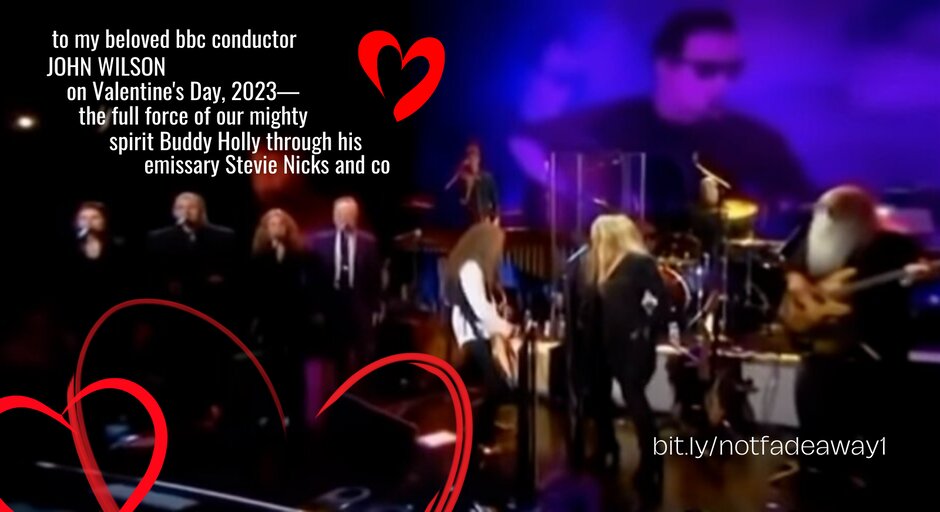
To my beloved BBC conductor John Wilson on Valentine’s Day, 2023—the full force of our mighty spirit Buddy Holly through his emissary Stevie Nicks and company:
Above: Buddy Holly’s classic “Not Fade Away” with Stevie Nicks, Waddy Wachtel et al in attendance.
I have a lot of toasty warm affection for this underrated movie (which I saw second-run in Minneapolis the summer before I started music school), not least because of Hungarian-born Miklós Rózsa‘s score, which he based on his Violin Concerto, op 24.
Robert Stephens as the great detective and Genevieve Page as his latest client. Yes, that’s Sherlock Holmes embracing a beautiful, nude, warm and willing woman while heroically subduing his id.
This is Austrian-born Wilder and Romanian-born Diamond at their best, examining—through impish Hollywood eyes, of course—that weird combination of emotional reticence and superciliousness that makes English men just sooo attractive. Their great detective, however, turns out in the end (not to give anything away) to be a lonely man, unsophisticated, profoundly vulnerable, and something of a loser. Stephens’s highly original performance makes his my favorite Holmes of all.




 Above Gustav Mahler, his wife Alma’s young lover, architect-in-the-making Walter Gropius, and Alma herself at 30: Daniel Barenboim conducts what Leonard Bernstein deems Mahler’s greatest symphony, the song cycle
 Reign of Guilds is a massively multiplayer online role-playing game (MMORPG) now in its trial run as of February 2023. Above: The heartbreaking


 Above: Buddy Holly’s classic
 "I'll Be Dead Before You Break My Heart"