Going Hollywood, Grieving for a Lost Star, “Stereophonic Sound” by Cole Porter, and Two Degrees of Separation from My Beloved English Conductor, John Wilson

From 2018: It actually would hurt me, John Wilson my beloved, if you ever believed I think of you the way MacFarlane thinks of you—as more or less part of his gig rather than as who you are, which is to say John Wilson. Something I’d like to throttle him for but’ll probably go on watching the pre-2013 Family Guy anyway. Nothing personal against your chum.

john-wilson-with-macfarlane (1)

No, I lie, it’s personal.

About 13, 14 years ago the best friend of the son of my (now ex-) friend died unexpectedly in New York, and it was a shock to everyone. My own son, who was the same age, was a big, big fan of his—more than a fan, in fact, he practically worshipped this young actor—and was in tears that day. I texted my friend and we shared our shock and grief. Daniel Day-Lewis stopped an interview, sobbing, “I didn’t know him, I have a strong impression I would have liked him very much…and so looked forward to the work he would do in the future.” I’d so like to have witnessed this young man’s progress on screen and stage through the years myself. He was the new Brando—better than Brando, in fact, as he not only acted and directed but wrote as well. And he wasn’t even thirty. He was handsome and vigorous, he had a beautiful speaking voice. He was the most committed actor I’d seen on screen since Nicholson in Five Easy Pieces.

So there he was dead in NY. On the streets of Beverly Hills, some roving celebrity reporter from one of the gossip shows was out and about getting sound bits for his show, and came across Rob Lowe and MacFarlane. After some genial exchange of bullshit the rover blurted, Did you hear the news from New York? and without a pause went right into giving them the news. Lowe dropped his mask, truly stunned for a moment, and turned human, while MacFarlane drawled almost offhandedly, “We-ell, this is disconcerting…” And at that moment I started to genuinely dislike the calculating little creep. MacFarlane’s an almost supernaturally gifted dealmaker, Stewie’s a pretty inspired animated character, and the guy seems to have a genuine fondness for the old styles…but that just isn’t enough for my scorecard. If you could say that there’s such a thing as a Seth MacFarlane Tolerance Level, mine’s pretty low I guess.

Anyway, I’m less ironical and more earnest than one would assume at first. And I tend to take things like that hard. Not exactly an asset around here.

On another note:

“Stereophonic Sound”
Silk Stockings, MGM 1957
Janis Paige, Fred Astaire
Rouben Mamoulian, director
Andre Previn, music director

As I said in another post, I’m three degrees away from my beloved John Wilson with one particular MGM musical, Give a Girl a Break, as the bridge. But! I’m only TWO degrees away from the man I love with this MGM musical, Silk Stockings—from me to Rouben Mamoulian to Andre Previn to John.

Silk Stockings was adapted from the 1955 stage musical of the same name, which itself was an adaptation of the film Ninotchka (MGM, 1939). It was directed by my old boss, Rouben Mamoulian, produced by Arthur Freed, and stars Fred Astaire and Cyd Charisse (who wound up as Mamoulian’s neighbor on Schuyler Road). Musical director was Andre Previn. It was the last movie Mamoulian, aka The Old Man, ever did (at 60—he died at 90), and “Stereophonic Sound” is one of the numbers on John Wilson+Orchestra’s 2014 Cole Porter album. But watch the clip instead. Janis Paige is the focus in this number but Fred Astaire at 58 is still a joy.


The entire film SILK STOCKINGS directed by my old boss, Rouben Mamoulian, is available to watch here

FULL DRESS // A gifted mesmerist—a sinister composer—a naive young conductor from the north…inspired by an episode from the life of Rachmaninoff // DOWNLOAD FREE BOOK POSTER

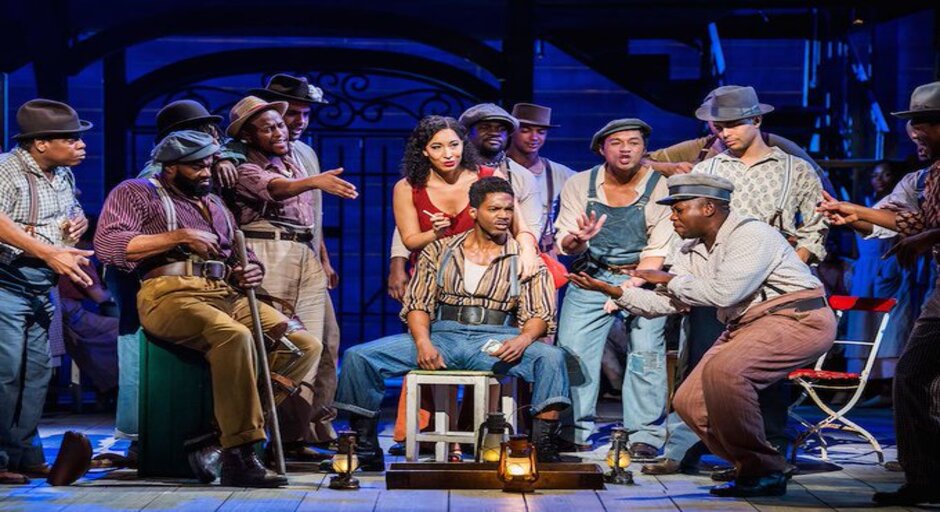
Porgy and Bess at the English National Opera, Conducted by John Wilson, Fall 2018

In a podcast interview for the English National Opera, this is what my bonny John Wilson, Conductor had to say:

“There are very few pieces I can say I’ve been waiting all my life to conduct, and this is one of them. In my, kind of, college years or whenever that was, I got the Simon Rattle LP and I kind of wore out the groove of those records and had to buy ‘em on CD…

“Of course it’s known for the hit tunes that have been extracted from it, but it’s much more than that… And I would even say that the most interesting music in the opera is the ariosos, the small pieces which link everything together and the incidental music… It’s really very ambitious… It’s George Gershwin at his most inventive, and as Gershwin was arguably the greatest tunesmith of the twentieth century, you’re looking at melodic material from the very very top drawer…”

Porgy and Bess ENOAbove: Nadine Benjamin sings “Summertime” in rehearsal


Tunesmith—sheesh.

And I miss the goat. Without the goat, there is no Porgy and Bess (2:31:25 at this complete 2002 Lincoln Center production).

Thanks to LA producer/theatre & film critic Myron Meisel for his commiseration on the goat, and for his comments on Gershwin and my old boss, Porgy & Bess‘s original director (1935) Rouben Mamoulian, on Facebook, which I answered there.

EXTRA! I found this pre-performance talk with John and a bunch of astonishingly, insultingly no-nothing weeds on Soundcloud here; my beloved is a fount of knowledge about Gershwin’s habits when writing P&B at least


FULL DRESS // A gifted mesmerist—a sinister composer—a naive young conductor from the north…inspired by an episode from the life of Rachmaninoff // DOWNLOAD FREE BOOK POSTER

Rouben Mamoulian, George Gershwin and the Cast of Porgy and Bess: The Full 1942 Album

…being wildly applauded in this photo of opening night. Lest we forget, it was The Old Man who directed the very first production of P&B. (Oh, he never let me forget it.) That’s him behind Gershwin in the goggle glasses.

Porgy and Bess MamoulianOf Porgy and Bess’s premiere, composer-critic Virgil Thomson wrote: “Gershwin’s lack of understanding of all the major problems of form, of continuity, and of serious or direct expression is not surprising in view of the impurity of his musical sources and his frank acceptance of the same. The material is straight from the melting pot. At best it is a piquant but highly unsavory stirring-up together of Israel, Africa and the Gaelic Isles… I do not like fake folklore, nor bittersweet harmony, nor six-part choruses, nor fidgety accompaniments, nor gefilte-fish orchestration.”* The 1934 production ran for 124 performances—for opera, a huge success, but by Broadway standards, a flop.

*Which is why I make it a point to never, ever listen to one note of anything by Virgil Thompson (although I’d heard 4 Saints in 3 Acts long before learning what an anti-semitic little stinker Thompson was, didn’t like it anyway)


FULL DRESS // A gifted mesmerist—a sinister composer—a naive young conductor from the north…inspired by an episode from the life of Rachmaninoff // DOWNLOAD FREE BOOK POSTER

John Wilson with Top Tips for Becoming a Conductor, 2017 Edition

This interview with my sweet John was put out into cyberland on the BBC Scottish Symphony Facebook page around 2017. I couldn’t resist the temptation to transcribe it verbatim, in its entirety (that’s Coates’s “Dancing Nights” above my darling):

John: “I think a lo’ of the successful relationships between the conductor and orchestra are founded on mutual need, so find a group that really needs you, whatever level that is, whether it be a community orchestra, a community choir, an amateur orchestra, a brass band, a musical theater group, and bring what professional skills you have to them so that you can feed off each other. And all that time, never stop studying scores. You know, that’s the single most useful piece of advice to give to any conductor, is learn your scores. Practice your technique and learn your scores. Learning to read a score is really crucial, learning all the transpositions and being able to look at a score and immediately know what that’s meant to sound like, so that when things aren’t right, your ear picks them up and you can correct things quickly and efficiently. Which is another useful skill for a conductor to have, your ears sharpened to the extent that, that you’re able to solve problems. Your early years should be spent learning, you know, learning what it is that you need to do as a conductor… Get in as much practical experience as you can. I did, sort of, at least a decade’s worth of conducting before I dared to stand in front of a professional orchestra, which was the single most terrifying experience of my life.

“I had a friend who was organizing concerts in London and had a concert series and I was invited to conduct… And I worked with the BBC, actually with the Concert Orchestra, as an arranger, and they asked me to conduct one of their recording sessions, a couple of CDs [John’s first 2 recordings, both of Eric Coates, which were released when he was 25 and 26], and so they showed faith in me, and I was grateful for the opportunity… And I guess I was interested in areas of music that didn’t have many champions, so I got a bit of a head start on that front… Um, and happily I’ve never stopped working since. Now the only challenge (laughs) is to keep on working…

“But there are lots of different routes into becoming a conductor. As Barbirolli said, ‘Conductors are born and not made.’ So if you want to do it badly enough I think you’ll get through.”


FULL DRESS // A gifted mesmerist—a sinister composer—a naive young conductor from the north…inspired by an episode from the life of Rachmaninoff // DOWNLOAD FREE BOOK POSTER

Edward Herrmann (21 July 1943 – 31 December 2014) and Stephen Sondheim’s Love Theme for the Film, Reds (Paramount, 1981)

You once asked me about the Little Flower. Still miss you, tender comrade.

Above: The Love Theme “Goodbye for Now” from the 1981 film “Reds, composed by Stephen Sondheim.


And here’s a lovely memory from the November 2016 Vanity Fair.


FULL DRESS // A gifted mesmerist—a sinister composer—a naive young conductor from the north…inspired by an episode from the life of Rachmaninoff // DOWNLOAD FREE BOOK POSTER

Sir Malcolm Arnold Conducts Deep Purple and the Royal Philharmonic in Jon Lord’s Concerto for Group and Orchestra at the Royal Albert Hall, 1969

Mister Grumble, who’s of an age and knows everything about English Progressive Rock, had no idea this piece existed. (He attributes it to having been distracted at the time of the 1969 concert, getting out of the US Army as he did, after spending 13 months overseas.) So when I played the live recording for him for the first time on Sunday he went to the moon.

malcolm-arnold-and-deep-purple.jpeg

The Concerto for Group and Orchestra was composed Jon Lord, lyrics by Ian Gillan. It was first performed by Deep Purple and the RPO conducted by Malcolm Arnold on 24 September; the record came out that December. The performance at the Royal Albert Hall was the first ever combination of rock music and a complete orchestra and paved the way for other orchestral rock performances.


FULL DRESS // A gifted mesmerist—a sinister composer—a naive young conductor from the north…inspired by an episode from the life of Rachmaninoff // DOWNLOAD FREE BOOK POSTER

A Reading Note Just for My Beloved John Wilson, Conductor: The Truest Rendering of My Feelings for You in The Black Prince by Iris Murdoch

From 2022: Hope you’re feeing better, mi vida, and that you’re up and getting ready for Sheffield. Given that my feelings for you lie somewhere between a Larry Hart lyric and an Iris Murdoch story, I want to share with you 1) one of most beautiful Rodgers+Hart songs; and 2) an early passage from my second favorite comic novelist’s 15th novel, The Black Prince* (Viking, 1973) before everybody goes to hell and—well, I won’t give it away:

…[I]t is one of the peculiarities, perhaps one of the blessings, of this planet that anyone can experience this transformation of the world. Also, anyone can be its object. … The foreverness of real love is one of the reasons why even unrequited love is a source of joy. The human soul craves for the eternal of which, apart from rare mysteries of religion, only love and art can give a glimpse. … Love brings with it also a vision of selflessness. How right Plato was to think that, embracing a lovely boy, he was on the road to the Good. I say a vision of selflessness, because our mixed nature readily degrades the purity of any aspiration. But such insight, even intermittent, even momentary, is a privilege and can be of permanent value because of the intensity with which it visits us. Ah, even once, to will another rather than oneself! Why could we not make of this revelation a lever by which to lift the world? Why cannot this release from self provide a foothold in a new place which we can then colonize and enlarge until at last we will all that is not ourselves? That was Plato’s dream. It is not impossible.

*The Black Prince is lust. Figured that out myself.

Above John’s adorable face: Jane Frohman sings the song I’d make a fool of myself singing on the streets of Southwark below his window, “With a Song in My Heart”.


FULL DRESS // A gifted mesmerist—a sinister composer—a naive young conductor from the north…inspired by an episode from the life of Rachmaninoff // DOWNLOAD FREE BOOK POSTER

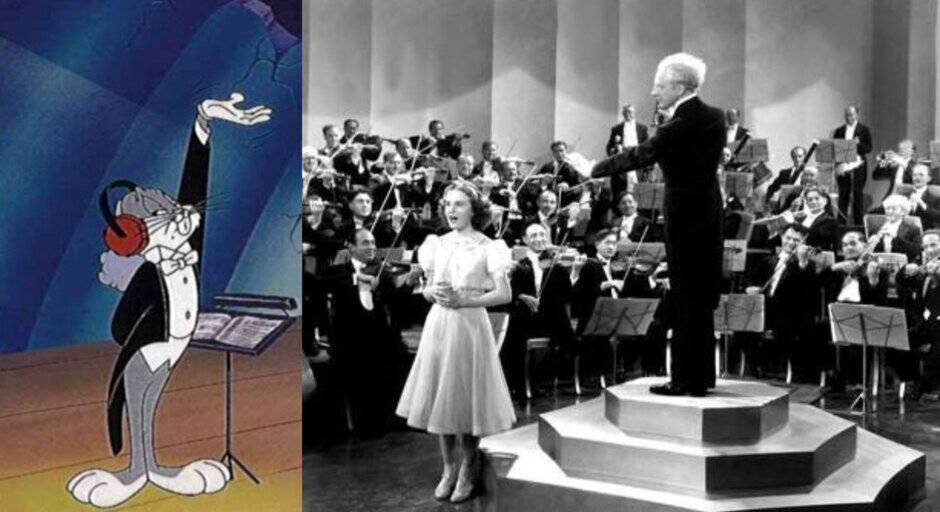
“Leopold! Leopold!”

Here’s Stokowski, international maestro (and, like my beloved John Wilson, a graduate of the Royal College of Music) in my second favorite Deanna Durbin movie: 100 Men and a Girl. Directed by Henry Koster. Universal, 1937. Andre Previn‘s great-uncle Charles Previn, musical director, arranger, composer and conductor at Universal, won an Oscar for his score for 100 Men and a Girl. While at Universal, Previn accumulated over 225 films to his credit, including most of Deanna Durbin’s films.

The bass-baritone in the Bugs Bunny classic “Long-Haired Hare” (Warner Bros 1949), where the title of this posting comes from, is voiced by bass-baritone SF native (and, like my son, a former pupil at Mission High School) Nicolai Shutorev.


FULL DRESS // A gifted mesmerist—a sinister composer—a naive young conductor from the north…inspired by an episode from the life of Rachmaninoff // DOWNLOAD FREE BOOK POSTER

My First Music: Friday Night Is Music Night with the BBC Concert Orchestra, Conducted by the Oh-So-Kissable John Wilson, August 2005

At around the same time of life the oh-so-kissable John Wilson was a wee bairn in Gateshead falling out of his high chair in excitement over the brand-new BBC news theme, I was in my playpen in the living room of the old one-bedroom apartment in South Minneapolis jumping up and down in excitement to the theme of Captain Kangaroo on TV.

Now here we are with my darling 33-year-old (in 2005) lad on the podium in the first televised broadcast of this longtime radio fixture, and I get to find out the titles of all those excerpts and show themes I’ve heard on the Beeb for years. The sign-in music, incidentally, is Charles Williams‘s “High Adventure.”

A Little Light MusicI will never understand the English tradition of drag. Now, the American tradition of drag, like future husband Mister Grumble doing his Twiggy impersonation at a gay revue in Dallas back in 1964—THAT’s hot. Above John and his admirer: Audio of the entire Friday Night Is Music Night program, “A Little Light Music”.

The program: “The Devil’s Galop” (Dick Barton Special Agent, Monty Python) / Charles Williams; “Portrait of a Flirt” / Robert Farnon; “The Lion and Albert” (comic verse) / Marriott Edgar; March from “Little Suite” (Dr Finlay’s Casebook) / Trevor Duncan; “Barwick Green” (The Archers) / Arthur Wood; “The Typewriter” (The News Quiz) / Leroy Anderson; “Roses of Picardy” / Haydn Wood; “Calling All Workers” (Music While You Work) / Eric Coates; “By the Sleepy Lagoon” (Desert Island Discs) / Eric Coates; “A Canadian in Mayfair” / Angela Morley; “In a Party Mood” / Jack Strachey; “Sailing By” (The Shipping Forecast) / Ronald Binge; “Charmaine” (Monty Python) / Erno Rapee; “Puffin’ Billy” (Captain Kangaroo!!!) at 47:00 / Edward White; “Birdsongs at Eventide” / Eric Coates; “The Dam Busters” March (from the 1954 film) / Eric Coates. Janis Kelly, soprano. Roy Hudd, host.


FULL DRESS // A gifted mesmerist—a sinister composer—a naive young conductor from the north…inspired by an episode from the life of Rachmaninoff // DOWNLOAD FREE BOOK POSTER

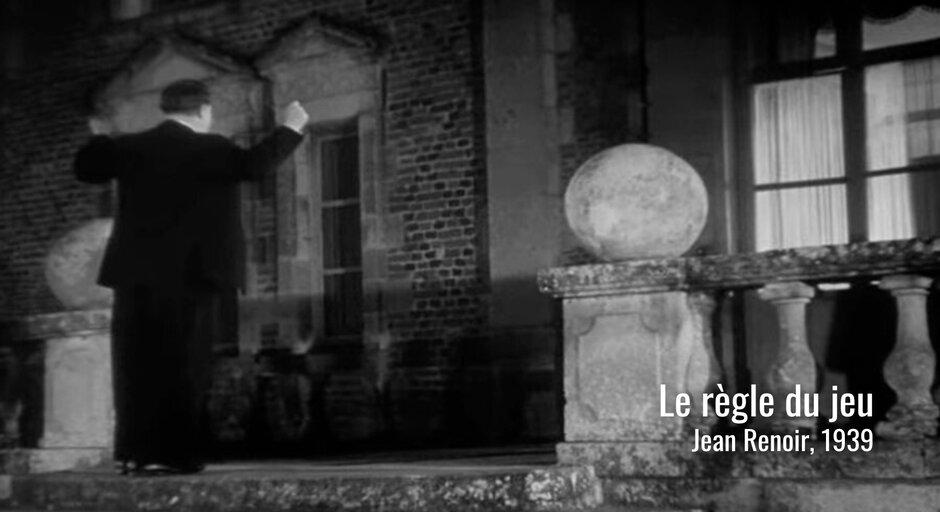
La règle du jeu (Jean Renoir, 1939)


The entire film RULES OF THE GAME is available here


FULL DRESS // A gifted mesmerist—a sinister composer—a naive young conductor from the north…inspired by an episode from the life of Rachmaninoff // DOWNLOAD FREE BOOK POSTER

John Wilson and The John Wilson Orchestra at the BBC Proms, the Royal Albert Hall, 27 August 2012: The Complete Concert of The Broadway Sound Including “Slaughter On Tenth Avenue”

Before I go into more of my bonny’s musical missteps that have done their part to perturb me to no end, I think it’s only fair to first share the best clips available of John Wilson’s own 24-year-old orchestra—cannily named, as I have mentioned, The John Wilson Orchestra—which, out of over 200(!) on YT in ten years, come down to really only about 4, maybe 5 of these “best clips” between 2009-2019.

This is from their 2012 show The Broadway Sound (@43:50) at the BBC Proms in the Royal Albert Hall in London, which seats 5200, with standing room for 1300 on the ground floor (tickets for which go for only 6L and for which people camp out overnight at the box office like it was Winterland). This is pertinent, because it seems like The JWO only does its best work when it can blast the roof off a barn.

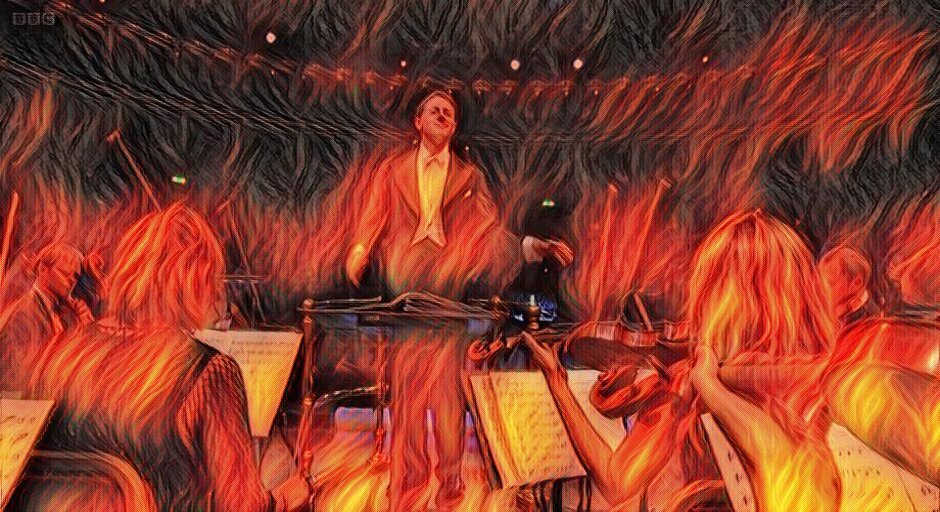
John in FlamesJohn my love, if conducting this incredibly hot number (audio here; video on my YT channel here) didn’t get you laid that night, I worry about your generation. Above John: The audio recording of the complete show, The Broadway Sound.


The entire 2012 BBC Proms concert The Broadway Sound with The John Wilson Orchestra is available here


I had the old Ben Bagley recording and the 1983 Broadway revival recording (conducted by John Mauceri) of the Rodgers & Hart show On Your Toes—which of course includes the climactic ballet “Slaughter on Tenth Avenue”—but both producer Bagley as well as musical theater preservationist Mauceri put on disc the 1936 Robert Russell Bennett orchestration rather than the 1954 one by Don Walker. Our John, being John (I’m starting to get into his “ear”), chose the Walker score to play in the Royal Albertwhich of course makes the most of those two “false” endingsand for once he was entirely correct.


FULL DRESS // A gifted mesmerist—a sinister composer—a naive young conductor from the north…inspired by an episode from the life of Rachmaninoff // DOWNLOAD FREE BOOK POSTER

Wide Sargasso Sea by Jean Rhys; Soundtrack Score for the 1993 Film by Stewart Copeland

When I was a teenager I read all of the Brontë novels, including The Professor, Shirley, Villette, Agnes Grey, and The Tenant of Wildfell Hall. When I was 19 I read all of Jean Rhys‘s novels, including this one. Whyd’you think Charlotte Brontë mutilated and blinded that racist bastard Mr Rochester anyway?

Above: Stewart Copeland’s weird, haunting music for the 1993 film


FULL DRESS // A gifted mesmerist—a sinister composer—a naive young conductor from the north…inspired by an episode from the life of Rachmaninoff // DOWNLOAD FREE BOOK POSTER

Stravinsky’s The Rite of Spring, Performed by the London Symphony Orchestra and Conducted by Leonard Bernstein, Telecast on BBC1 22 January 1967

Performed at the 1800-seat Fairfield Halls in Croydon. If you look fast you’ll notice 2nd violins leader Sir Neville Marriner (at the time former professor at the Royal College of Music, recent founder of the chamber orchestra St Martin in the Fields, and to-be music director of the Minnesota Orchestra). Note that touching moment at the end when the members of the LSO refuse to rise, at Bernstein’s insistence, for the applause of the audience, instead remaining seated and applauding Bernstein themselves. Now that’s respect.

bernstein-stravinsky


FULL DRESS // A gifted mesmerist—a sinister composer—a naive young conductor from the north…inspired by an episode from the life of Rachmaninoff // DOWNLOAD FREE BOOK POSTER

Leonard Bernstein’s West Side Story In Concert Performed Oedipally by John Wilson and The John Wilson Orchestra at the BBC Proms, 2018; Lovingly by the San Francisco Symphony Conducted by Michael Tilson Thomas, 2013

A few postings ago (“On Conductor John Wilson’s Full Dress and The First Porn Movie I Ever Did, 1”) I said, “I’m in love with John but he plows through Gershwin like a bull moose and treats Bernstein like Bernstein’s Saruman and he’s Frodo.” Well…he was pretty respectful in his “Highlights from Candide” Proms show in 2015, and I have faith that somehow, somewhere during The Bernstein Year (2018) my bonny got through “The Age of Anxiety” with a clear conscience. But the crowning glory of my beloved John Wilson, Conductor’s relationship with composer Leonard Bernstein is supposed to be, by his own estimation, West Side Story, which he claims he’s conducted “a lo’, I’ve done a few complete productions of it”—so he should know what it’s all about, at least musically, right?

But first, let’s get that other business out of the way concerning John’s WSS attempt of 2018. I HATE HATE HATE to see The Race Card being played. Usually I try to avoid having to address the issue but sometimes it’s right in your face. If you don’t know what I’m talking about you can read about it here. Then read about the outcome here.

Know what I think? In the past few years I’ve begun to believe, and I’m probably coming late to this, that when Orwell was writing about Big Brother, he was really talking about the BBC. This is probably sooo evident to a lot of people, but I’ve been paying steady attention to the BBC for only about the last ten years and I’ve watched it devolve in ways previously unimaginable to me, so highly did I once esteem this radio/TV/internet broadcaster. So when I tell you I suspect that it was the Beeb behind that inane shuffling of sopranos and no one else, I do have a basis. (But not to go into that now. I’ll get to it when I talk in detail about Oklahoma!—and The Race Cardagain.)

To get back to John, The John Wilson Orchestra, and West Side Story at the Royal Albert Hall, BBC Proms, 2018. Why the story above tells another possible story: One – soprano announces her withdrawal from the BBC Proms (that is, her reneging on her contract with the BBC) in April; two – five months later in August the new soprano is announced, a blatantly bogus attempt at more politically-correct casting, but anyway; three – at the same time, and only then, the show’s musical format is, for the first time in wide advertising, properly described as the official concert version. Which, let’s face it, makes the racial makeup of any of the singers totally irrelevant. Do you hear me squawking over Kim Criswell doing “Bali Ha’i”?

So in all this hoo-ha there’s John, who has absolutely nothing to do with the matter but nonetheless possibly, probably feels just a bit tainted by it, and who goes to his beloved orchestra with a “Gentlemen, ladies, let’s rise above this, shall we?” attitude, and a “Let’s give it all we’ve got!” kind of gungho-ness I last saw in Back to Bataan.

Because that’s how it came out in the music. Listening to the concert online, I got that same unsettling feeling you get some nights when you suspect your boyfriend’s unusually poundy lovemaking isn’t actually directed at you. It was almost unbearable to take. Mister Grumble even left the room. Before leaving he pointed an accusing finger at me. “This is your John Wilson,” he intoned darkly. “He’s not mine,” I declared. “He belongs to England!” But I couldn’t quite get the Vivien Leigh delivery so that bit just died.

But you know, I think that’s the crux of the matter, my beloved John being English and a Geordie and therefore too pigheaded to truly understand the American idiom. That, and Big Brother Beeb breathing down your neck, can cramp anyone’s sense of freedom, freedom of course being the American idiom.

I’m assuming, of course, that John, vaunted musicologist that he is, truly wants to understand the American idiom.

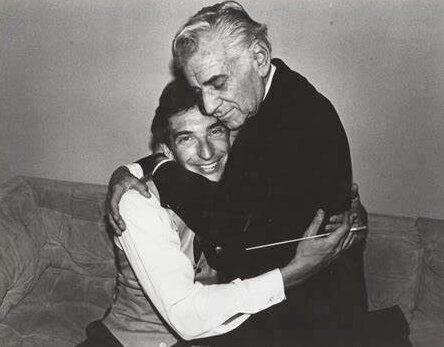
Leonard Bernstein Hugs Michael Tilson Thomas

Of the 2013 concert, said Joshua Kosman in the SF Chronicle: “One of the great revelations of Thursday’s dynamic concert performance by Michael Tilson Thomas and the San Francisco Symphony was just how remarkable the score sounds in isolation… Bernstein’s creation stood more or less alone as a compendium of all the musical references swirling around in that great musical clearinghouse that was his mind.”

Above Lenny and MTT: Quartet from the ground-breaking San Francisco Symphony concert version of West Side Story, conducted by Michael Tilson Thomas, Bernstein’s true heir to the podium. Below: The Dance at the Gym (VN*) sequence from West Side Story. Once again, MTT with the SFSO, 2013, who released the recording on their own label in 2014.

*VN means Visual Note. Check it out. I made a good one this time.

1 Blues | 2 Promenade | 3 Mambo |4 Cha-Cha | 5 Meeting | 6 Jump


FULL DRESS // A gifted mesmerist—a sinister composer—a naive young conductor from the north…inspired by an episode from the life of Rachmaninoff // DOWNLOAD FREE BOOK POSTER