This 2010 clip was uploaded to YT as a fundraiser in 2020 for Concordia, a group dedicated to promoting and supporting struggling young musicians. My beloved John Wilson was one of those struggling young musicians, and now as guest conductor he leads Concordia Foundation Artists here in a performance of Vaughan Williams’s Serenade to Music from the Foundation’s 15th Anniversary Concert, held at The Queen Elizabeth Hall in London on 22nd November 2010, with a reading of the text by Founder and Artistic Director, Gillian Humphreys OBE. This is the piece that made Rachmaninoff weep.
How sweet the moonlight sleeps upon this bank!
Here will we sit and let the sounds of music
Creep in our ears: soft stillness and the night
Become the touches of sweet harmony...

~William Shakespeare, The Merchant of Venice, Act V
BBC’s resident singer/interviewer Clare Teal welcomes Proms stalwart and all-around “shouty scary” (her description) conductor John Wilson to the studio to talk about his new CD album Cole Porter in Hollywood and his orchestra’s 2014 tour, as well as spin a few swing platters, none of which we hear in entirety. Toward the end of the interview John Wilson Orchestra drummer Matt Skelton rips through “Begin the Beguine”.
Clare Teal and Conductor John Wilson, 28 September 2014. Above John and Clare: Pete Townshend sings “Begin the Beguine“.
“Begin the Beguine” is a song written by Cole Porter (a song is music with WORDS John, you know?) who composed it at the piano in the bar of the Ritz Hotel in Paris. The beguine comes from the Caribbean; it’s a combination of French ballroom dance and Latin folk dance and was popular in Paris at the time Porter was writing.
The song is notable for its 108-measure length, departing drastically from the conventional thirty-two-bar form. Where a typical standard popular song of its time was written in a fairly strict 32-measure form consisting of two or three eight-measure subjects generally arranged in the form A-A-B-A or A-B-A-C, “Begin the Beguine” employs the form A-A-B-A-C1-C2 with each phrase being sixteen measures in length rather than the usual eight. The final C2 section is stretched beyond its 16 measures an additional twelve bars for a total of 28 measures, with the twelve additional measures providing a sense of finality to the long form. The slight differences in each of the A sections, along with the song’s long phrases and final elongated C2 section at the end, give it unique character and complexity. The fact that the song’s individual parts hold up melodically and harmonically over such a long form also attests to Porter’s talent and ability as a songwriter.
Porter reportedly once said of the song, “I can never remember it—if I want to play I need to see the music in front of me!” Alec Wilder described it in his book American Popular Song: The Great Innovators 1900-1950 as “a maverick, an unprecedented experiment and one which, to this day, after hearing it hundreds of times, I cannot sing or whistle or play from start to finish without the printed music”.
Pete Townshend “Begin the Beguine“ Cole Porter, words+music Another Scoop (1987) Pete Townshend Catalog
When they begin the beguine
It brings back the sound of music so tender
It brings back a night of tropical splendor
It brings back a memory ever green

I'm with you once more under the stars
And down by the shore an orchestra's playing
And even the palms seem to be swaying
When they begin the beguine

To live it again is past all endeavor
Except when that tune clutches my heart
And there we are, swearing to love forever
And promising never, never to part

What moments divine, what rapture serene
Til clouds came along to disperse the joys we had tasted
And now when I hear people curse the chance that was wasted
I know but too well what they mean

So don't let them begin the beguine
Let the love that was once a fire remain an ember
Let it sleep like the dead desire I only remember
When they begin the beguine

Oh yes, let them begin the beguine, make them play
'Til the stars that were there before return above you
'Til you whisper to me once more
Darling, I love you

And we suddenly know what heaven we're in
When they begin the beguine
When they begin the beguine
Sondheim: The use of songs in it I hope will be different than the so-called “integrated musical” where the songs and the story constantly flow in and out of each other. It’d been going on for so many years now, I think a rather tired formula, that…
Host: Well, it was a good thing when it happened. I remember all those years in operetta, bursting into song for no reason… But that’s not what you’re going to do with this.
Sondheim: Oh, we might. It’s fun as long as it works.
Above Carol and Bronson: Jason Alexander and LA cast sing “Comedy Tonight”.
Here’s the show’s most lascivious number, cunningly retooled for modern times, from the 1999 Broadway revue highlighting Sondheim’s music, Putting It Together:
Everybody ought to have a maid
Everybody ought to have a working boy
Everybody ought to have a lurking boy
To putter around the house...
25 May, 2019. This afternoon someone in Glyndebourne will be cutting my beloved John Wilson’s cake into tiny little slices, and so I wish them all well at the gathering.
La Dietrich inspires a handsome young English orchestra conductor to artistic heights with her transfiguring and deeply sexual love in this erotically frank Pre-Code movie from Paramount. If only you understood dirty German, my bonny…
Behold the worst reviewmy bonny conductor John Wilson ever got and I cherish it because it’s so on the money. But first things first. Samuel Barber completed this Violin Concerto in 1939; a work in three movements, it lasts about 22 minutes. I’ve got this classic 1964 recording and it’s one of my yummier ones.
From Bachtrack: Exaggeration and Disinterest Mar John Wilson’s CBSO Programme
Simon Cummings, 08 April 2019. Great composers—or, rather, their greatest compositions—have a tendency to be able to shine through less than ideal performances. This was the situation that faced us in Symphony Hall last Saturday, though it’s important to stress that the root cause lay not with the City of Birmingham Symphony Orchestra, or their Chorus, or with either of the evening’s two soloists, but with conductor John Wilson.
Wilson’s approach to all three works on the programme could be summarised as ‘filmic’. It was as if each piece wasn’t quite adequate on its own terms but needed to be given the kind of superficial gloss that might make it suitable for Hollywood. The resulting effect of this was two-fold: exaggeration of the works’ more obviously lyrical or bombastic high points, and a kind of disinterested flattening of their less show-stopping sequences.
Thus, the contrasting episodes of Copland’s Appalachian Spring felt less like components of a single, overarching continuity than the vagaries of a narrative that kept changing its mind. At its most relaxed, as in the deliciously sleepy, dawn- and dusk-like music with which the works begins and ends, Wilson seemed to have little idea what to do, allowing its inherent prettiness to sound with indifference to pacing, shape and nuance. Only when the material became conspicuously excited did Wilson do the same, leading to a more appealing rendition of the assorted Allegro sections, which were lively and fun. (It’s interesting to note that Symphony Hall’s renowned acoustics, supposedly good for everything, audibly struggle when presented with small orchestras performing tight, crisp rhythms such as those in the Copland, on this occasion making the CBSO sound more than a little swamped.) But in hindsight these only made it more apparent how flat was the rest of the work, with clunky gear changes and a weak sense of connection.
The nature of the material in Samuel Barber’s Violin Concerto played much more into Wilson’s wheelhouse. The lyrical first two movements contain much that is redolent of silent film scores, which therefore suited the cinematic treatment they received. The sweetness in the music often felt rather cloying and over-earnest—where Copland had been likeable, Barber seemed to be spending all his time desperately trying to get us to like him–but the sense of dialogue between soloist James Ehnes and the orchestra, clearly heard here as equals, was highly engaging.
The Violin Concerto is a problematic work at the best of times, due to its weird structural combination of two emotionally-charged movements followed by an evidently bolted-on presto finale that appears to stem more from a desire to satisfy the demands of the original violinist than from the same creative impulse as the rest of the work. Yet on this occasion, Ehnes’ enthusiasm in the finale was a huge relief, his breakneck fingerwork rising above the robotic pulse laid down by Wilson. Best of all, though, was Ehnes’ even more unstoppable encore, a performance of Eugène Ysaÿe’s Violin Sonata no 3 that took real risks, resulting in such nail-biting excitement that the concerto was almost immediately forgotten.
For all the issues that had manifested in the Copland and Barber, nothing and no-one can stand in the way of the juggernaut that is Walton’s Belshazzar’s Feast. Wilson’s tendency to exaggeration was matched by Walton’s own overblown response to Osbert Sitwell’s libretto. To stunning effect, particularly in the first half of the work: testifying again that the devil has the best tunes, the combination of orchestra and chorus (who, on this occasion, augmented by the University of Birmingham Voices, were simply enormous) during Belshazzar’s unbound, sacrilegious revelries was an absolute riot and hugely involving. Considering the downfall that we all knew was coming next, one almost felt guilty for enjoying it so much.
Bass-baritone Božidar Smiljanić was by turns mesmerising, moving and borderline prophetic as soloist. His take on the introduction to Babylon was masterful, moving abruptly from proudly rattling off a list of valuable commodities to a stern, almost witheringly prolonged articulation of the word “slaves”, concluding with a tender lament for the “souls of men”. Likewise, the almost laughably undramatic moment when the libretto sums up almighty judgement in the wake of all the ungodly merriment in just a single sentence, Smiljanić made profound, as if he were heralding not merely the end of Belshazzar’s days but everyone’s.
Again, though, the music’s more inverted, painful episodes lacked weight, Wilson making them brisk and functional, mere lulls before the storms. When these came, they were overwhelming—how could they not be? But it was just such a shame that the most powerful moments of the concert, such as these, were for the most part in spite of John Wilson’s best efforts, rather than because of them.
On Thursday 16 May 2019, His Royal Highness The Prince of Wales, President of the Royal College of Music (RCM), held a special gala concert at Windsor Castle. The concert showcased some of the RCM’s most acclaimed alumni, including Sir Thomas Allen, Dame Sarah Connolly and Conductor John Wilson, performing alongside Maxim Vengerov, Polonsky Visiting Professor of Violin, and the talented young musicians in the RCM Chamber Orchestra. The evening included a performance of George Frideric Handel’s Overture to an English Opera (here played by the Little Orchestra of London).
Music and lyrics by Joe Lubin, Hal Kanter and Terry Melcher; arranged by composer Jack Nitzsche (of One Flew Over the Cuckoo’s Nest fame). Sung by Doris Day and chorus with West Coast session singers The Blossoms, featuring Darlene Love(!!!), Fanita James, and Jean King.
…including a complete concert performance of Trial By Jury which I sang in, in a fully-staged Equity-waiver production, the year before my sweet Geordie lad was born.
Hastily conceived as a one-act filler for an evening’s entertainment with Offenbach’s La Périchole, Trial By Jury quickly established itself as the real hit of the production. Although this was not Gilbert & Sullivan’s first collaboration, it was the work that established the partnership for good. The first performance of Trial By Jury was on 25 March, 1875.
From Bachtrack.com: The Orchestra of the Age of Enlightenment has always gone its own way, choosing its own repertoire and collaborators and pioneering a now established framework for ‘historically informed’ performance. So what would happen when its players alighted upon WS Gilbert and Arthur Sullivan, alongside the vivacious and intrepid John Wilson, king of 20th-century popular repertoire? Wilson drew miraculous playing from the OAE, which seemed completely at home among the clouds of meringue and piles of whipped cream that Gilbert & Sullivan offer their audiences. The overture to The Gondoliers is rather boilerplate stuff, lacking Sullivan’s flair for pastiche and relentless tunefulness we find in say, Iolanthe, whose wispy opening enchanted later. But Wilson offered us a generous cone of creamy gelato, coaxing sumptuous and effulgent warmth from the OAE strings… ~Benjamin Poore
But to get on with this posting. One of the nominees at the 64th Tony Awards was the revival of Promises, Promises with a score by Burt Bacharach, including some of his interpolated standards (like “A House is Not a Home” and “I Say a Little Prayer”, neither of which were in the original production), so I’m thinking that this bootleg vidcomp from an actual performance would be a good introduction to the work of this (as my beloved John Wilson, Conductor might deem him) “top-drawer American tunesmith”.
The connection to my posting on Milhaud above? Bacharach was a student of Darius Milhaud, and you can hear what he retained from the modernist master in his distinctive, almost Latin, rhythms—think of Eddy Mitchell’s “Always Something There to Remind Me” or Dusty Springfield‘s “Twenty-four Hours from Tulsa”.
You wouldn’t look at him to think that Levant, the eternal loafer/boy genius, was a fine tunesmith as well, would you? But here’s his plaintive standard sung by one of the most identifiable singers in American music. From After Midnight, Capitol Records.
If I cried a little bit
When first I learned the truth
Don't blame it on my heart
Blame it on my youth
Oscar Moore, guitar and Joe Comfort, double bass. The creamy Nat Cole at the piano.
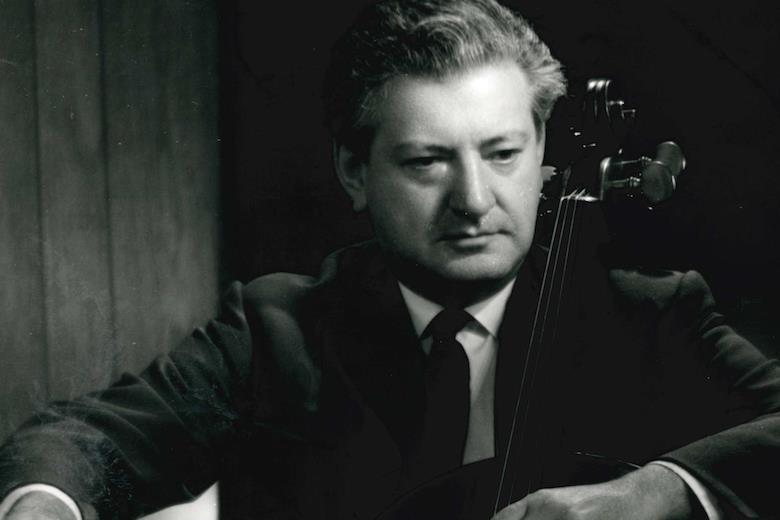
Counted among one of the greatest cellists in the Golden Age of String Players, George Neikrug has died, the day after turning 100.
Born in New York, at age 24, Neikrug met D.C. Dounis, a Greek pedagogue, whose revolutionary approach had a profound influence on the young cellist. “Trying to tell you about Dounis’s teaching is like asking me to tell you about a whole science like biology,” Neikrug said. “Dounis put very much emphasis on the most basic things I did like how I played a down bow and an up bow. He would show me how to play a down bow and an up bow and then I would play through a whole piece and he would sit there and practise with me. If he caught me doing one thing wrong I’d have to do it over again so I learned this tremendous amount of concentration…”
It was thanks to his studies with Dounis that Neikrug resolved to devote his life to teaching at schools including Detmold, Oberlin, the University of Texas-Austin and Boston University, whose arts faculty he joined in 1971.
In 1960, Neikrug performed “Schelomo: Rhapsodie Hébraïque“, the final work in Swiss composer Ernest Bloch’s 1916 Jewish Cycle. with the NBC Symphony at Carnegie Hall and Leopold Stokowski, who described the cellist’s performance as “unforgettable”.
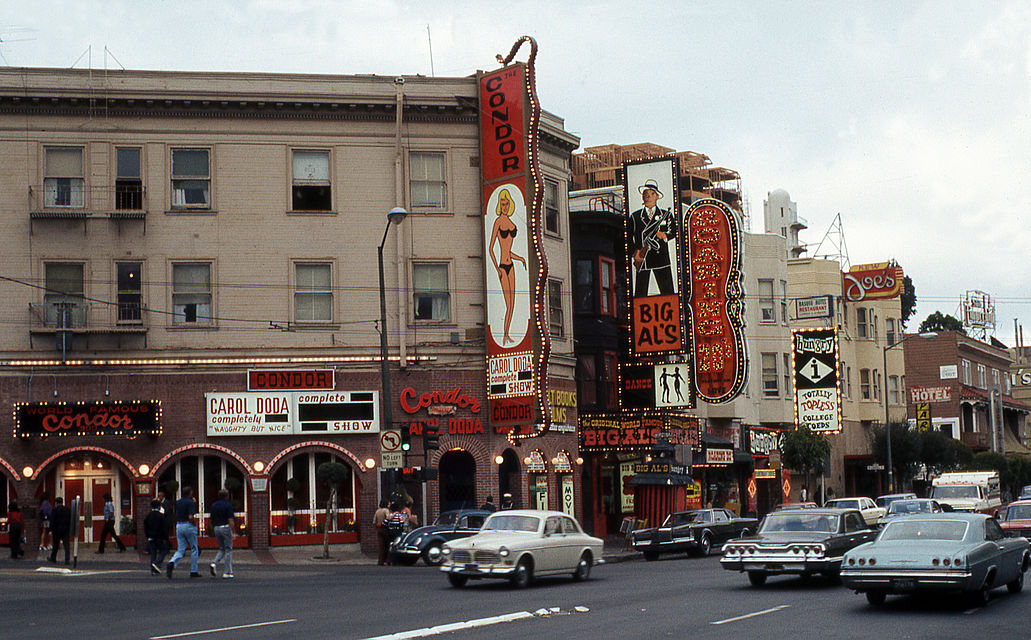
Carol Doda’s Condor Club on Broadway and Columbus. I used to work the live hetero sex act at Adam and Eve’s (upstairs from Spec’s on Broadway) on this street in the late 70s, around when this picture was taken. Yes, Carol’s tits lit up at night.
Above: Donna Summer sings “Hot Stuff”. Would you download it if I told you I danced naked to it?
In November 1983, I heard, bouncer Jimmy Ferrozzo and his girlfriend, exotic dancer Theresa Hill, decided after hours to do the deed atop the famous white piano upon which, after being lowered from the ceiling by cables, Carol would make her nightly entrance. They accidentally hit the On switch, and the piano rapidly rose to the ceiling, trapping the couple. Ferrozzo was asphyxiated. Hill survived, only because she was thinner than Ferrozo.
In winter 1979, Charisse and her husband, singer Tony Martin (“Temptation”) lived in a house up the hill from The Old Man on Schuyler Road in Beverly Hills in tranquil retirement. However, at the top of the hill also lived the Shah of Iran’s 86 year-old mother, and came the revolution Iranian students from all over the Southland marched up Schuyler Road to demonstrate outside her house, indulging in a little vandalism on the way. Mamoulian was, of course, furious, and his lovely wife Zayde, who never left her bedroom, buzzed me on the intercom to fume over the “criminals” (her word) who toppled their sovereign letter receptacle. The Old Man’s second concern—after his own mailbox, of course—was the mailbox of his good friend and former leading lady, and I was dispatched to phone them at once. Happily, the protesters had missed theirs.

 Clare Teal and Conductor John Wilson, 28 September 2014. Above John and Clare: Pete Townshend sings “
 Above Carol and Bronson: Jason Alexander and LA cast sing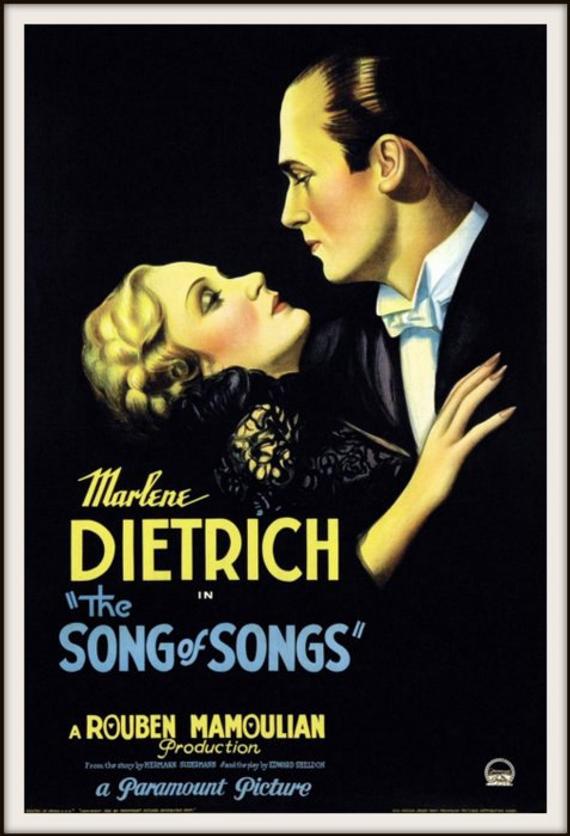


 Above my bonny John and members of the Trial by Jury cast:
 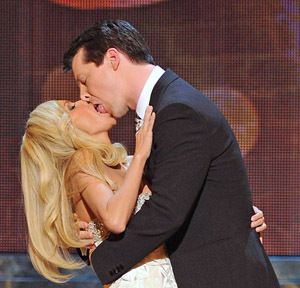 Above that hot kiss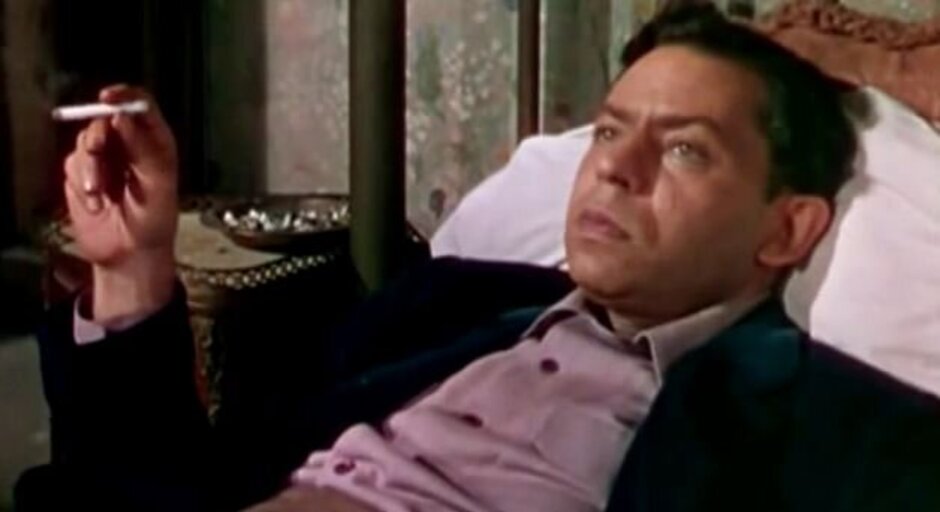

 Above: Donna Summer sings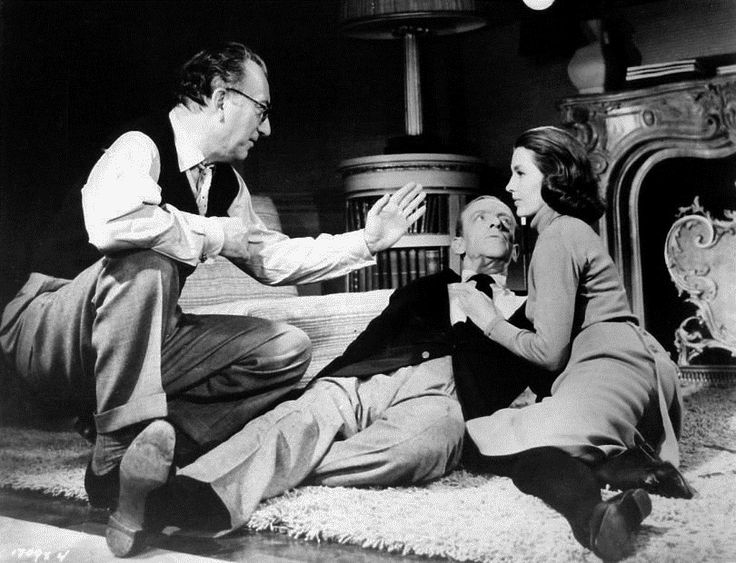
 "I'll Be Dead Before You Break My Heart"